
Quick answer
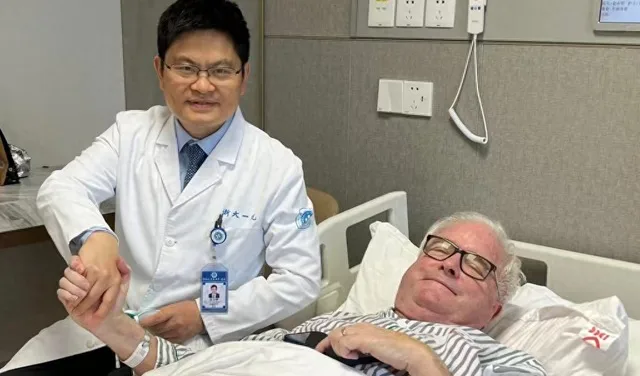
In 2018 a Bangladeshi trader developed leg pain that hospitals in three countries treated as atherosclerosis. He arrived in Hangzhou in late 2024. A CT angiogram on his first visit showed the real cause: a clot growing on the wall of his aortic arch, shedding fragments into his limbs. He was admitted on day three, operated on day four and discharged on day seven, according to the hospital's own account [1][2].
Key takeaways
- Patient: Saleh (a pseudonym), a Bangladeshi cross-border trader who was just over 50 when the pain began [1].
- Six years of treatment for arteriosclerosis obliterans across Bangladesh, India and Singapore [1][2].
- Correct diagnosis: a primary mural thrombus in the aortic arch, throwing emboli to both legs and one arm [1].
- Timeline: outpatient visit and CT angiography on day 1, admission on day 3, hybrid operation on day 4, discharge on day 7 [1].
- The hospital publishes no cost figure and no follow-up beyond discharge for this case [1].
How the case unfolded
Everything below comes from the hospital's published account and from a subsequent report by a national health newspaper. Neither source is an independent clinical record, and neither reports costs or long-term follow-up [1][2].
| When | What happened |
|---|---|
| 2018 | Leg pain in Bangladesh. Local hospitals did not carry out specific investigations, and he travelled to India, where he was first diagnosed with arteriosclerosis obliterans and treated with antiplatelet drugs [1]. |
| Around 2020 | Symptoms returned: pain on walking that eased with rest [1]. |
| 2024 | The right leg showed the same pattern, then the left arm became painful and cold [1]. |
| Late 2024 | A Zhejiang trading partner saw his appeal for help online and pointed him to the vascular surgery department in Hangzhou [1]. |
| Day 1 | Outpatient review with a chief physician, and a CT angiogram the same day, showing embolism in the arteries of both legs [1]. |
| Day 3 | Admitted to the international healthcare centre ward [1]. |
| Day 4 | Hybrid operation: open embolectomy plus balloon angioplasty, both legs in one session [1]. |
| Day 6 | Walking again, with warmth returning to the feet [1]. |
| Day 7 | Discharged on anticoagulation, with follow-up advised [1]. |
What was actually wrong
The earlier label was arteriosclerosis obliterans, a chronic narrowing of the arteries that is common in older patients. The Hangzhou team concluded that the problem was different: a primary mural thrombus sitting on the wall of the aortic arch in an otherwise normal aorta, breaking up and sending fragments downstream [1].
That distinction matters. Atherosclerosis is treated by relieving a fixed narrowing; a mural thrombus is treated by removing the mobile clot and preventing new ones, because the danger is the next embolus rather than the original blockage. Cardiac causes were excluded in this case: the heart workup was normal, which ruled out atrial fibrillation and valve disease as the source of the clot [1].
The operation
The procedure was a hybrid one, performed in a hybrid theatre: open arteriotomy to extract the old clot, followed by balloon dilatation of the artery, with both legs treated in the same session. The hospital says the decision to treat both sides at once was driven partly by the difficulty of a repeat journey from Bangladesh, after an assessment of overall safety [1].
The clot had been in place for six years. The hospital describes it as firm and adherent to the arterial wall, which makes extraction slower and riskier than removing a fresh embolus, and says the operation ran from midday until dark [1].
What this case shows, and what it does not
It shows how much a single imaging decision can change: the diagnosis that had stood for six years was overturned by a CT angiogram ordered at the first outpatient visit. It also shows that speed of workup, not surgical novelty, was the practical difference between this centre and the ones he had already attended [1][2].
A parallel case, published by the hospital that treated it, points the same way: a thyroid tumour patient from Myanmar reached Yunnan after a remote consultation and a quoted budget, completed workup and consent within 24 hours of arrival, was operated on within 48 hours and went home after 19 days [4]. Two cases are not a pattern, but both suggest the binding constraint is preparation and scheduling rather than the operation itself.
It does not show that outcomes in China are better than elsewhere. This is one patient, described by the hospital that treated him, with no independent verification and no follow-up beyond the discharge date. There is no cost figure, no comparison group, and no patient-reported outcome measure. His own quoted verdict — that a week here beat seeing a doctor for a cold abroad — is enthusiasm, not evidence [1].
Nor does a successful discharge mean a cured artery. Anticoagulation and surveillance continue, and recurrence is the risk that made the diagnosis worth correcting in the first place [1][5].
The condition in context: primary aortic mural thrombus
Primary mural thrombus of a normal or minimally atherosclerotic aorta is rare. Patients are often asymptomatic until a fragment embolises to a limb or an abdominal organ, which is why the diagnosis is usually made during a workup for something else [1][6].
| Feature | What the literature and the case report say | Source |
|---|---|---|
| Frequency | Rare; most published experience is case series and reviews rather than trials | [5][6] |
| Typical presentation | Embolic ischaemia of a limb or viscus; the aorta itself is usually silent | [1][6] |
| Who is affected | In the series cited by the hospital, women outnumbered men 19 to 1, with a mean diagnostic age of 40 to 56 | [1] |
| Treatment | Anticoagulation, clot removal, or aortic repair, chosen case by case; there is no randomised evidence to settle the choice | [5][6] |
If you were this patient: what to arrange
- Bring the original imaging. A CT angiogram on disk travels better than a printed report, and re-scanning adds days you may not need to add [1].
- Ask what the diagnosis actually is. "Narrowed artery" and "clot on the artery wall" lead to different operations, and the second one is the one that is easily missed [1][6].
- Ask whether one side or both will be treated. Treated in one session or two changes the length of stay and the cost of the trip [1].
- Plan for more than a week. This patient was unusually fast; workup, admission and discharge came in seven days, but nothing in the system guarantees that for the next patient [1].
- Check visa and payment assumptions early. China has no medical-visa category, and international departments sit outside Chinese medical insurance [3].
Availability and limits
- This is an editorial summary of hospital and newspaper reporting, not a clinical record or a recommendation [1][2].
- One patient, reported by the treating institution, with no independent audit [1].
- No cost data: the hospital has not published a bill for this case [1].
- No follow-up beyond discharge, so durability of the repair is unknown [1].
- International departments price above the Chinese insurance catalogue, and treatment is paid for by the patient or an insurer [3].
- Results at one high-volume centre do not transfer automatically to smaller hospitals [5].
What to ask before booking
| Question | Why it matters |
|---|---|
| Will the diagnosis be confirmed by CT angiography before any operation is scheduled? | The whole case turned on one scan [1]. |
| Is the plan embolectomy, bypass, or anticoagulation alone? | The options are not interchangeable [5][6]. |
| Which department handles foreign patients, and in what language? | The hospital is a working hospital we do not book; confirm international-department coordination and language support. |
| What is the estimated total cost, and what is excluded? | Public reporting rarely includes a bill; ask for a written estimate [3]. |
| What surveillance is planned after discharge? | Recurrence is the reason the diagnosis matters [1]. |
Questions patients ask
Can a foreign patient get this operation in China?
The hospital in this case admits international patients through its international healthcare centre, and reports that patients from more than 60 countries were treated there in 2024 [1][2]. Access still depends on the individual department accepting the case.
How long did the whole thing take?
Outpatient review and CT angiography on day 1, admission on day 3, surgery on day 4 and discharge on day 7, according to the hospital [1]. That is unusually fast and should be treated as one hospital's best case, not a schedule.
What did it cost?
The hospital has not published a figure for this case. For context, international departments are not covered by Chinese medical insurance, and charges sit outside the standard catalogue [3]. Ask for a written estimate before travelling.
Why was the diagnosis wrong for six years?
The working label was arteriosclerosis obliterans, a common cause of leg pain in older patients. A mural thrombus in a normal aorta produces similar symptoms but needs different treatment, and is easy to miss without dedicated aortic imaging [1][6].
Is removing a six-year-old clot safe?
The hospital describes the clot as firm and adherent, which makes extraction slower and carries a risk of arterial injury. Published experience with these thrombi is limited and there is no randomised evidence to guide the choice between surgery and anticoagulation [1][5][6].