
Quick answer
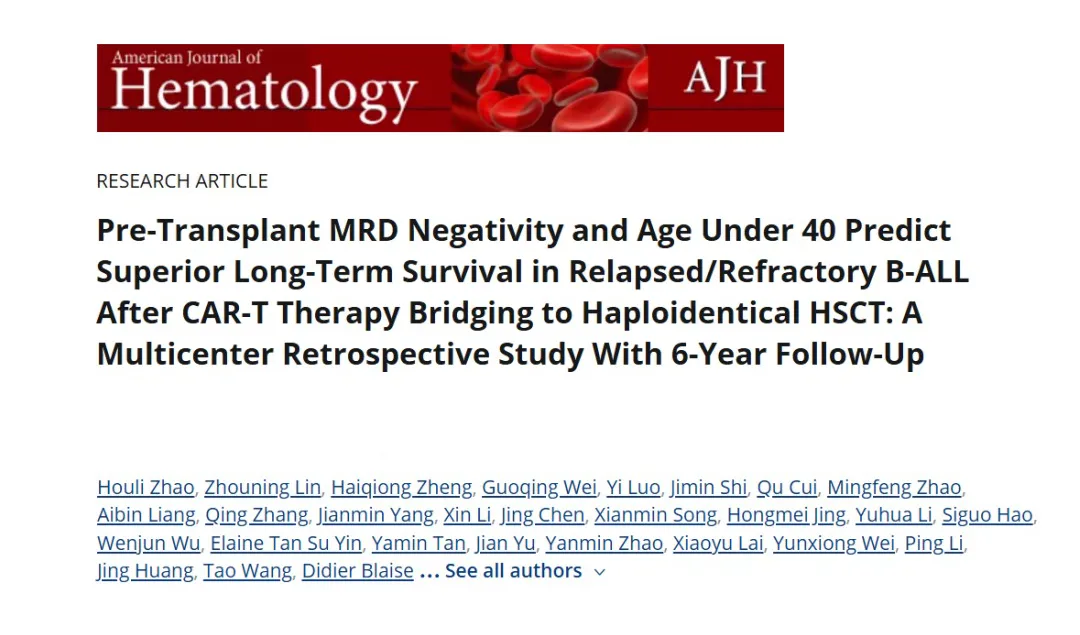
Relapsed or refractory B-cell acute lymphoblastic leukaemia (B-ALL) in adults is a disease where most patients die. Two technologies might help — CAR-T cells and haploidentical stem cell transplant — but combining them has been difficult because the conditioning needed for transplant destroys the CAR-T cells first. Huang He and Hu Yongxian at Zhejiang University's First Affiliated Hospital built a sequence in which CAR-T clears the leukaemia and prepares the marrow, then a half-matched transplant consolidates the result. A six-year multicentre follow-up, published in the American Journal of Hematology, reports durable survival and identifies who benefits most [1][2].
Key takeaways
- Published online on 13 May 2026 in the American Journal of Hematology [1][2].
- Multicentre retrospective study with six years of follow-up in relapsed/refractory B-ALL [1].
- Pre-transplant MRD negativity and age under 40 predicted superior long-term survival [1][3].
- Corresponding authors: Huang He, Hu Yongxian and Mohamad Mohty of Saint-Antoine Hospital, Paris [2].
- The centre's broader "Hangzhou Protocol" pairs donor-derived CD7 CAR-T with haploidentical transplant, skipping myeloablative conditioning and GVHD prophylaxis [4][5].
Why the sequence is hard
A transplant requires two things: near-total clearance of tumour and space in the marrow. Conventional practice achieves both with myeloablative chemotherapy, then suppresses the new immune system to prevent graft-versus-host disease (GVHD). Both steps are toxic, and both kill the CAR-T cells that were supposed to control the disease [4].
The Hangzhou team's insight was that CD7 CAR-T causes profound marrow suppression as a side effect — and that this side effect is exactly the preconditioning a graft needs. By using donor-derived CD7 CAR-T, they could clear leukaemic cells and open marrow space in one step, then infuse the same donor's stem cells without a separate conditioning regimen. In their framing, one intervention achieves four things: tumour clearance, reduced conditioning toxicity, avoidance of GVHD prophylaxis, and long-term survival [4][5].
What the six-year data show
The retrospective analysis found that reaching MRD negativity before transplant was the strongest predictor of lasting remission, with age under 40 adding independent prognostic value. Those two factors divide patients into groups with markedly different long-term survival — a result that is useful clinically because both are known before the transplant decision is made [1][3].
This is a multicentre retrospective analysis, not a randomised trial; selection of patients fit enough to reach transplant is itself a filter. Six-year follow-up is a genuine strength in this field, but the findings describe who does well rather than proving the sequence is superior to alternatives. The centre's more radical CD7 protocol has been reported in phase 1 form and in case reports, including an 82-year-old patient described as the oldest recorded allogeneic transplant recipient — an individual result, not an outcome rate [1][4][5].
The condition in context: refractory B-ALL
Adult B-ALL that relapses after chemotherapy has few durable options.
| Region | What the data shows | Source |
|---|---|---|
| Prognosis | Relapsed/refractory adult B-ALL has historically poor long-term survival [1]. | AJH paper summary [1] |
| Transplant access | Haploidentical donors widen availability, since a half-match is usually found in the family [4]. | Sohu interview [4] |
| Age limit | Conventional transplant is usually capped around 70; the centre has treated older patients under its protocol [5]. | Tencent News [5] |
Because the alternative for refractory disease is palliative, even a selective long-term survival signal matters [1].
Why it matters
| Potential | What the report suggests | Source |
|---|---|---|
| Durability | Six years of follow-up, unusual in CAR-T bridging studies [1]. | [1] |
| Selection | MRD status and age identify who benefits [3]. | [3] |
| Caution | Retrospective design; not a randomised comparison [1]. | [1] |
Availability and limits
- This is an editorial summary of the publication and hospital reports, not a treatment recommendation [1][2].
- The evidence is retrospective and multicentre, with selection bias [1].
- The full Hangzhou Protocol requires donor-derived CAR-T and specialist transplant infrastructure [4].
- Eligibility depends on disease status, organ function and donor availability [4].
- Long-term complications of transplant, including infection and chronic GVHD, remain significant [5].
What to ask before booking
| Question | Why it matters |
|---|---|
| Can I reach MRD negativity before transplant? | It is the strongest predictor of durable survival [1]. |
| Is a haploidentical donor available? | Half-matched family donors widen access [4]. |
| Which department handles foreign patients, and in what language? | The hospital is a working hospital we do not book; confirm international-department coordination and language support. |
| What is the plan if CAR-T response is incomplete? | Not all patients proceed to transplant [1]. |
Questions patients ask
What did the study find?
In a six-year multicentre retrospective of relapsed/refractory B-ALL treated with CAR-T then haploidentical transplant, MRD negativity before transplant and age under 40 predicted superior long-term survival [1][3].
What is the Hangzhou Protocol?
The centre's approach of donor-derived CD7 CAR-T followed by haploidentical transplant, using CAR-T-induced marrow suppression in place of myeloablative conditioning and omitting GVHD prophylaxis [4][5].
Where was it published?
The American Journal of Hematology, online 13 May 2026 [1][2].
Is it a cure?
No — it is a strategy that produces durable survival in a subset; many patients still relapse or cannot reach transplant [1].
Is this relevant to international patients?
It is useful context for China's transplant and cell therapy capacity. The hospital is a working hospital we do not book — contact its international department directly [1].