
Quick answer
Diminished ovarian reserve (DOR) means the ovary is running out of eggs ahead of schedule: AMH falls, follicle counts drop, and fertility declines. A 40-year-old woman whose AMH was 0.59 ng/mL — well below the 1.1 ng/mL threshold that signals reserve loss — joined a study at Hubei Provincial Hospital of TCM's acupuncture centre. She received "yinyang regulation moxibustion": two protocols alternated weekly, with no electroacupuncture, herbs or other adjuncts. After 14 sessions she conceived naturally, and gave birth to a daughter in May 2026 [1][2][3].
Key takeaways
- Patient: 40 years old, AMH 0.59 ng/mL found at a health check in 2025 [1][2].
- Protocol: "warming yang and benefiting the kidney" moxibustion alternating with "warming the kidney and the uterus", once weekly [2].
- No electroacupuncture, Chinese herbs or other adjunctive treatment was used during the course [2][3].
- Follicle monitoring three times showed improved follicle quality after moxibustion [2].
- She conceived in October 2025 and delivered in May 2026; she was the second of 28 participants in the study to conceive [1][3].
What the treatment involves
Moxibustion burns prepared mugwort near or on acupuncture points to deliver sustained heat. In this protocol, two point combinations are used in alternation: one aimed at warming yang and supplementing the kidney, the other at warming the kidney and the uterus. Each session is weekly, and the course in this case ran to 14 sessions before conception [2].
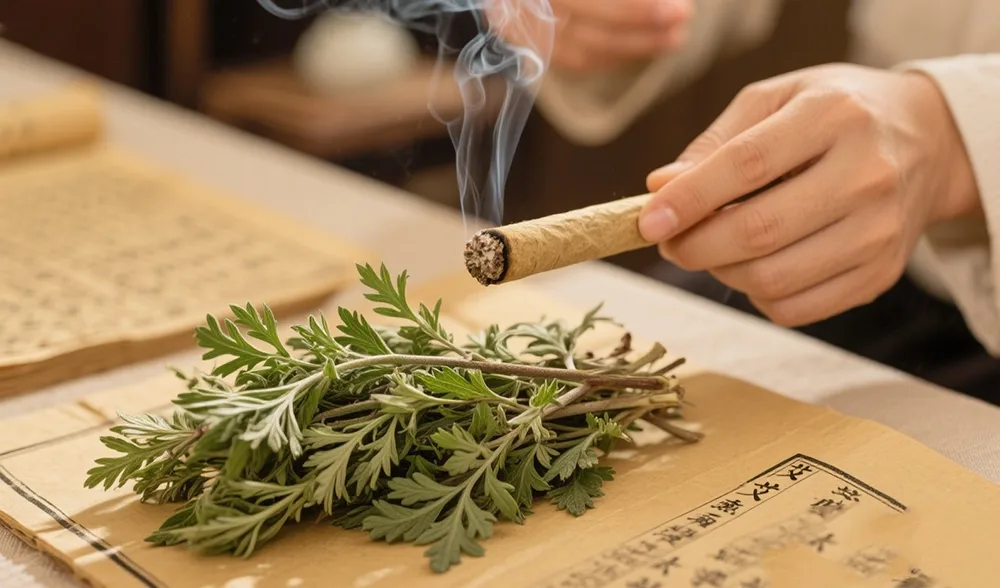
The hospital's rationale is that DOR reflects kidney-essence depletion with liver and spleen involvement, and that moxibustion warms the pelvic circulation and regulates the reproductive axis. The acupuncturist involved describes the aim as improving the follicular environment rather than stimulating ovulation directly [2][4].
How much this proves
Very little, on its own. This is a single patient within a 28-person study, reported through hospital and local media rather than a peer-reviewed trial. Natural conception is possible at 40 with an AMH of 0.59 — AMH predicts response to stimulation better than it predicts spontaneous fertility — so a single pregnancy cannot be attributed to moxibustion [1][2].
The study is described as an ongoing clinical research project with 28 participants, of whom two conceived. No control group, randomisation or outcome rates are reported in the available sources. Two conceptions in 28 women over an unspecified period is not distinguishable from what would happen without treatment. A properly controlled trial with live birth as the endpoint is what the field needs [1][2][5].
The condition in context: diminished ovarian reserve
DOR is common in women in their late thirties and forties and is a major reason for fertility treatment.
| Region | What the data shows | Source |
|---|---|---|
| Threshold | AMH below 1.1 ng/mL indicates diminished ovarian reserve [1][2]. | Hubei Daily [1] |
| Limits of IVF | Poor reserve means few eggs retrieved and lower success, whatever the protocol [4]. | Hospital [4] |
| China | The hospital lists DOR among its 30 "advantage diseases" for integrated care [4]. | Hospital [4] |
Because there is no treatment that restores ovarian reserve, any intervention claiming benefit needs careful testing rather than enthusiastic reporting [4].
Why it matters
| For the patient | What the report suggests | Source |
|---|---|---|
| Non-pharmacological | Moxibustion avoids hormones and injections [2]. | [2] |
| Reported effect | Follicle quality improved on monitoring in this case [2]. | [2] |
| Caution | Single case; no control group [1]. | [1] |
Availability and limits
- This is an editorial summary of hospital and media reports, not a treatment recommendation [1][2].
- It describes one pregnancy among 28 study participants [1].
- Moxibustion carries a risk of burns and should not replace fertility assessment [5].
- AMH does not reliably predict spontaneous conception [2].
- Women over 40 with low reserve should have a full fertility workup in parallel [4].
What to ask before booking
| Question | Why it matters |
|---|---|
| What are my AMH, antral follicle count and FSH? | They define whether I have DOR at all [2]. |
| Is a controlled trial or registry available? | Case reports cannot establish benefit [1]. |
| Which department handles foreign patients, and in what language? | The hospital is a working hospital we do not book; confirm international-department coordination and language support. |
| What is the burn and infection risk of moxibustion? | It involves burning material near the skin [5]. |
Questions patients ask
What happened in this case?
A 40-year-old woman with AMH 0.59 ng/mL received 14 weekly sessions of alternating moxibustion protocols, conceived naturally in October 2025 and gave birth in May 2026 [1][2][3].
What is yinyang regulation moxibustion?
Two point combinations alternated weekly — one warming yang and supplementing the kidney, one warming the kidney and uterus [2].
Does this prove moxibustion works?
No — it is one pregnancy among 28 study participants, with no control group or published outcome rates [1].
What is AMH?
Anti-Müllerian hormone, a marker of ovarian reserve; below 1.1 ng/mL suggests diminished reserve [1][2].
Is this relevant to international patients?
It is useful context for China's integrative fertility care. The hospital is a working hospital we do not book — contact its international department directly [1].