
Quick answer
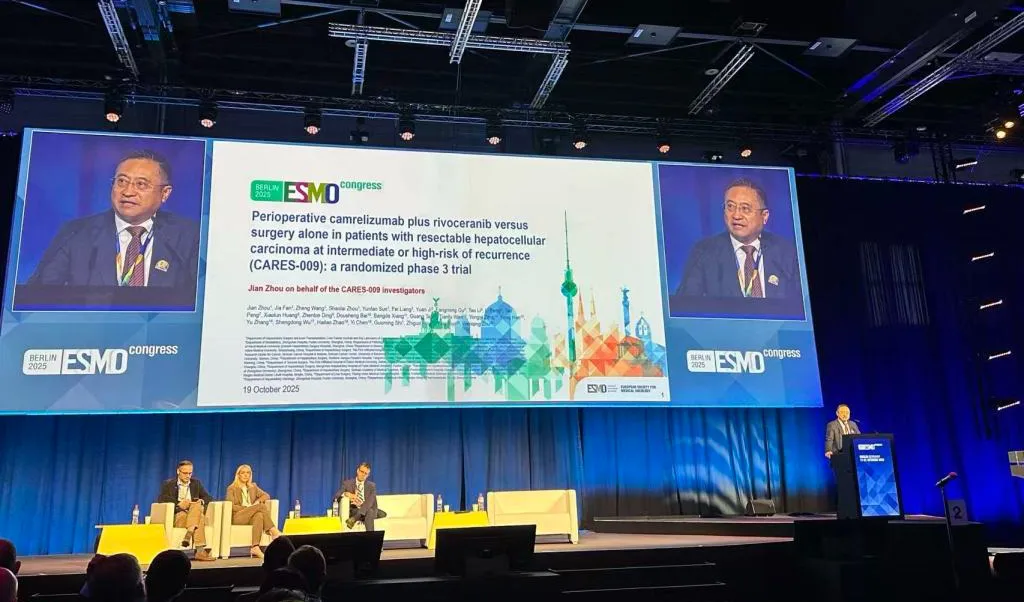
Surgery can cure hepatocellular carcinoma, and then it often comes back: five-year recurrence after resection runs at 60–70%. Adjuvant treatment has repeatedly failed to change that. CARES-009, led by Zhou Jian at Zhongshan Hospital under Fan Jia, tried treating before and after surgery — a "sandwich" of neoadjuvant plus adjuvant camrelizumab (PD-1) and rivoceranib (an anti-angiogenic TKI) — across 16 Chinese centres. Median event-free survival was 42.1 months versus 19.4, more than double. It was presented at ESMO and published in The Lancet on 19 October 2025 [1][3][5].
Key takeaways
- Design: investigator-initiated, multicentre, open-label, randomised phase 2/3 trial (NCT04521153) [4][5].
- Population: resectable hepatocellular carcinoma at intermediate or high risk of recurrence [1].
- Intervention: neoadjuvant camrelizumab plus rivoceranib, surgery, then adjuvant camrelizumab plus rivoceranib, versus surgery alone [3][5].
- Primary result: median event-free survival 42.1 versus 19.4 months [3][4].
- Described as the first phase 3 trial in the perioperative HCC setting to report a positive result [1][5].
Why before surgery as well as after
Adjuvant-only strategies have failed in this disease, for a structural reason: after a liver resection the patient is recovering, liver function is variable, and a substantial proportion never complete the planned course. Giving treatment first has three advantages — the tumour is measurable so response can guide the decision to operate, the patient is fit enough to complete it, and micrometastases are treated while they are still small [1][5].
The combination is deliberate: an anti-angiogenic TKI normalises the abnormal tumour vasculature, which may improve immune cell access, while PD-1 blockade releases the T-cell brake. The same doublet is already standard in advanced HCC, which reduces the biological risk of the approach [3][6].
How to read a doubled event-free survival
Doubling a median from 19 to 42 months in a cancer with a 60–70% recurrence rate is a large effect, and the trial's positive result has been described by independent commentators as a meaningful advance in multimodal liver cancer treatment [1][4].
Event-free survival is not overall survival, and the trial is reported before mature survival data. The design was open-label, which matters when the decision to operate and the timing of follow-up imaging are not blinded. Neoadjuvant treatment delays surgery, and a proportion of patients progress or become inoperable while on it — a real cost that a median benefit can obscure. Postoperative liver failure and surgical complication rates are the safety questions specific to giving an anti-angiogenic drug immediately before hepatectomy, and readers should check them in the paper [2][5].
The condition in context: hepatocellular carcinoma
China carries the largest share of the global burden, largely because of hepatitis B.
| Region | What the data shows | Source |
|---|---|---|
| Recurrence | Five-year recurrence and metastasis after resection is 60-70% [1][5]. | People's Daily / Xinhua [1][5] |
| Prior standard | No perioperative regimen had shown a positive phase 3 result before this trial [1][5]. | People's Daily / Xinhua [1][5] |
| Advanced disease | The same doublet is established first-line therapy in advanced HCC from CARES-310 [5]. | Xinhua [5] |
Because most HCC arises on a background of cirrhosis, any perioperative regimen must be tolerable for a liver that is already compromised [2].
Why it matters
| Potential | What the report suggests | Source |
|---|---|---|
| Effect size | Median event-free survival 42.1 versus 19.4 months [3][4]. | [3][4] |
| First in class | First positive phase 3 in the perioperative HCC setting [1][5]. | [1][5] |
| Caution | Open-label; overall survival immature [2]. | [2] |
Availability and limits
- This is an editorial summary of the publication, not a treatment recommendation [1][3].
- Overall survival data are not yet mature [2].
- Neoadjuvant treatment can delay surgery and allow progression [5].
- Anti-angiogenic therapy before hepatectomy raises surgical safety questions [2]
- Eligibility requires adequate liver function and resectable disease [1].
What to ask before booking
| Question | Why it matters |
|---|---|
| Do I meet the trial's recurrence-risk criteria? | The benefit was shown in that population [1]. |
| What happens if the tumour progresses before surgery? | That is the main risk of neoadjuvant therapy [5]. |
| Which department handles foreign patients, and in what language? | Zhongshan is a working hospital we do not book; confirm international-department coordination and language support. |
| Is my liver function adequate for this regimen? | Cirrhosis limits tolerance [2]. |
Questions patients ask
What did CARES-009 test?
Perioperative camrelizumab plus rivoceranib — before and after surgery — versus surgery alone in resectable hepatocellular carcinoma at intermediate or high recurrence risk, across 16 Chinese centres [1][5].
What was the result?
Median event-free survival was 42.1 months with the perioperative regimen versus 19.4 months with surgery alone [3][4].
Where was it published?
The Lancet, online 19 October 2025, with presentation at ESMO the same day [1][2].
Does it improve overall survival?
Not yet established — event-free survival is the reported endpoint and survival data are immature [2].
Is this relevant to international patients?
It is useful context for China's liver cancer care. Zhongshan is a working hospital we do not book — contact its international department directly [1].