
Quick answer
Between 70% and 90% of patients with advanced cancer have pain, and for some, oral or injected opioids either fail or cause intolerable side effects. On 30 July 2026, Fan Bifa's pain department at China-Japan Friendship Hospital implanted China's first SynchroMed III intrathecal drug-delivery system — an implanted pump and catheter that delivers analgesia directly into the spinal fluid, where a microgram dose can replace hundreds of milligrams taken by mouth [1][2].
Key takeaways
- The implant was performed on 30 July 2026 by Fan Bifa's team at China-Japan Friendship Hospital's pain department [1].
- The system delivers drug directly into the subarachnoid space, giving stable, continuous analgesia with lower systemic exposure [2].
- Intrathecal morphine can achieve the same relief as roughly 1/300 of the oral dose [4].
- SynchroMed III is MRI-conditional at 1.5T and 3.0T and simplifies refills [2].
- The hospital describes it as China's first implantation of this generation of the device [1].
The problem and the device
Cancer pain is often undertreated. Escalating oral opioids brings constipation, sedation, nausea and tolerance, and some patients reach doses that no longer help. Intrathecal delivery changes the arithmetic: the drug enters cerebrospinal fluid and binds receptors in the spinal cord and brain directly, so a tiny dose produces the same effect with far less systemic exposure [2][4].
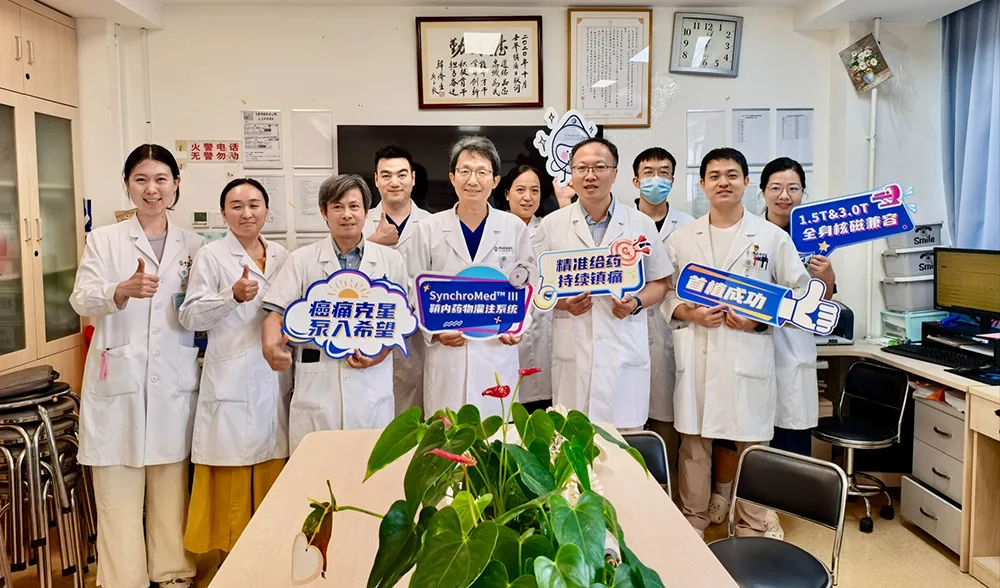
The pump is implanted under the skin of the abdomen and connected by a tunnelled catheter to the spinal canal; a clinician programmes the infusion rate, and refills are given through a port. The third-generation device supports 1.5T and 3.0T whole-body MRI — important for cancer patients who need repeated imaging — and adds simpler refill workflows and improved data security [2][3].
What was reported
The hospital reports the procedure as the country's first implantation of SynchroMed III, for a patient with moderate-to-severe cancer pain, and frames it as part of a multidisciplinary pain pathway that runs from assessment through long-term follow-up [1][3].
This is a first-implant report, not a comparative study. Intrathecal pumps are established technology with known risks — infection, catheter problems, programming errors, withdrawal if the pump fails — and they suit selected patients whose pain is poorly controlled systemically. The report does not present outcome data beyond the immediate implant [1][2].
The condition in context: cancer pain
Pain is one of the most feared consequences of advanced cancer, and its control remains uneven.
| Region | What the data shows | Source |
|---|---|---|
| Prevalence | 70–90% of patients with advanced cancer experience pain [1]. | China-Japan Friendship Hospital [1] |
| Overall | About 60% of all cancer patients have pain at some point [5]. | People's Daily [5] |
| Dose ratio | Intrathecal morphine can match oral dosing at about 1/300 of the dose [4]. | Haodf / Fan Bifa [4] |
Because uncontrolled pain affects sleep, nutrition, mobility and mood, better delivery matters as much as better drugs [1].
Why it matters
| For the patient | What the report suggests | Source |
|---|---|---|
| Efficacy | Continuous targeted delivery can control pain that systemic opioids do not [2]. | [2] |
| Side effects | Much lower systemic exposure means less nausea, sedation and constipation [2][4]. | [2][4] |
| Caution | Implant surgery carries infection and catheter risks; patient selection matters [1]. | [1] |
Availability and limits
- This is an editorial summary of hospital and media reports, not a treatment offer [1][2].
- It is a first-implant report with no comparative outcome data [1].
- Intrathecal pumps suit selected patients; many do well on oral or transdermal opioids [2].
- Device and refill costs are substantial and coverage varies [1].
- Prevalence figures describe cancer pain generally, not this device's results [5].
What to ask before booking
| Question | Why it matters |
|---|---|
| Has my pain failed systemic opioid therapy? | Intrathecal therapy is for patients whose pain is not controlled or not tolerated orally [2]. |
| Who manages refills and programming long term? | The pump needs ongoing specialist management [2]. |
| Which department handles foreign patients, and in what language? | China-Japan Friendship Hospital is a working hospital we do not book; confirm international-department coordination and language support. |
| What is the cost, and what happens if the catheter fails? | Device complications require revision and carry withdrawal risk [1]. |
Questions patients ask
What was implanted?
The SynchroMed III intrathecal drug-delivery system — an implanted pump and catheter that infuses analgesia directly into the spinal fluid [1][2].
When and where?
30 July 2026, by Fan Bifa's pain department at China-Japan Friendship Hospital in Beijing, described as China's first implantation of this device generation [1].
Why is intrathecal delivery better?
It achieves similar relief at about 1/300 of the oral morphine dose, with far less systemic exposure and fewer side effects [4].
Is it suitable for everyone with cancer pain?
No — it is for selected patients whose pain is poorly controlled or poorly tolerated on systemic opioids [2].
Is this relevant to international patients?
It is useful context for China's cancer-pain services. China-Japan Friendship Hospital is a working hospital we do not book — contact its international department directly [1].