
Quick answer
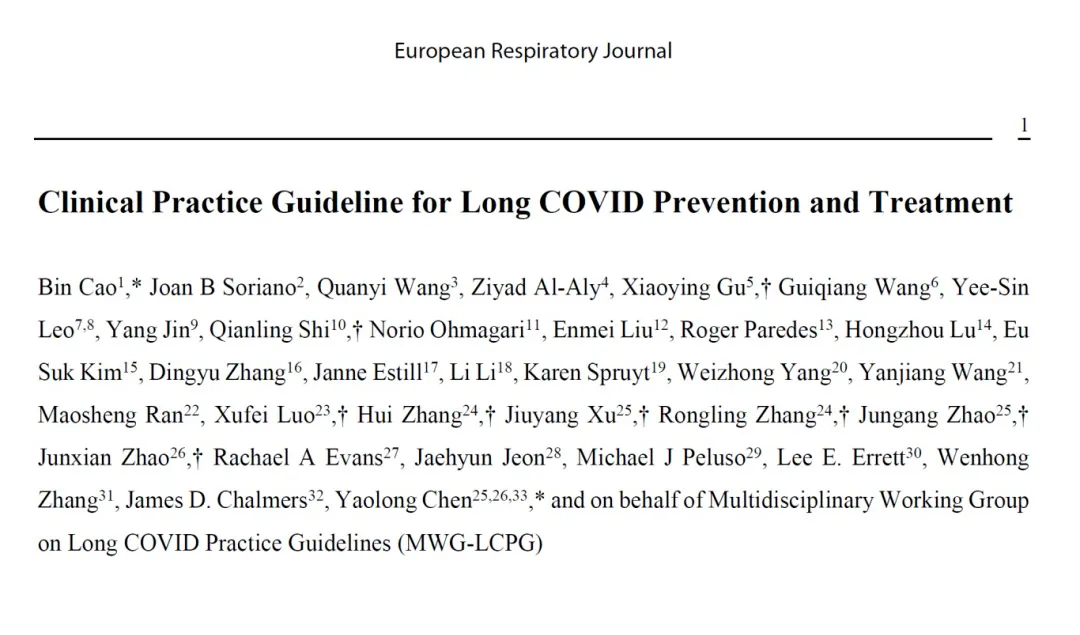
At least 10% of people infected with SARS-CoV-2 have persistent or new symptoms three months later, and more than twenty guidelines already exist — most of them methodologically weak, mutually inconsistent, or silent on treatment. A working group of 60 experts from 10 countries and 10 specialties, chaired by Cao Bin of China-Japan Friendship Hospital, spent two years producing a guideline that answers eight clinical questions with graded recommendations. It was published in the European Respiratory Journal on 19 March 2026 [1][2][4].
Key takeaways
- Ten countries, ten specialties, 60 experts; registered on PREPARE as PREPARE-2024CN123 [4].
- Co-corresponding authors: Cao Bin (China-Japan Friendship Hospital) and Chen Yaolong (Lanzhou University) [2][4].
- Developed following the WHO guideline handbook, reported per RIGHT, appraised with AGREE II, graded with GRADE [4].
- Eight clinical questions, eight recommendations, focused on adults [4][5].
- Who data: more than 770 million infections globally, about 10% with long COVID at three months [1][6].
What long COVID is, formally
The WHO definition used here is a condition occurring three months after infection with symptoms that last at least two months and cannot be explained by another diagnosis. The commonest are fatigue, palpitations, breathlessness and cognitive slowing, but the symptom set spans multiple organ systems, which is precisely why single-specialty guidelines have struggled [1][6].
The methods matter as much as the content. Registration before work began, a formal conflict-of-interest process, GRADE grading of both evidence certainty and recommendation strength, and external review are what distinguish this from consensus statements written by interested parties [4].
What the guideline does and does not claim
Cao has described the guideline's philosophy as doing less: re-examining long-standing practices that lack evidence and removing them, rather than adding interventions. That is an honest position in a field where the therapeutic evidence base is thin and where patients are vulnerable to unproven products [5].
GRADE grading is designed to be transparent about certainty, and much of the long COVID evidence is low or very low certainty. Recommendations in such areas are conditional and depend on patient values. The guideline is also explicitly for adults; paediatric long COVID is addressed elsewhere. Readers should look at the strength of each recommendation rather than treating all eight as equivalent [4][5].
The condition in context: long COVID
Long COVID is now a substantial chronic disease burden, and China's contribution has moved from case series to guideline leadership.
| Region | What the data shows | Source |
|---|---|---|
| Global | More than 779 million infections and over 7 million deaths; at least 10% develop long COVID [6]. | Respiratory World [6] |
| Guideline landscape | More than 20 long COVID guidelines exist, with inconsistent methods and content [1]. | STAR guidelines commentary [1] |
| Scope | Post-infective syndromes also follow influenza and other respiratory pathogens [3]. | HKU infection forum [3] |
Because long COVID has no diagnostic test, guidance depends on clinical definition and exclusion — which is exactly what a rigorous guideline can standardise [2].
Why it matters
| For the patient | What the report suggests | Source |
|---|---|---|
| Consistency | One internationally developed reference rather than dozens of conflicting documents [1]. | [1] |
| Restraint | Recommendations emphasise stopping unevidenced treatments [5]. | [5] |
| Caution | Much evidence is low certainty; recommendations are conditional [4]. | [4] |
Availability and limits
- This is an editorial summary of the guideline and its coverage, not medical advice [1][2].
- The guideline addresses adults, not children [4].
- Evidence certainty is low for several questions [4].
- Implementation depends on local rehabilitation and primary care capacity [6].
- Patients should beware unregulated long COVID "protocols" sold outside guideline care [5].
What to ask before booking
| Question | Why it matters |
|---|---|
| Has my symptom cluster been assessed against the WHO case definition? | Long COVID is a diagnosis of pattern and exclusion [6]. |
| Which recommendations are strong, and which conditional? | They carry different weight [4]. |
| Which department handles foreign patients, and in what language? | The hospital is a working hospital we do not book; confirm international-department coordination and language support. |
| Is any treatment being offered outside the guideline? | Unproven therapies are common in this field [5]. |
Questions patients ask
Who led the guideline?
Cao Bin of China-Japan Friendship Hospital chaired the working group, with Chen Yaolong of Lanzhou University as chief methodologist; both are co-corresponding authors [2][4].
Where was it published?
The European Respiratory Journal, online 19 March 2026 [1][2].
How many recommendations?
Eight recommendations addressing eight clinical questions on prevention and treatment in adults [4][5].
What makes it different?
It followed WHO guideline methodology with PREPARE registration, AGREE II appraisal, RIGHT reporting and GRADE grading of evidence and recommendation strength [4].
Is this relevant to international patients?
It is a global reference document. The hospital is a working hospital we do not book — contact its international department directly [1].