
Quick answer
Endobronchial ultrasound-guided needle aspiration is the standard way to sample enlarged mediastinal lymph nodes, and it is excellent at answering one question — is this cancer? It is much weaker at answering others: is this sarcoidosis, tuberculosis or lymphoma, and what does the architecture of the node look like? Needles yield cells, not structure. Hou Gang's team at China-Japan Friendship Hospital ran a multicentre randomised trial of a different technique, EBUS-guided transbronchial mediastinal cryobiopsy, and found it diagnosed 97.1% of non-metastatic cases versus 79% for needle aspiration. It was published in Med on 26 January 2026 [1][2][4].
Key takeaways
- Design: multicentre randomised controlled trial in non-metastatic mediastinal and hilar lymphadenopathy [1][2].
- Overall diagnostic yield: 97.1% with cryobiopsy versus 79% with needle aspiration [1].
- Technique: a tunnel is created with a dilation catheter so the cryoprobe can reach the node, avoiding needle-knife incision [2][7].
- Frozen specimens preserve tissue architecture, enabling histology and molecular testing [1][3].
- Jürgen Hetzel, who developed transbronchial cryobiopsy, wrote an accompanying viewpoint in Med [2].
Why tissue architecture matters
Sarcoidosis is diagnosed by non-caseating granulomas; lymphoma by clonal architecture and immunohistochemistry; tuberculosis by caseating granulomas and cultures. None of these can be reliably established from cytology alone. The consequence in practice is repeat procedures, empirical treatment, or a diagnosis made on probability rather than evidence [1][3].
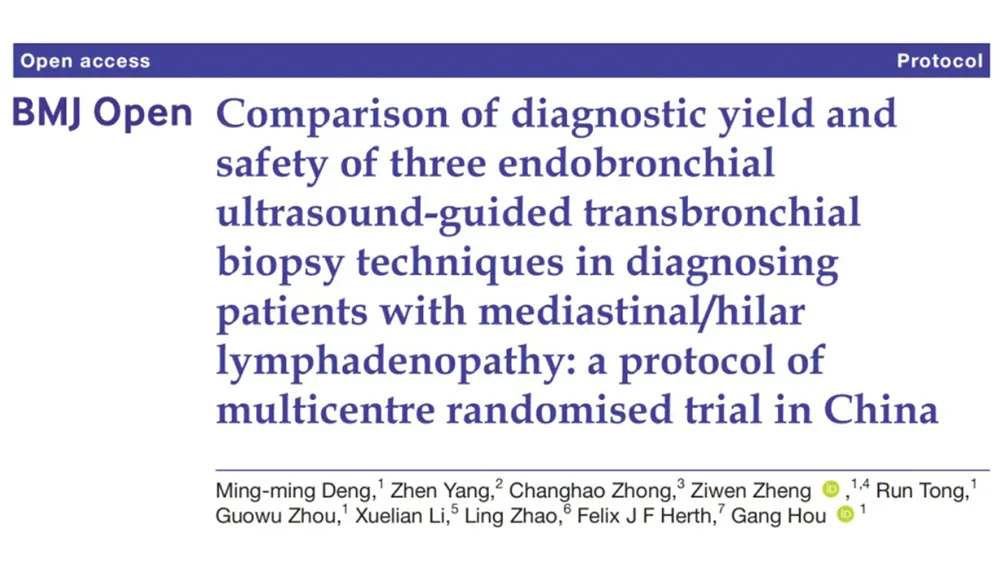
The team's procedural contribution is the tunnel: rather than cutting a path with a needle knife — which raised safety concerns among some operators — they dilate a tract so biopsy forceps can pass. The standardised technique was published separately with video in Endoscopic Ultrasound [2][7].
Reading the result carefully
A 18-point absolute difference in diagnostic yield is large for a diagnostic procedure, and the population — non-metastatic nodes, where the diagnostic question is hardest — is the right one to study. The trial also matters because earlier comparisons of cryobiopsy were not head-to-head in design [4][7].
Cryobiopsy takes a bigger specimen than a needle, so bleeding and pneumomediastinum are the relevant harms; the trial reports safety, but a procedure with higher diagnostic yield is only clearly better if complications do not rise meaningfully. The technique is also operator-dependent — a learning-curve study from the same group found that diagnostic yield stabilised only after a number of cases. Centres without that experience should not assume these figures [4][5].
The condition in context: mediastinal lymphadenopathy
Enlarged mediastinal nodes have a wide differential, and the diagnosis determines years of treatment.
| Region | What the data shows | Source |
|---|---|---|
| Differential | Sarcoidosis, tuberculosis, lymphoma and metastatic cancer are the main causes [3]. | Respiratory World [3] |
| Needle limits | Cytology specimens may not support histological diagnosis in sarcoidosis or lymphoma [1]. | AABIP coverage [1] |
| Learning curve | Diagnostic yield stabilises only after accumulated experience [5]. | CMT Respiratory [5] |
Because a benign diagnosis avoids unnecessary oncological treatment and a lymphoma diagnosis requires a different pathway entirely, yield is not a technical nicety [2].
Why it matters
| For the patient | What the report suggests | Source |
|---|---|---|
| Fewer repeats | Higher first-procedure yield reduces re-biopsy [1]. | [1] |
| Molecular testing | Tissue blocks support sequencing and PD-L1 testing [3]. | [3] |
| Caution | Operator-dependent; bleeding risk [4][5] | [4][5] |
Availability and limits
- This is an editorial summary of the publication, not a treatment recommendation [1][2].
- Requires a cryotherapy unit and specific training [5].
- Bleeding and mediastinal complications require on-site management capability [4].
- Yield figures come from experienced operators [5].
- It complements, rather than always replaces, needle aspiration, and adjuncts such as confocal endomicroscopy are being explored to guide sampling [2][6].
What to ask before booking
| Question | Why it matters |
|---|---|
| Is a histological diagnosis needed, or would cytology suffice? | The advantage is architecture and tissue [1]. |
| How many of these has the operator performed? | Yield improves with experience [5]. |
| Which department handles foreign patients, and in what language? | The hospital is a working hospital we do not book; confirm international-department coordination and language support. |
| What is the plan if bleeding occurs? | It is the main procedural risk [4]. |
Questions patients ask
What was compared?
EBUS-guided transbronchial mediastinal cryobiopsy versus conventional EBUS needle aspiration in non-metastatic mediastinal and hilar lymphadenopathy, in a multicentre randomised trial [1][2].
What was the result?
Diagnostic yield was 97.1% with cryobiopsy versus 79% with needle aspiration [1].
Where was it published?
Med, online 26 January 2026, with an accompanying viewpoint by Jürgen Hetzel [1][2].
Is it safe?
Safety was reported, but larger specimens carry bleeding and mediastinal risk, so operator experience matters [4][5].
Is this relevant to international patients?
It is useful context for China's interventional pulmonology. The hospital is a working hospital we do not book — contact its international department directly [1].