
Quick answer
Intraocular lenses have been made from essentially the same acrylic and silicone materials for decades, and China's high-end lenses have been imported. On 12 May 2026, Yao Ke at the Eye Hospital of Zhejiang University implanted the world's first intraocular lens made from cross-linked polyisobutylene — a new polymer with high transparency and elasticity — in a 62-year-old man whose right eye had been reduced to light perception by diabetic retinopathy and dense cataract [1][2][4].
Key takeaways
- The lens is the DiamondSoft cross-linked polyisobutylene aspheric IOL, developed by Xi'an Eyedeal [2][4].
- It is described as the first new IOL material in the global ophthalmic industry in more than 30 years [1][5].
- The optic is 6.5 mm but can be folded into a 2 mm incision because the material tolerates high compression [2].
- Surgery took about ten minutes; the patient read wall signs the next day [1][2].
- Yao Ke's cataract centre is described as one of the largest in the world by volume [2][4].
Why the material matters
An intraocular lens has to satisfy contradictory demands: optically perfect, flexible enough to fold through a small incision, stable enough not to deform inside the eye, and biologically inert for decades. Acrylic and silicone have dominated because they meet most of these; polyisobutylene is a different chemistry that the developers say combines higher refractive index and elasticity, so a larger optic can pass through a smaller wound [2][4].
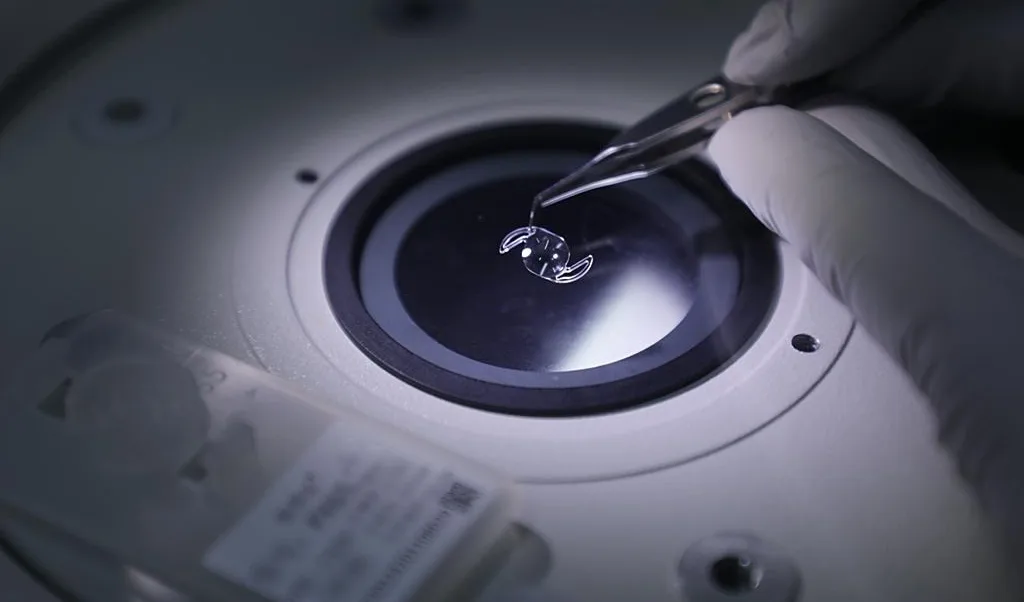
That combination matters most in eyes that are already compromised — diabetic retina, high myopia, small pupil — where surgical trauma and optical quality have outsized effects. The first patient fell into exactly that category, having been turned down elsewhere as too high risk [1][3].
What was reported
The surgery took roughly ten minutes through a 2 mm incision; the lens unfolded smoothly without wrinkles and sat stably. The patient's vision improved from light perception to reading signage the following day. Yao described the material as offering a large optical surface with good colour rendition and stability in complex eyes [2][4].
This is a single first-in-human implantation, not a trial. Safety and optical performance over years — the timescale that matters for an implant — are unknown, and the claim of being the first new material in 30 years rests on the developer's and clinicians' characterisation. Larger series and registry follow-up are the next steps [1][2].
The condition in context: cataract
Cataract is the leading cause of blindness worldwide and surgery is the only treatment.
| Region | What the data shows | Source |
|---|---|---|
| Global | Cataract is the top cause of blindness; surgery is the accepted treatment [1][4]. | People's Daily / Eyedeal [1][4] |
| China | High-end lens materials have been largely imported, constraining domestic device makers [1]. | People's Daily [1] |
| Complex eyes | Diabetic retinopathy, high myopia and small pupils make surgery harder [2]. | Eyedeal [2] |
Because cataract surgery is one of the most common operations in the world, a material advance has large aggregate consequences even if individual gains are modest [1].
Why it matters
| Potential | What the report suggests | Source |
|---|---|---|
| Supply | A domestic material reduces dependence on imports [1]. | [1] |
| Complex cases | Large optic through small incision suits compromised eyes [2]. | [2] |
| Caution | One case; long-term biocompatibility unknown [2]. | [2] |
Availability and limits
- This is an editorial summary of hospital and company reports, not a treatment recommendation [1][2].
- One implantation has been reported [1].
- Long-term stability and posterior capsule behaviour are unknown [2].
- Regulatory status and pricing are not described [4].
- Outcomes in routine cases versus existing lenses have not been compared [2].
What to ask before booking
| Question | Why it matters |
|---|---|
| Is a new-material lens appropriate for my eye? | Complex anatomy is where the design may help [2]. |
| What evidence exists beyond the first case? | Long-term data are not yet available [1]. |
| Which department handles foreign patients, and in what language? | The hospital is a working hospital we do not book; confirm international-department coordination and language support. |
| How will the implant be monitored over time? | Implant surveillance is a decades-long question [2]. |
Questions patients ask
What was implanted?
A cross-linked polyisobutylene aspheric intraocular lens — the first of its material — in a 62-year-old man with diabetic retinopathy and severe cataract [1][2].
Who performed it?
Yao Ke, director of the Eye Hospital of Zhejiang University and the ophthalmology centre at Zhejiang University Second Affiliated Hospital [1].
Why is the material significant?
It is described as the first new intraocular lens material in over 30 years, allowing a 6.5 mm optic through a 2 mm incision [2][5].
Is it available generally?
It is a first-in-human case; wider use depends on further trials and approval [1].
Is this relevant to international patients?
It is useful context for China's ophthalmic devices. The hospital is a working hospital we do not book — contact it directly [1].