
Quick answer
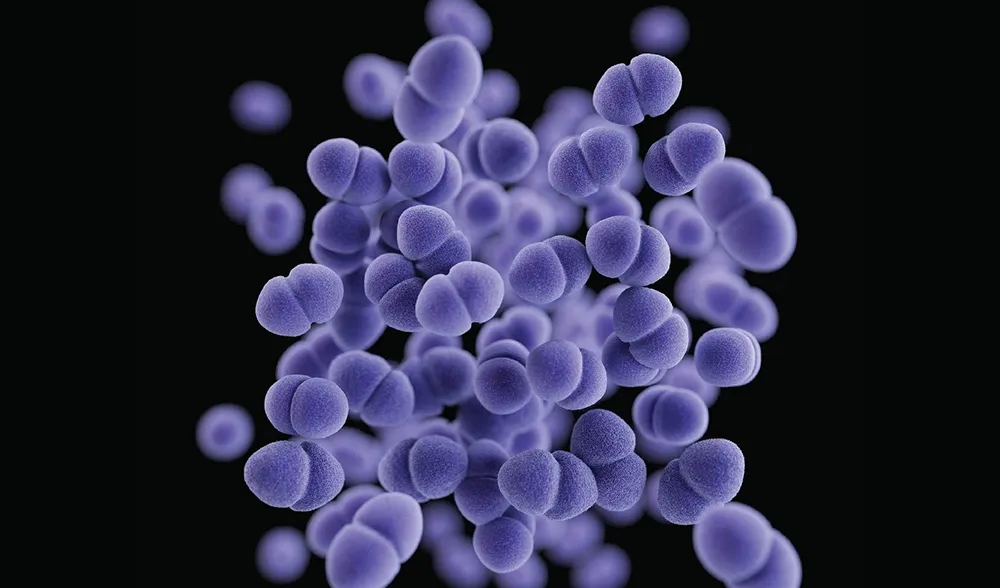
Staphylococcus aureus, and especially MRSA, kills more than a million people a year, and vancomycin — the drug of last resort — is losing effectiveness. Every new antibiotic eventually meets resistance, because resistance is what bacteria do. Wang Ben and Xu Feng at the Second Affiliated Hospital of Zhejiang University tried something else: instead of poisoning the bacteria, make them calcify. Their engineered conjugate binds the bacterial wall, nucleates calcium phosphate on it, and turns the organism into an immobile mineral deposit that the immune system can then clear. It was published in Nature Biotechnology on 15 July 2025 [1][3][5].
Key takeaways
- Construct: an antibody–polysialic acid conjugate (APC) — an antibody fragment against wall teichoic acid coupled to polysialic acid [3][4].
- Mechanism: targeted nucleation of calcium phosphate on the bacterial surface, forming a calcified shell [2].
- Consequence: the bacteria are immobilised and the calcified deposits also modulate the immune response to clear residual organisms [1][2].
- Published in Nature Biotechnology on 15 July 2025 [3].
- Design rationale drawn from clinical observation that healed chronic infections leave calcified foci [2].
Why calcification is a clever target
Antibiotic resistance works by mutating the drug's target, pumping the drug out, or destroying it. None of those defences helps against a process that precipitates mineral onto the cell surface — there is no enzyme to mutate that removes a calcium shell. That is the conceptual appeal: a physical rather than pharmacological mechanism [2][5].
The inspiration was clinical: urinary tract infection is followed by stones, and healed tuberculosis leaves calcified foci in the lung. Those deposits are the residue of an immune process that worked. The team's contribution is to trigger that process deliberately and specifically, using the antibody to localise it to bacteria rather than healthy tissue [2].
What this is not yet
The work is preclinical. Delivering a nanoparticle to a chronic infection — biofilm, abscess, intracellular reservoir — is the harder half of any antibacterial development, and the paper's challenge is the same one facing every non-antibiotic approach [1][5].
The sources reviewed describe efficacy in infection models, not human trials. Antibody conjugates are expensive to manufacture and require cold chain, which is awkward for the settings where MRSA mortality is highest. Chronic staphylococcal infections are protected by biofilm and by intracellular persistence, and a surface-acting agent may reach neither. Safety questions include whether calcification could occur in unintended tissues and whether repeated dosing provokes neutralising antibodies against the conjugate [3][5].
The condition in context: MRSA
Resistance is a slow-moving pandemic with a large burden in hospitals and, increasingly, in the community.
| Region | What the data shows | Source |
|---|---|---|
| Mortality | More than 1 million deaths a year from S. aureus infection [3]. | The Paper [3] |
| Resistance burden | Nearly 5 million deaths worldwide were associated with antibiotic resistance in 2019 [5]. | Huangpu science association [5] |
| Last-line drugs | Vancomycin and similar agents are showing treatment failure [5]. | Huangpu science association [5] |
Because resistance erodes each new antibiotic within years, mechanisms that do not rely on a specific molecular target have disproportionate long-term value [2][5].
Why it matters
| Potential | What the report suggests | Source |
|---|---|---|
| Resistance-proof logic | A physical mechanism with no enzymatic target [2][5]. | [2][5] |
| Dual action | Calcification plus immune modulation [1][2]. | [1][2] |
| Caution | Preclinical; delivery and cost unresolved [3]. | [3] |
Availability and limits
- This is an editorial summary of a research paper, not a treatment option [1][3].
- No human data are reported [5].
- Biofilm and intracellular infections may not be reached [3].
- Manufacturing cost and cold chain limit deployment [3].
- Established antibiotics remain the treatment for MRSA today [5].
What to ask before booking
| Question | Why it matters |
|---|---|
| Is my infection confirmed as MRSA with susceptibility testing? | Treatment choice depends on it [5]. |
| Are any trials of this approach open? | None in humans is reported [3]. |
| Which department handles foreign patients, and in what language? | The hospital is a working hospital we do not book; confirm international-department coordination and language support. |
| Has the source of infection been controlled surgically? | Drainage and debridement remain essential [3]. |
Questions patients ask
What was developed?
An antibody–polysialic acid conjugate that binds staphylococcal wall teichoic acid and induces calcification of the bacterial surface, immobilising the organism and promoting immune clearance [1][3].
Why is that different from an antibiotic?
It relies on a physical process rather than a molecular target, so classical resistance mechanisms such as target mutation or drug efflux do not apply [2][5].
Where was it published?
Nature Biotechnology, 15 July 2025 [3].
Is there a treatment for patients?
No — the work is preclinical, with no human data [5].
Is this relevant to international patients?
It is useful context for China's infectious disease research. The hospital is a working hospital we do not book — contact its international department directly [1].