
Quick answer
The Second Affiliated Hospital of Zhejiang University School of Medicine (Zhejiang University Second Affiliated Hospital) reports a fully domestically developed closed-loop spinal neural interface system for spinal cord injury. The implant reads a patient's own residual neural or muscle signals and automatically adjusts spinal-cord stimulation so the brain's intent can reach the legs. According to the hospital's reports, more than 20 spinal cord injury patients had received the implant by late 2026, and an international child walked again with assistance months after surgery [1].
Key takeaways
- The system is a closed-loop spinal neural interface: an epidural spinal electrode plus a small implanted pulse generator that reads muscle feedback and tunes stimulation in real time [2].
- It is described as fully domestically developed, from electrode design to control algorithm, by the hospital together with Zhejiang University and a local medical-device company [3].
- More than 20 spinal cord injury patients had received the implant, with several regaining assisted standing and stepping [1].
- An international pediatric patient (a Russian girl) became, per the hospital, the first international severe SCI patient in China to achieve assisted walking via the closed-loop interface [3].
- The device is a clinical program, not a completed randomised trial; results are early and individual, not a guarantee of recovery [1][2].
The technology
The implant is a closed-loop neuromodulation platform rather than a brain-computer interface that bypasses the cord entirely. A spinal electrode is placed in the epidural space and a matchbox-sized, wireless-rechargeable pulse generator is implanted in the abdomen. The device captures the patient's residual voluntary signals and delivers precisely timed stimulation to bridge the injured segment, aiming to restore a brain-spinal-muscle loop. The hospital describes the device as the smallest battery-powered closed-loop neuromodulation platform developed in China — about 51 mm long and 18 g — rechargeable wirelessly and controlled via Bluetooth [2].
What has been reported
The hospital describes a clinical program that began with a domestic first case — a man with complete paraplegia from a fall who, after implantation, stood and stepped with assistance. By September 2026 the team reported more than 20 spinal cord injury patients treated, several with meaningful motor recovery [1][2].
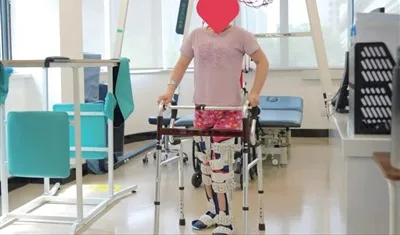
A Russian girl severely injured in a 2025 road accident was implanted in Hangzhou in 2026 after remote assessment found residual neural signalling. About three months later she took assisted steps with a walker — described by the hospital as the first international severe SCI patient in China to do so. Her case shows the approach's promise but is a single, selected patient, not a population result [3].
The condition in context: spinal cord injury
Spinal cord injury is a life-altering event caused mainly by road traffic crashes, falls, violence and sports. It produces permanent changes in movement, sensation and autonomic function below the level of injury, and it carries high personal and economic cost [5].
| Region | What the data shows | Source |
|---|---|---|
| Worldwide | Spinal cord injury affects millions of people globally, with road traffic crashes and falls among the leading causes; the burden is rising with urbanisation and ageing [5]. | U.S. National Institute of Neurological Disorders and Stroke [5] |
| United States | The national registry estimates about 18,000 new traumatic SCI cases each year and roughly 300,000 people living with SCI [4]. | National Spinal Cord Injury Statistical Center [4] |
| China | With a large population and high road-traffic and fall injury rates, China has a substantial SCI burden; programs like this address a large domestic need [1]. | Zhejiang University Second Affiliated Hospital reports [1] |
Most people with chronic SCI live in low- and middle-income countries, and effective restorative options remain limited — which is why device-based approaches attract strong interest [5].
Why it matters
| For the patient | What the report suggests | Source |
|---|---|---|
| Recovery | Some patients regained assisted standing and stepping, including an international child [1][3]. | [1][3] |
| Access | A domestically developed, smaller, rechargeable device could lower cost and widen access in China [2]. | [2] |
| Caution | Early, selected cases; not a randomised trial and not a cure. Outcomes vary widely by injury [1][2]. | [1][2] |
Availability and limits
- This is an editorial summary of hospital and media reports, not an independent clinical assessment or a booking channel [1][2][3].
- The work is described as a clinical program with more than 20 patients, not a completed controlled trial; evidence of benefit is still early [1].
- The device is investigational in this application; regulatory approval as a standard therapy is not implied [2].
- Recovery depends heavily on the injury's level and completeness; the highlighted cases are selected, not representative [1][3].
- Burden figures describe spinal cord injury generally and come from registries, not from this program [4][5].
What to ask before booking
| Question | Why it matters |
|---|---|
| Is this interface available to foreign patients, and at what stage? | The program has treated an international child, but confirm current eligibility and whether you are a candidate [1][3]. |
| What are my chances given my injury level and completeness? | Outcomes vary widely; an individual assessment, not the headline cases, should guide expectations [1][2]. |
| Which department handles foreign patients, and in what language? | The hospital is a working institution we do not book; confirm international-department coordination and language support. |
| How are surgery, rehabilitation and stay scheduled? | Implantation plus months of rehab is required; travel and accommodation planning is part of care. |
Questions patients ask
What is the closed-loop spinal neural interface?
It is an epidural spinal electrode plus a small implanted, wireless-rechargeable pulse generator that reads a patient's residual signals and adjusts spinal stimulation in real time to help reconnect the brain's intent to the legs. The hospital describes it as fully domestically developed [2].
How many patients have been treated?
The hospital reported more than 20 spinal cord injury patients implanted by late 2026, with several regaining assisted standing or stepping. These are early, selected results, not a population outcome [1].
Did a foreign patient really walk again?
Yes — a Russian girl with a severe spinal cord injury was implanted in Hangzhou in 2026 and took assisted steps about three months later; the hospital calls her the first international severe SCI patient in China to do so. She is a single, selected case [3].
Is this a proven cure for paralysis?
No. It is an early clinical program, not a completed randomised trial, and not a cure. Recovery depends on the injury's level and completeness, and the publicised cases are selected [1][2].
Is this relevant to international patients considering care in China?
It is useful context; the program has treated an international child. The hospital is a working institution we do not book — contact its international department directly and confirm candidacy, language support and travel logistics before committing [1][3].