
Quick answer
Zhejiang Provincial Hospital of Chinese Medicine has developed an integrated traditional Chinese and Western medicine program for adolescent idiopathic scoliosis (AIS), built around a "spinal balance method" that combines herbal medicine, tuina (manual) treatment and therapeutic exercise, plus bracing and rehabilitation. The hospital reports a correction rate of about 90% and an 87% reduction in the need for surgery, and in 2026 its summer intensive camp treated 210 adolescents [1][2].
Key takeaways
- The program uses a staged approach: mild curves (10–20°) get manual therapy, bone-setting, exercise and rehabilitation; moderate (20–40°) is the key window; severe (>40°) gets intensive care to avoid surgery [2].
- Its core is the "spinal balance method" — whole-body herbal regulation, precise manual correction, and daoyin exercise to strengthen muscles and bones [2].
- The hospital reports a 90% correction rate and an 87% fall in surgery, aiming for "correct the moderate, operate on none of the severe" [2].
- In summer 2026, 210 adolescents completed the systematic program and scoliosis specialty visits passed 1,000 [1].
- The hospital leads the national Hangzhou pilot for TCM intervention in child and adolescent scoliosis and runs school screening [4].
The problem and the approach
Adolescent idiopathic scoliosis is a sideways curvature of the spine that can worsen during growth spurts. Mild curves are watched; moderate ones may need bracing; severe curves may need surgery. Traditional Chinese medicine adds manual therapy and exercise aimed at muscle imbalance, which many families pursue alongside — or before — bracing and surgery [2][5].
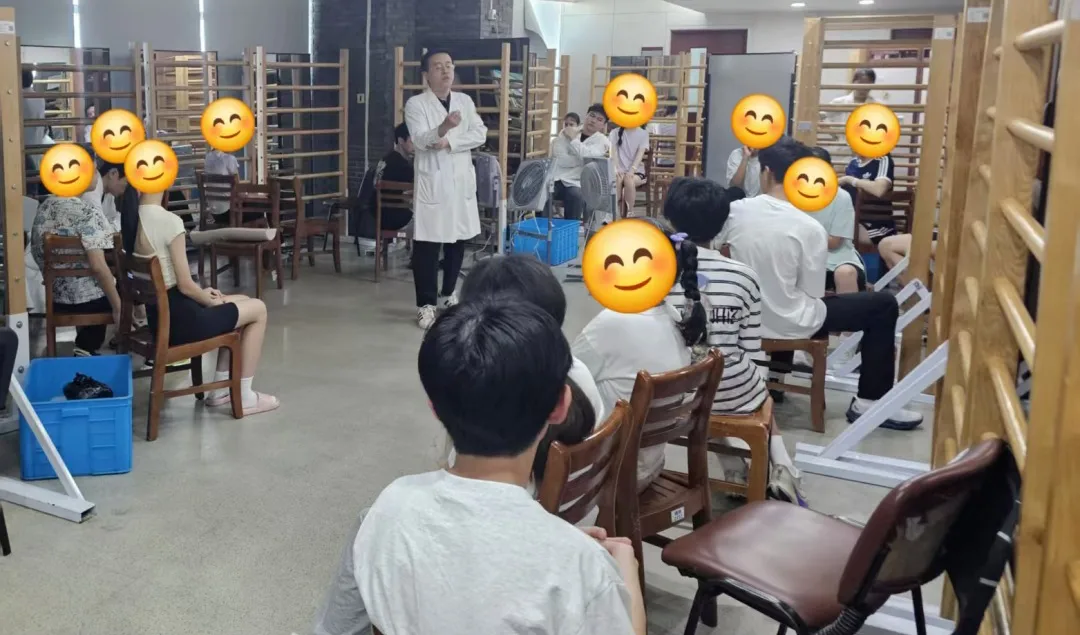
The hospital's team spent about a decade developing the approach, which it calls an "integrated correction technology" for AIS. It blends TCM theory with Western assessment and rehabilitation, and defines AIS stages so that herbal treatment, manual correction, bracing and training can be combined for each patient [2]. The department itself dates to 1961 and runs one of the province's largest tuina services [3].
What was reported
In the 2026 summer intensive program, held as a closed residential camp, 210 adolescents completed systematic integrated treatment; the hospital reports visible improvements in posture and spinal function, with many mild-to-moderate cases improving shoulder symmetry and curve [1].
The 90% correction and 87% surgery-reduction figures are the hospital's own reported outcomes, not a randomised trial. Scoliosis is also treated with bracing and surgery in mainstream care, and results depend on curve size and growth stage; families should treat these numbers as programme claims, not guaranteed outcomes [2].
The condition in context: adolescent idiopathic scoliosis
AIS is the most common spinal deformity of adolescence, and early, structured treatment can reduce progression.
| Region | What the data shows | Source |
|---|---|---|
| Worldwide | AIS affects roughly 2–3% of adolescents and is the most common spinal deformity in this age group [5]. | Scoliosis Research Society [5] |
| Staging | Curves of 10–20°, 20–40° and over 40° get different intensity of treatment; moderate curves are the key window [2]. | Zhejiang TCM Hospital [2] |
| China | The hospital leads the national Hangzhou pilot for TCM intervention and runs school screening [4]. | Zhejiang TCM / media [4] |
Because AIS is common and progression depends on growth, programmes that combine monitoring, exercise and manual therapy may help some families avoid bracing or surgery — though evidence quality varies [2][5].
Why it matters
| For the family | What the report suggests | Source |
|---|---|---|
| Non-surgical option | Structured TCM plus rehab may improve posture and reduce progression in mild-moderate curves [1][2]. | [1][2] |
| Intensity | A residential summer camp gives concentrated daily treatment that weekly visits cannot [1]. | [1] |
| Caution | Reported rates are programme claims; severe curves still need specialist and possibly surgical care [2]. | [2] |
Availability and limits
- This is an editorial summary of hospital and media reports, not an independent clinical assessment or a booking channel [1][2][4].
- The 90% correction and 87% surgery-reduction figures are the hospital's own reported outcomes, not a randomised trial [2].
- Enrolment requires a Cobb angle of at least 10° and an assessment that the child can take part [2].
- Severe curves (>40°) may still need surgery; the program targets progression and avoidance where possible [2].
- Prevalence figures describe AIS generally and come from the Scoliosis Research Society, not this programme [5].
What to ask before booking
| Question | Why it matters |
|---|---|
| What is my child's Cobb angle and growth stage? | Curve size and remaining growth determine the treatment intensity and prognosis [2]. |
| Is this program suitable for my child's curve, or is bracing/surgery needed? | Severe or rapidly progressing curves need specialist and possibly surgical care [2]. |
| Which department handles foreign patients, and in what language? | This is a working hospital we do not book; confirm international-department coordination and language support. |
| How long is the residential camp, and how is follow-up arranged? | The camp is intensive and residential; plan timing and post-camp review [1]. |
Questions patients ask
What is the integrated scoliosis program?
A traditional Chinese and Western medicine approach for adolescent idiopathic scoliosis at Zhejiang Provincial Hospital of Chinese Medicine, combining herbal medicine, tuina manual correction, therapeutic exercise, bracing and rehabilitation [2].
How well does it work?
The hospital reports a 90% correction rate and an 87% reduction in surgery, though these are programme-reported outcomes rather than a randomised trial [2].
Which curves does it suit?
Mild curves (10–20°) are treated with manual therapy and exercise; moderate curves (20–40°) are the key window; severe curves (>40°) get intensive care to try to avoid surgery [2].
What happens in the summer camp?
A closed residential camp provides concentrated daily integrated treatment; in 2026, 210 adolescents completed it, and specialty visits passed 1,000 [1].
Is this relevant to international patients considering scoliosis care in China?
It is useful context for TCM-integrated scoliosis care. The hospital is a working hospital we do not book — contact its international department directly and confirm candidacy, language support and logistics [1][4].