
Quick answer
Removing the whole colon for disease such as familial adenomatous polyposis (FAP) can leave patients with a permanent stoma, because joining the colon straight to the anus without a rectum causes incontinence. On 4 August 2023, surgeons Liang Tingbo and Wu Guosheng at Zhejiang University's First Affiliated Hospital performed the world's first rectal transplant with recto-anal anastomosis — replacing the small bowel and part of the colorectum, and transplanting a rectum to connect to the anus — freeing a 37-year-old man from a 12-year stoma [1][2].
Key takeaways
- The patient, "Da Liu", developed FAP at 25; his entire colon was removed and a permanent stoma was created, which he lived with for 12 years [2].
- Six years later a new tumour invaded his remaining small bowel and encased major blood vessels; multiple hospitals judged it unresectable [2].
- The team replaced the small intestine and part of the colorectum, and transplanted a rectum to anastomose with the anus, because colon-to-anus alone would cause incontinence [1][4].
- More than 20 days after surgery, all transplanted organs survived with no rejection or infection, and the transplanted rectum healed with the anus; he was discharged on 29 August 2023 [2].
- In 2026 the patient, now 39, was reported to be living normally and preparing to marry [2].
The case and the problem
FAP causes hundreds of polyps throughout the colon and carries a near-certain risk of colorectal cancer, so the colon is often removed entirely. The result is usually a permanent ileostomy — a stoma bag — which is life-saving but socially and psychologically burdensome. For patients whose tumour also involves the small bowel and vessels, even resection may be impossible [1][2].
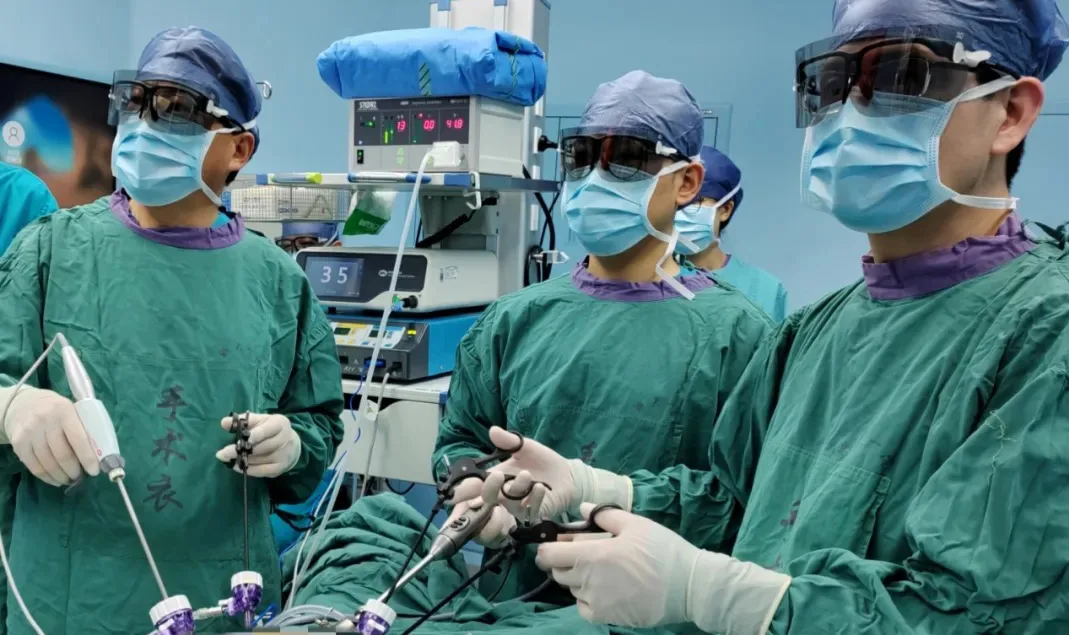
Wu Guosheng, director of colorectal surgery and an internationally known small-bowel transplant surgeon [3], proposed the bold solution: transplant a rectum so the remaining bowel could be joined to the anus and continence preserved. The operation, co-led by Liang Tingbo, was performed on 4 August 2023 [1][4].
What was reported
The hospital reported that the transplanted small intestine and colon all survived, with no immune rejection or infection, and the transplanted rectum healed well with the anus; bowel function gradually returned. He left hospital on 29 August 2023. A 2026 report described him, aged 39, living a normal life and planning to marry [2].
This is a single, high-risk first-in-human operation, not a trial. It shows feasibility and points toward future anorectal en-bloc transplantation, but long-term function, immunosuppression burden and wider applicability still need study [1][4].
The condition in context: stoma and colorectal disease
Permanent stomas are common after surgery for low rectal cancer, inflammatory bowel disease, FAP and severe pelvic trauma.
| Region | What the data shows | Source |
|---|---|---|
| Worldwide | Colorectal cancer is among the most common cancers, and many patients need a stoma [5]. | World Health Organization [5] |
| Stoma causes | Low rectal cancer, IBD/FAP total colectomy, pelvic trauma and congenital malformation can require lifelong stoma [4]. | Health Point report [4] |
| China | Zhejiang University's First Affiliated Hospital performed the world-first rectal transplant in 2023 [1][2]. | Health Point / Wenzhou News [1][2] |
Because a stoma profoundly affects daily life and body image, any option that restores continence has high value to patients [1][2].
Why it matters
| For the patient | What the report suggests | Source |
|---|---|---|
| Continence | Transplanting a rectum allows anastomosis to the anus and avoids incontinence [4]. | [4] |
| New direction | It lays groundwork for anorectal en-bloc transplantation [4]. | [4] |
| Caution | Single case; requires lifelong immunosuppression and specialist centres [1]. | [1] |
Availability and limits
- This is an editorial summary of hospital and media reports, not an independent clinical assessment or a booking channel [1][2][4].
- It is a single world-first case; it is not a routine or widely available procedure [1].
- Transplant recipients need lifelong immunosuppression and close monitoring [1].
- Long-term bowel function and durability of the transplanted rectum are still being observed [2].
- Burden statements describe colorectal cancer generally and come from WHO, not this case [5].
What to ask before booking
| Question | Why it matters |
|---|---|
| Is my tumour resectable, and could a transplant be an option? | Only a specialist transplant assessment can judge this [1]. |
| What are the risks of lifelong immunosuppression? | Transplant carries rejection, infection and medication risks [1]. |
| Which department handles foreign patients, and in what language? | Zhejiang's First Affiliated is a working hospital we do not book; confirm international-department coordination and language support. |
| How is follow-up and stoma/continence management planned? | Transplant recovery needs long-term monitoring and support [2]. |
Questions patients ask
What was the world-first operation?
A rectal transplant with recto-anal anastomosis, combined with small-bowel and partial colorectal replacement, performed at Zhejiang University's First Affiliated Hospital on 4 August 2023 by Liang Tingbo and Wu Guosheng [1][2].
Why transplant a rectum rather than just join the colon to the anus?
Without a rectum, connecting the colon directly to the anus causes faecal incontinence; a transplanted rectum allows a functional anastomosis and preserves continence [4].
Who was the patient?
A man with familial adenomatous polyposis whose colon was removed at 25, leaving him with a stoma for 12 years; a later tumour invaded his small bowel and vessels [2].
How is he now?
He was discharged on 29 August 2023, and a 2026 report described him aged 39, living normally and preparing to marry [2].
Is this relevant to international patients considering transplant care in China?
It is useful context for China's transplant capability. Zhejiang's First Affiliated Hospital is a working hospital we do not book — contact its international department directly and confirm candidacy, language support and travel logistics [1][2].