
Quick answer
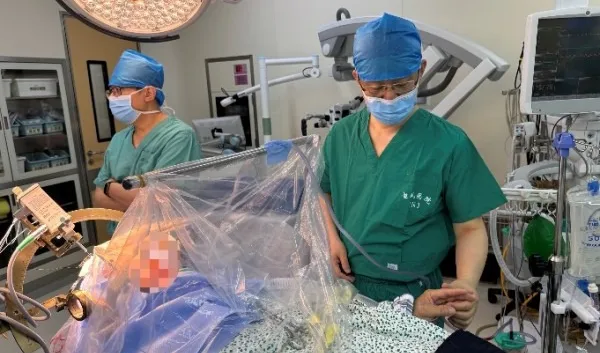
Conventional deep brain stimulation (DBS) delivers constant electrical pulses, whether the patient needs them or not. A closed-loop system senses brain activity and adjusts stimulation in response. On 22 May 2026, Xuanwu Hospital (Zhao Guoguang) and Tiantan Hospital (Zhang Jianguo) each implanted their first patient in a multicentre, double-blind, randomised trial comparing closed-loop with open-loop DBS in Parkinson's disease, using a device developed by Tsinghua University and Pins Medical [1][2][3].
Key takeaways
- The trial is supported by China's 14th Five-Year key R&D programme and registered as a device trial (临械审[2026]011号-001) [1].
- Design: multicentre, randomised, double-blind, comparing closed-loop with open-loop stimulation [1][3].
- Both national neurological disease centres implanted their first patients on the same day [2][3].
- The device both stimulates and records, enabling "sense–decode–feedback" closed-loop control [1][4].
- Patients will be followed on both modes under the GCP protocol [1][5].
What "bidirectional" adds
Standard DBS is one-way: the electrode stimulates, and the programming is adjusted at clinic visits. A bidirectional system records local field potentials from the same electrodes, so the device can detect the pathological beta-band activity that accompanies Parkinsonian symptoms and adapt stimulation accordingly [1][4].
The theoretical benefits are fewer stimulation-induced side effects, longer battery life, and better control of symptom fluctuations. The practical difficulty is that the control algorithm must be reliable — a closed loop that misreads the signal can deliver too much or too little stimulation [1][4].
Why a randomised trial matters
Closed-loop DBS has been studied internationally for more than a decade, but mostly in small, short studies. A double-blind randomised comparison against conventional open-loop stimulation is the design that can establish whether the extra complexity translates into better motor scores, fewer side effects and better quality of life [1][3].
These are first implantations, not results. The trial will take years to complete, and blinded comparison of two stimulation modes requires careful programming to keep patients and assessors unaware of allocation. Chinese-made closed-loop DBS would be significant for cost and supply, but regulatory approval and clinical benefit remain to be demonstrated [1][2].
The condition in context: Parkinson's disease
Parkinson's disease is a progressive neurodegenerative disorder whose motor symptoms respond well to DBS in selected patients.
| Region | What the data shows | Source |
|---|---|---|
| Treatment | DBS is established for medication-refractory tremor and motor fluctuations [3]. | Top News [3] |
| Limitations | Open-loop stimulation is continuous and can cause dyskinesia or speech effects [1]. | Xuanwu Hospital [1] |
| China | Both implanting centres are national neurological disease medical centres [2][3]. | Tencent News [2] |
Because DBS programming is time-consuming and specialist-dependent, a system that adapts itself could widen access if it proves safe [1]. The trial's blinded comparison of two modes in the same patients is designed to separate the effect of the algorithm from the effect of surgery itself.
Why it matters
| Potential | What the report suggests | Source |
|---|---|---|
| Adaptive control | Stimulation could follow symptom state rather than stay fixed [1][4]. | [1][4] |
| Domestic device | A Chinese closed-loop system would reduce import dependence [2]. | [2] |
| Caution | No outcome data yet; algorithm safety is unproven [1]. | [1] |
Availability and limits
- This is an editorial summary of launch reports, not a treatment offer [1][2].
- The device is investigational and available only within the trial [1].
- Eligibility follows DBS criteria plus trial-specific requirements [3].
- Results will take years; no efficacy data are reported [1].
- Implanted hardware carries surgical and hardware-related risks [3].
What to ask before booking
| Question | Why it matters |
|---|---|
| Am I a candidate for DBS at all? | The trial enrols only patients who meet DBS criteria [3]. |
| Is the trial open at a centre I can reach? | Only two lead centres are described [2]. |
| Which department handles foreign patients, and in what language? | Xuanwu is a working hospital we do not book; confirm international-department coordination and language support. |
| How is programming and follow-up arranged? | Closed-loop systems need specialist tuning [1]. |
Questions patients ask
What started?
A multicentre, double-blind, randomised trial comparing closed-loop with open-loop DBS for Parkinson's disease, with first implantations at Xuanwu and Tiantan on 22 May 2026 [1][2].
What is closed-loop DBS?
A system that records brain activity and adjusts stimulation in response, rather than delivering a constant pulse [1][4].
Who developed the device?
Tsinghua University with Pins Medical, under a national key R&D programme [2][3].
Are results available?
No — the trial has only begun enrolling [1].
Is this relevant to international patients?
It is useful context for China's neurotechnology. Xuanwu is a working hospital we do not book — contact its international department directly [1].