
Quick answer
Gestational diabetes affects about 14% of pregnancies worldwide and is diagnosed with an oral glucose tolerance test at 24–28 weeks — late enough that the fetus has already been exposed to the metabolic environment driving macrosomia and pre-eclampsia. Earlier prediction has been attempted with single-fluid metabolomics, with limited success. Liang Chaoxia's team at Zhejiang University's women's hospital profiled saliva, serum and urine together in 1,241 pregnant women and found biomarkers that change as early as 9–13 weeks. The work was published in Nature Communications [1][2][5].
Key takeaways
- Design: prospective observational nested case-control study across multiple cohorts [1][4].
- Population: 1,241 women in mid-pregnancy, with early-pregnancy samples also analysed [2].
- Method: nanostructure-assisted laser desorption/ionisation time-of-flight mass spectrometry across three body fluids [2].
- Output: 50 discriminating biomarkers, plus diagnostic, adverse-outcome and early-warning models [1].
- Eleven biomarkers were already altered at 9–13 weeks [1].
Why three fluids rather than one
Serum reflects systemic circulation; saliva reflects both circulating metabolites and local glandular activity and can be collected without a needle; urine integrates renal handling over hours. Each alone gives a partial picture, which is why previous single-fluid studies produced inconsistent biomarker panels [1][2][4].
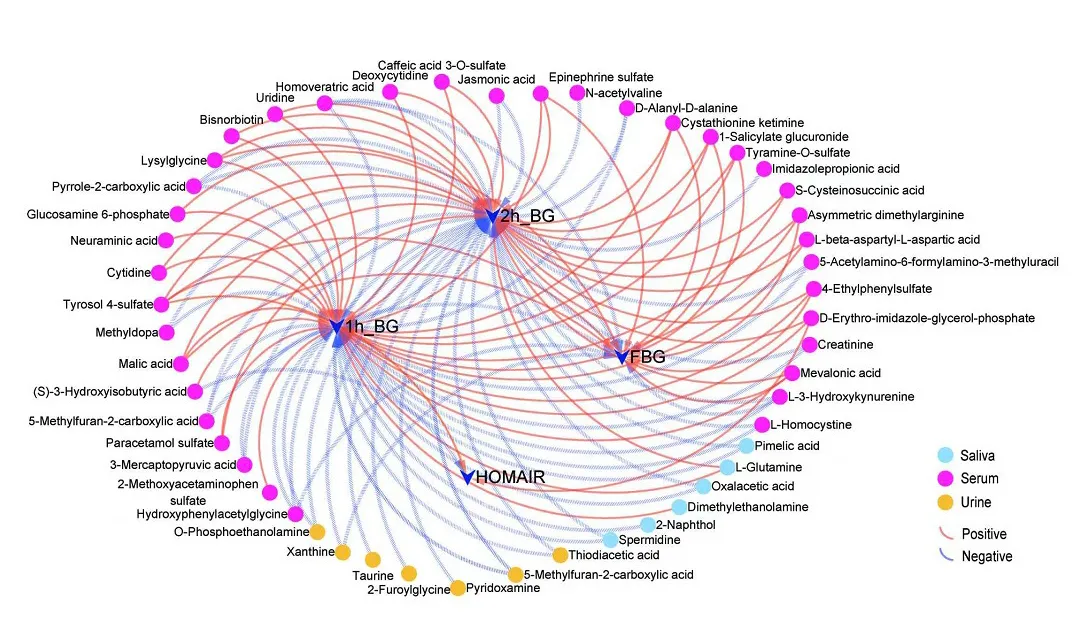
The practical appeal of saliva and urine is obvious for a condition screened in every pregnancy: no venepuncture, no fasting glucose load, and the possibility of sampling in primary care. Whether the panel performs well enough to replace or precede the glucose tolerance test is the question that follows [2][5].
What the models can and cannot do
The team built three models — discrimination of GDM, prediction of adverse pregnancy outcomes, and early warning — and reports good performance for each. Discrimination and prediction are different claims: identifying who has GDM at 24 weeks is easier than predicting at 10 weeks who will develop it [1][2].
This is a case-control design nested in prospective cohorts, which is efficient but can inflate apparent accuracy compared with a true screening population where most women will not develop GDM. External validation in a separate population, and a prospective impact study showing that earlier detection changes outcomes, have not been reported. Mass spectrometry platforms are also not available in routine antenatal clinics. The result is a credible biomarker discovery study, not a replacement for the OGTT [4][5].
The condition in context: gestational diabetes
GDM is the commonest medical complication of pregnancy, and its diagnosis triggers monitoring, diet, and often insulin.
| Region | What the data shows | Source |
|---|---|---|
| Prevalence | About 14% of pregnancies worldwide [1][2]. | Provincial key laboratory / Xiamen [1][2] |
| Consequences | Increased pre-eclampsia, caesarean delivery, macrosomia and neonatal hypoglycaemia [2]. | Xiamen University [2] |
| Diagnostic limit | The OGTT at 24–28 weeks is late, unpleasant and burdensome [2]. | Xiamen University [2] |
Because the fetal overgrowth trajectory is established well before 24 weeks, earlier identification is the only route to earlier intervention [3].
Why it matters
| Potential | What the report suggests | Source |
|---|---|---|
| Earlier window | Eleven markers altered at 9–13 weeks [1]. | [1] |
| Non-invasive | Saliva and urine avoid venepuncture [2]. | [2] |
| Caution | Case-control design; no external validation [4]. | [4] |
Availability and limits
- This is an editorial summary of a research paper, not a clinical test [1][2].
- No commercial assay exists for this panel [4].
- Case-control sampling may overstate accuracy [4].
- Mass spectrometry infrastructure is required [2].
- The OGTT remains the diagnostic standard [2].
What to ask before booking
| Question | Why it matters |
|---|---|
| Am I in a risk group that warrants early testing? | Risk factors justify earlier screening now [3]. |
| Is this metabolomic test available clinically? | No — it is research-stage [4]. |
| Which department handles foreign patients, and in what language? | ZJU Women's Hospital is a working hospital we do not book; confirm international-department coordination and language support. |
| When is my glucose tolerance test scheduled? | It remains the standard diagnostic step [2]. |
Questions patients ask
What was studied?
Metabolomic profiling of saliva, serum and urine in 1,241 pregnant women to identify biomarkers of gestational diabetes, using mass spectrometry [1][2].
What was found?
Fifty discriminating biomarkers and 11 that were already altered at 9–13 weeks, with diagnostic, outcome-prediction and early-warning models [1].
Where was it published?
Nature Communications, reported by the hospital in January 2026 [1][2].
Can it replace the glucose tolerance test?
Not yet — external validation and prospective impact studies are needed [4].
Is this relevant to international patients?
It is useful context for China's obstetric research. ZJU Women's Hospital is a working hospital we do not book — contact its international department directly [1].