
Quick answer
Oral pathology is a specialty where the specimen volume is high, the subtypes are numerous, and the diagnosis rests on expert pattern recognition that takes a decade to acquire — precisely the conditions in which image-based AI is plausible, and also the conditions in which an error matters. On 28 November 2025, West China Hospital of Stomatology and Westlake University put HXDental-PathAI into service in the hospital's pathology department, describing it as the world's first clinical-grade multimodal oral pathology model. It covers more than 30 oral diseases and reports 98% sensitivity and 97% specificity for distinguishing benign from malignant lesions [1][2][6].
Key takeaways
- Developed by the hospital's pathology department with Westlake University [1][2].
- Architecture: multimodal large-language-model backbone, attention-based multiple-instance learning, hundred-billion-parameter network [1][6].
- Training data: million-scale pathology features plus clinical multimodal data [1][4].
- Scope: interactive diagnosis across more than 30 diseases including squamous cell carcinoma, leukoplakia, fibroma and cysts [1][6].
- Performance: 98% sensitivity and 97% specificity for benign versus malignant and suspicious lesions [1][3].
Why pathology is the natural place to start
A pathology slide is a high-information image with a definitive ground truth — the diagnosis is written down, and outcomes eventually confirm or refute it. That makes supervised training unusually clean compared with, say, radiology, where the reference standard is fuzzier [1][4].
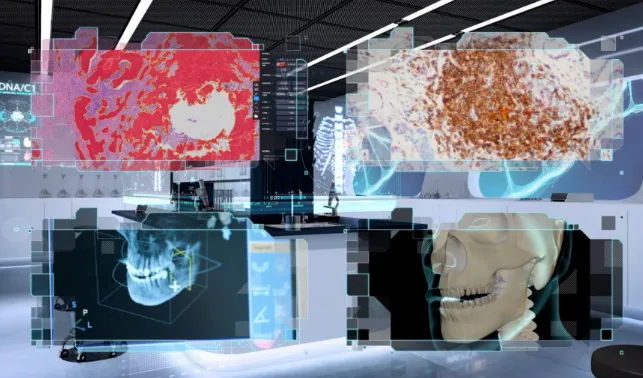
What the multimodal backbone adds is the ability to answer questions about a slide, not just classify it: a pathologist can ask where the suspicious region is, what the differential is, or what the grade appears to be. For teaching, the model links images to typical cases and current literature, which is why the hospital frames it as "human-machine shared intelligence" rather than replacement [2][5].
Reading a 98% sensitivity figure
High sensitivity and specificity in a validation set is the beginning of an evaluation, not the end of one. The relevant question for a clinical tool is what happens in the cases the model has never seen — rare subtypes, poor-quality sections, ambiguous margins [1][3].
The reported figures come from the developers' clinical validation, and the sources reviewed do not describe the reference standard, the external test set, or performance by disease subclass — so it is not possible to judge whether the model is equally good at, say, dysplastic leukoplakia and a simple cyst. "Clinical-grade" is the developers' designation, not a regulatory approval. Deployment at the originating hospital, where the scanning hardware and slide preparation are uniform, is the easiest case; the planned remote collaboration platform for primary care is the harder test, because scanner differences alone can degrade pathology AI substantially [4][6].
The condition in context: oral pathology capacity
Oral cancer has a poor prognosis partly because it is diagnosed late, and pathological confirmation is the bottleneck in many settings.
| Region | What the data shows | Source |
|---|---|---|
| Workload | High specimen volume with numerous subtypes, and diagnosis heavily dependent on expert experience [1][2]. | Science and Technology Daily [1][2] |
| Access gap | Quality pathology capacity is scarce at primary level [1]. | Science and Technology Daily [1] |
| Policy context | Positioned as a response to the national "AI plus healthcare" initiative [4]. | Chengdu Daily [4] |
Because the constraint is expert time rather than staining or scanning, triage support has a plausible role in extending specialist oversight [2][5].
Why it matters
| Potential | What the report suggests | Source |
|---|---|---|
| Triage speed | Benign versus malignant triage in seconds [1][6]. | [1][6] |
| Teaching | Interactive image-question answering linked to cases and literature [2][5]. | [2][5] |
| Caution | Not a regulated device; validation detail not public [3][4]. | [3][4] |
Availability and limits
- This is an editorial summary of hospital and press reporting, not a diagnostic service offer [1][2].
- Deployed at one hospital; not a licensed diagnostic device [4].
- External validation and subclass performance are not reported [3].
- Scanner and staining variation affect pathology AI performance [6].
- A pathologist's sign-off remains legally and clinically required [2].
What to ask before booking
| Question | Why it matters |
|---|---|
| Will a pathologist review my slide independently? | The model is decision support, not a diagnosis [2]. |
| How are ambiguous or rare lesions handled? | Subclass performance is not published [3]. |
| Which department handles foreign patients, and in what language? | The hospital is a working hospital we do not book; confirm international-department coordination and language support. |
| What is the turnaround time for a pathology report? | AI triage is only one step in the workflow [1]. |
Questions patients ask
What is HXDental-PathAI?
A clinical-grade multimodal large model for oral pathology developed by West China Hospital of Stomatology and Westlake University, covering more than 30 oral diseases [1][2].
What performance is reported?
98% sensitivity and 97% specificity for distinguishing benign from malignant and suspicious lesions [1][3].
When did it enter service?
Reported on 28 November 2025, with clinical application from December 2025 [1][6].
Does it replace pathologists?
No — it is positioned as decision support and teaching, with pathologist sign-off retained [2][5].
Is this relevant to international patients?
It is useful context for China's oral pathology capacity. The hospital is a working hospital we do not book — contact its international department directly [1].