
Quick answer
Researchers led by Professor Lin Yunfeng at West China Hospital of Stomatology, Sichuan University, reported what is described as the world's first framework-nucleic-acid drug tested in patients, in an investigator-initiated trial. Of nine people treated, seven improved markedly, using roughly one-thousandth of the conventional dose. The work builds on tetrahedral framework nucleic acid (tFNA), a DNA nanostructure the team proposes as a delivery vehicle for medicines [1][2].
Key takeaways
- The core technology is the "DNA tetrahedron": a rigid, about 10-nanometre tetrahedral framework nucleic acid assembled from four DNA strands, designed as a delivery system for drugs and genes [3].
- Reported as the first framework-nucleic-acid drug used in patients anywhere, via an investigator-initiated trial [1].
- Result: of nine patients treated, seven improved significantly, at about one-thousandth of the traditional drug dose, with onset reportedly shortened from weeks to as fast as three days [1][2].
- The related delivery-system project won a 2025 China Medical Science and Technology Award first prize, and a framework-nucleic-acid theory project was nominated for a 2025 Sichuan Natural Science Award first prize [1][2].
- The team first framed the "framework nucleic acid" concept and helped set international standards, aiming to solve the cell-delivery bottleneck for nucleic-acid drugs [3].
The technology and the problem it targets
Nucleic-acid medicines — siRNA, mRNA and gene therapies — are widely seen as the next generation of biopharma, but a global bottleneck remains: getting them safely and efficiently into cells. The team's approach is a roughly 10-nanometre tetrahedral DNA framework that can carry a drug or gene to a target, like a "nano high-speed rail" for therapeutics [3].
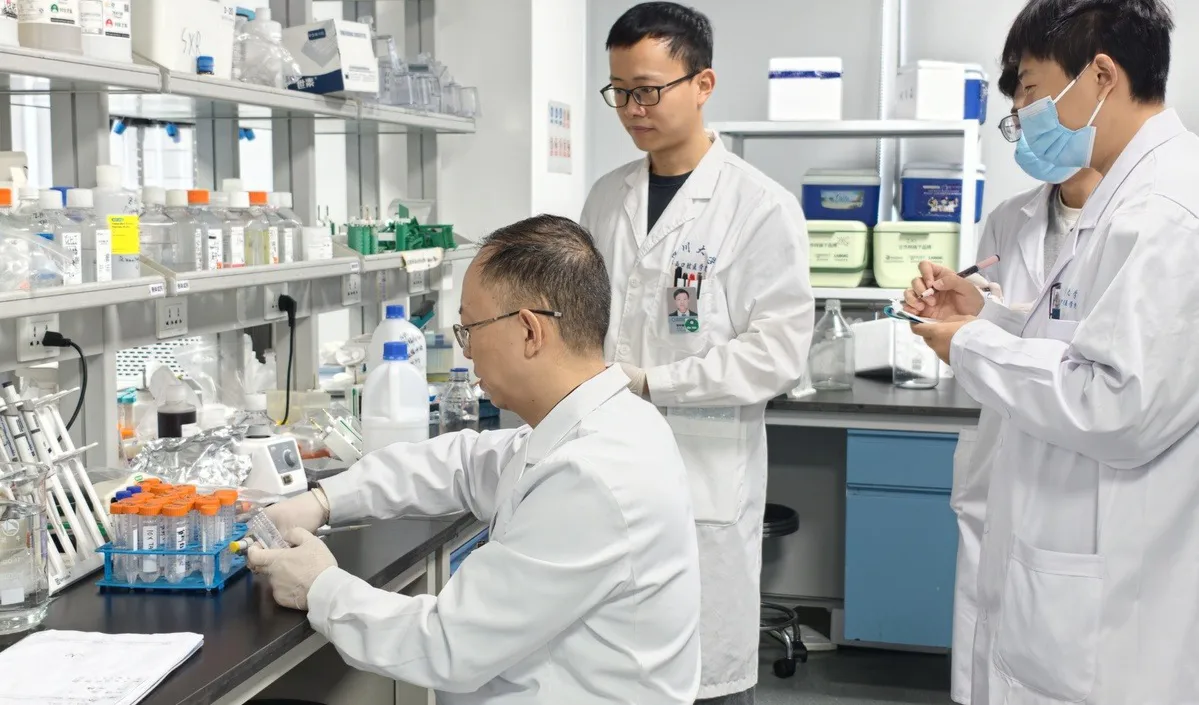
West China Hospital of Stomatology traces its origins to 1917 as China's first modern dental college and hosts a state key laboratory for oral disease research — an oral-health institution that produced a widely applicable nucleic-acid delivery technology [4].
What the trial showed
In the reported investigator-initiated trial, nine patients received the framework-nucleic-acid drug and seven improved markedly. The team highlighted the very low dose (about one-thousandth of a conventional drug) and a faster onset as potential advantages of the delivery platform [1][2].
This is a first-in-patients, investigator-initiated trial in nine people. It demonstrates feasibility and encouraging early signals, but larger controlled studies are needed to confirm efficacy and safety and to move toward approved medicines [1][2].
The condition in context: nucleic-acid drug delivery
The importance of nucleic acids to modern medicine was underscored when the 2023 Nobel Prize in Medicine recognised mRNA nucleoside modifications — work that underpins mRNA vaccines and a broader wave of nucleic-acid therapies [5].
| Aspect | What the report shows | Source |
|---|---|---|
| Worldwide | Nucleic-acid drugs are a next-generation frontier, but cell delivery is a long-standing bottleneck [3][5]. | Chengdu Municipal Government [3]; Nobel Prize [5] |
| The bottleneck | Many candidates fail because they cannot enter cells efficiently and safely; delivery vehicles are the missing piece [3]. | Chengdu Municipal Government [3] |
| First in patients | Nine patients, seven markedly improved, about one-thousandth of the conventional dose; faster reported onset [1][2]. | China Daily [1]; China Economic Net [2] |
The delivery challenge is the field's choke point, which is why a platform that works across many medicines — rather than one drug — draws attention [3].
Why it matters
| Potential | What the report suggests | Source |
|---|---|---|
| Dose | Far lower effective dose (about one-thousandth) could mean less drug and fewer side effects [1][2]. | [1][2] |
| Platform | A general delivery system could help many nucleic-acid medicines reach cells [3]. | [3] |
| Caution | Nine is a very small first study; benefits need confirmation in larger trials [1][2]. | [1][2] |
Availability and limits
- This is an editorial summary of hospital, government and media reports, not an independent clinical assessment or a booking channel [1][2][3].
- The clinical evidence is a very small investigator-initiated trial (nine patients); it is not a pivoted registration trial and not an approved drug [1][2].
- Platform-level technology is at an early translational stage; real-world benefit depends on larger, controlled studies [3].
- Contextual figures and the Nobel example describe the nucleic-acid field, not a specific treatment outcome [5].
What to ask before booking
| Question | Why it matters |
|---|---|
| Is there a clinical trial I qualify for? | The tFNA technology is in early trials; ask the treating centre about relevant studies [1][2]. |
| Is this an approved treatment or a trial? | It is an early investigator-initiated trial, not an approved therapy [1]. |
| Which department handles foreign patients, and in what language? | The hospital is a working institution we do not book; confirm international-department coordination and language support. |
| How are trial screening and follow-up scheduled around travel? | Clinical-trial participation involves screening, treatment and close follow-up; plan accordingly. |
Questions patients ask
What is tetrahedral framework nucleic acid (tFNA)?
It is an artificially designed DNA nanostructure — a rigid tetrahedron about 10 nanometres across, built from four DNA strands — that can carry drugs or genes into cells, acting as a delivery vehicle [3].
What did the first-in-patients trial show?
In an investigator-initiated trial, nine patients were treated and seven improved markedly, using roughly one-thousandth of the conventional drug dose, with reports of faster onset [1][2].
Is this an approved treatment?
No. It is described as the first framework-nucleic-acid drug tested in patients — a small investigator-initiated trial. It is not an approved therapy, and larger controlled studies are needed [1][2].
Why does delivery matter for nucleic-acid drugs?
siRNA, mRNA and gene therapies are powerful but hard to get inside cells safely, and that delivery bottleneck limits the field. tFNA aims to solve that general problem, which is why the 2023 Nobel for mRNA work is often cited in this context [3][5].
Is this relevant to international patients considering care in China?
It is useful context for China's biotech and clinical-research depth. West China Hospital of Stomatology is a working hospital we do not book — for treatment, contact its international department directly and confirm candidacy, language support and travel logistics [1][4].