
Quick answer
West China Hospital of Stomatology (Sichuan University) and its spin-off company developed TARS, an augmented-reality and AI dental implant navigation system. It is described as the world's first AR/AI dental implant navigation device to receive China's Class III medical-device registration, and as China's first medical device equipped with an augmented-display system. Worn as a head-mounted display, TARS projects sub-millimetre guidance into the surgeon's view so implants can be placed precisely without free-hand estimation [1].
Key takeaways
- TARS overlays real-time, sub-millimetre navigation onto the surgical field, merging the operating light and vision system into one AR unit [3].
- It is described as the world's first AR/AI dental implant navigation device cleared in China (National Medical Products Administration Class III certificate, early 2026) [2].
- The system is a university spin-off: created by clinician-scientist Tian Taoran and his twin, Tian Yiran, through Chengdu-based Fangtian Medical [3].
- By late 2026 it had been delivered to more than 30 customers across over 10 provinces and adopted by leading teaching hospitals [2].
- In June 2026 West China Stomatology signed a clinical-research and training agreement with the University of Freiburg Dental School in Germany, taking the system abroad [1].
The technology
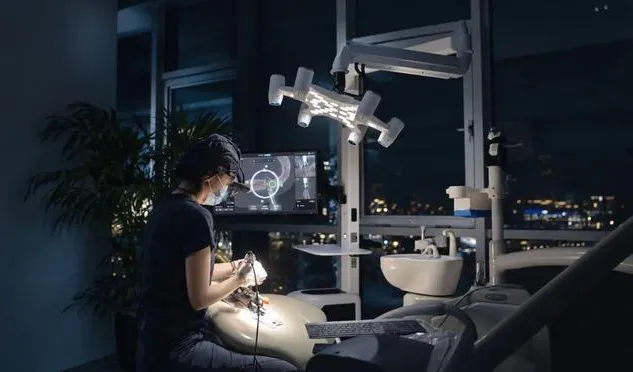
TARS is an augmented-reality surgical navigation system for dental implants. The surgeon wears a head-mounted display that merges a shadowless operating light with a vision system, so virtual indicators appear directly over the patient's mouth. The software, trained on the hospital's implant experience, guides drill angle, depth and position to sub-millimetre accuracy, aiming to standardise the procedure, raise precision and efficiency, lower complication risk and shorten recovery [3]. By embedding guidance in the surgeon's natural field of view rather than on a separate screen, the design is meant to lower the skill barrier for implant placement [2].
What has been reported
The hospital and its partners report that a routine implant case using TARS took a little over 40 minutes with the patient comfortable throughout, and that the system reduces the operational threshold for less-experienced operators [3]. After winning the medical-device first prize at Sichuan's 2025 medical-technology translation competition, TARS received its Class III registration in early 2026 and moved into commercial production via Fangtian Medical in Tianfu New Area [2].
By late 2026 TARS had been delivered to more than 30 customers in over 10 provinces and used at regional leading teaching hospitals in Beijing, Tianjin, Jiangsu and Zhejiang. In June 2026 the hospital signed a clinical-research and education agreement with the University of Freiburg Dental School in Germany, the first international deployment of the training and research program [1][2].
The condition in context: tooth loss and implants
Tooth loss is extremely common and erodes chewing, speech and quality of life. Dental implants have become the standard reconstructive option where bone allows, and demand has grown sharply as populations age and expectations rise [4].
| Region | What the data shows | Source |
|---|---|---|
| Worldwide | Oral diseases are among the most prevalent conditions; severe tooth loss affects hundreds of millions of people, a major driver of implant demand [5]. | World Health Organization, oral health fact sheet [5] |
| United States | About 120 million Americans are missing at least one tooth and roughly 36 million are edentulous; implant use continues to climb [4]. | American College of Prosthodontists [4] |
| China | With a large and ageing population, China is a fast-growing implant market; domestic navigation tools like TARS address cost and access [1][2]. | West China Hospital of Stomatology reports [1][2] |
While implants are widely performed, precision and consistency still depend on operator skill, which is exactly the gap AR navigation aims to close [3].
Why it matters
| For the patient | What the report suggests | Source |
|---|---|---|
| Precision | Sub-millimetre, in-view guidance can improve placement accuracy and lower complication risk [3]. | [3] |
| Access | A domestically developed, lower-cost navigation system could widen access and standardise care [2]. | [2] |
| Caution | This is a device and rollout report, not a clinical-outcome trial; real-world benefit at scale is still being established [1][2]. | [1][2] |
Availability and limits
- This is an editorial summary of hospital and media reports, not an independent clinical assessment or a booking channel [1][2][3].
- TARS holds a Chinese Class III registration and is in commercial rollout; availability outside China depends on local approvals [2].
- The claims are device and adoption reports, not published comparative clinical outcomes [1][2][3].
- Implant suitability still depends on bone volume and general oral health, assessed case by case [4].
- Burden figures describe tooth loss and implants generally and come from registries, not from this device [4][5].
What to ask before booking
| Question | Why it matters |
|---|---|
| Am I a candidate for implants, and is navigation used here? | Candidacy depends on bone and gum health; ask whether AR navigation is part of the workflow [4]. |
| Which department handles foreign patients, and in what language? | The hospital is a working institution we do not book; confirm international-department coordination and language support. |
| What does navigation add to cost and recovery? | AR guidance may shorten surgery and reduce complications; confirm specifics and pricing [2][3]. |
| How are visits, imaging and the prosthetic phase scheduled? | Implant care spans planning, surgery and restoration over weeks; travel planning is part of care. |
Questions patients ask
What is TARS?
TARS is an augmented-reality and AI dental implant navigation system from West China Hospital of Stomatology. The surgeon wears a head-mounted display that overlays sub-millimetre, real-time guidance onto the mouth, merging the operating light and camera into one AR unit [3].
Is it approved and available?
It is described as the world's first AR/AI dental implant navigation device cleared in China (NMPA Class III registration, early 2026) and had been delivered to more than 30 customers across over 10 provinces by late 2026 [2].
Why would AR guidance matter for implants?
Implant precision and consistency still hinge on operator skill; in-view, sub-millimetre guidance is meant to standardise placement, improve accuracy and lower complication risk, while lowering the skill barrier [3].
Has it gone international?
In June 2026 the hospital signed a clinical-research and training agreement with the University of Freiburg Dental School in Germany, the first international step for the program [1].
Is this relevant to international patients considering dental care in China?
It is useful context for dental-implant care in China. The hospital is a working institution we do not book — contact its international department directly and confirm candidacy, language support and travel logistics before committing [1][2].