
Quick answer
X-linked retinoschisis (XLRS) splits the layers of the retina, usually in boys, and slowly takes their central vision. There has been no approved treatment. On 10 June 2026, a West China Hospital team published in the New England Journal of Medicine a first-in-human study in which 12 children received a single subretinal injection of an AAV8 vector carrying the RS1 gene. Vision improved by a mean 10.8 ETDRS letters at 52 weeks, and the retinal splits closed in every treated eye [1][2][3].
Key takeaways
- Vector: scAAV8-hRS1 (JWK002), a self-complementary AAV8 carrying codon-optimised human RS1 cDNA [2][4].
- Route: subretinal injection, placing the vector next to the photoreceptors [2].
- 12 paediatric patients; all treated eyes had split cavities closed by week 13, sustained to week 52 [3].
- Mean BCVA gain 10.8 letters; central retinal thickness fell by 437.7 μm [3].
- No grade 3 or higher adverse events and no ocular inflammation reported [3].
Why the route mattered
An earlier XLRS gene therapy trial delivered the vector into the vitreous and failed to improve retinal structure. West China's team injected into the subretinal space instead, so the vector reaches the outer retina where RS1 is needed. They also chose a self-complementary AAV8 capsid, which infects retinal cells efficiently without provoking a strong immune response [2][5].
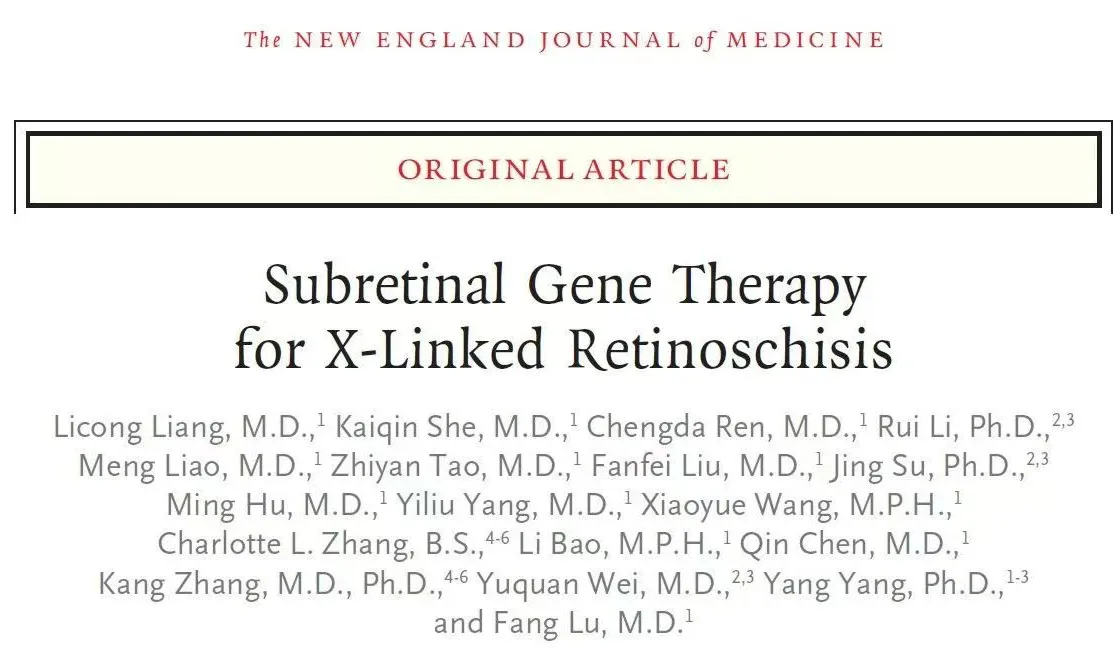
XLRS is caused by loss of retinoschisin, a protein that holds the retinal layers together. Replacing the gene restores the glue; the structural closure seen on imaging is the direct evidence that it worked, and the vision gain followed [1][3].
What the study found
All 12 treated eyes closed their schisis cavities by week 13 and remained closed through week 52, with a mean central retinal thickness reduction of 437.7 μm and a 10.8-letter BCVA gain. Safety was the other headline: no grade 3 or higher events, and no ocular inflammation, which is a common concern with intraocular AAV delivery [3][4].
Twelve children, one year of follow-up and no control arm. Natural history in XLRS varies, and the study is not randomised; the structural endpoint is objective but the visual one is not. Longer follow-up is needed to know whether the effect persists, and whether a single injection suffices as children grow. This is early-phase evidence, not an approved therapy [1][2].
The condition in context: X-linked retinoschisis
XLRS is rare, inherited and currently untreatable apart from supportive care.
| Region | What the data shows | Source |
|---|---|---|
| Prevalence | About 1 in 5,000 to 1 in 25,000 males [4]. | Biological World [4] |
| Onset | Vision loss typically begins in the first decade of life and progresses [1]. | Sichuan University [1] |
| Treatment gap | No approved disease-modifying therapy; care is supportive [1][5]. | Sichuan University [1] |
Because the disease is monogenic and confined to the retina, it is a natural target for gene replacement — which is why this result has attracted attention beyond ophthalmology [1].
Why it matters
| Potential | What the report suggests | Source |
|---|---|---|
| Structure | All treated eyes closed their splits [3]. | [3] |
| Function | Mean 10.8-letter gain, roughly two lines on a chart [3]. | [3] |
| Caution | Small, open-label, one-year data [2]. | [2] |
Availability and limits
- This is an editorial summary of the publication and university reports, not a treatment offer [1][2].
- The therapy is investigational; it is not approved [1].
- Twelve patients, no control arm, 52 weeks of follow-up [3].
- Subretinal injection is a surgical procedure with risks including detachment and inflammation [2].
- Eligibility requires confirmed RS1 mutation and suitable retinal anatomy [1].
What to ask before booking
| Question | Why it matters |
|---|---|
| Has my child a confirmed RS1 mutation? | The therapy is gene-specific [1]. |
| Are trial slots open, and what does follow-up involve? | Enrolment is limited and follow-up is intensive [3]. |
| Which department handles foreign patients, and in what language? | West China Hospital is a working hospital we do not book; confirm international-department coordination and language support. |
| What are the surgical risks of subretinal injection? | The route is not risk-free [2]. |
Questions patients ask
What did the trial test?
scAAV8-hRS1, a gene therapy carrying the RS1 gene, given as a single subretinal injection to 12 children with X-linked retinoschisis [1][2].
What were the results?
All treated eyes closed their retinal splits by week 13, vision improved by 10.8 ETDRS letters at 52 weeks, and no grade 3 or higher adverse events occurred [3].
Why subretinal rather than intravitreal?
An earlier intravitreal trial failed to improve structure; subretinal delivery reaches the outer retina where RS1 is needed [5].
Is it available as treatment?
No — it is investigational, with one year of follow-up in 12 patients [1].
Is this relevant to international patients?
It is useful context for China's gene therapy capacity. West China Hospital is a working hospital we do not book — contact its international department directly [1].