
Quick answer
Rheumatoid arthritis is diagnosed partly by antibodies against citrullinated proteins — a post-translational modification in which arginine becomes citrulline. Those modified proteins are the autoantigens that drive the disease, but they are present at vanishingly low abundance, and the methods used to find them need milligrams of sample and specialised chemistry. Dai Lunzhi and Zhao Yi at West China Hospital built a platform called Iseq-Cit that works from nanograms, then used it to map citrullination across the course of disease and to predict treatment response [1][2][4].
Key takeaways
- Published in Nature Biomedical Engineering on 3 March 2026, with Hu Meng, Zhu Chenxi and colleagues as co-first authors [1][2][6].
- Iseq-Cit needs about 1,000-fold less protein than existing methods and costs about 90% less [1][2].
- It uses a hyper-citrullinated peptide internal standard generated by enzymatic catalysis, avoiding the need for enrichment [5].
- Applied to a large longitudinal cohort spanning healthy people, high-risk individuals and patients [5].
- Citrullination abnormalities and immune activation were already present in the high-risk group before diagnosis [5].
Why citrullination is hard to measure
Citrullination changes a single residue by 0.984 daltons — less than the mass difference between carbon isotopes — so mass spectrometry struggles to distinguish it from deamidation or from a 13C peak. Because the modification is also scarce, chemical probes were needed to enrich it, and those probes require large amounts of starting material [2][5].
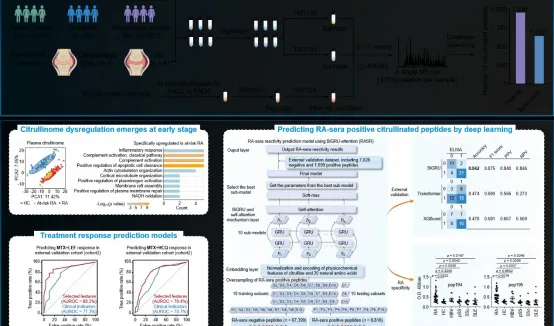
The workaround removes the need for enrichment: an internal standard of heavily citrullinated peptides raises the reference signal, so a conventional mass spectrometer can quantify the modification in tiny samples. Targeted mass spectrometry confirmed the identifications [5].
From map to treatment choice
The clinically interesting part is the stratification. Combining citrullinated peptide levels with routine clinical variables, the team built models that predict response to methotrexate plus leflunomide and to methotrexate plus hydroxychloroquine — two standard Chinese first-line combinations. They also trained a deep-learning model on large ELISA datasets to flag which citrullinated peptides are immunogenic, expanding the list of candidate autoantigens [2][3].
The cohort is substantial and longitudinal, but the treatment-response models were built and tested in the same programme, and independent external validation in a different population is the test that matters. Whether the platform can run in a routine immunology laboratory — it still requires mass spectrometry and expertise — is a separate barrier. The autoantigen discovery is hypothesis-generating; each new candidate needs confirmatory serology and T-cell work [3][5].
The condition in context: rheumatoid arthritis
RA affects around 0.5–1% of adults, causes progressive joint destruction, and has a narrow window for early effective treatment.
| Region | What the data shows | Source |
|---|---|---|
| Diagnosis | Anti-citrullinated protein antibodies are the most specific serological marker [1]. | West China Hospital [1] |
| Treatment choice | First-line combinations differ, and response is currently found by trial and error [3]. | protein portal commentary [3] |
| Pre-disease window | Citrullination and immune activation precede diagnosis in high-risk individuals [5]. | Biotrade [5] |
Because joint damage accrues before treatment starts, a marker that predicts which combination works would save both time and irreversible erosion [3].
Why it matters
| Potential | What the report suggests | Source |
|---|---|---|
| Sample size | Nanogram input makes citrullination analysis feasible in small clinical samples [1]. | [1] |
| Stratification | Models predicting response to two common combinations [2][3]. | [2][3] |
| Caution | No external validation yet; platform needs mass spectrometry [5]. | [5] |
Availability and limits
- This is an editorial summary of a research paper, not a clinical test [1][2].
- The treatment-response models require external validation [3].
- Mass spectrometry infrastructure and expertise are prerequisites [1].
- New autoantigen candidates need independent serological confirmation [5].
- Cost reduction is relative; the assay is not yet a routine test [2].
What to ask before booking
| Question | Why it matters |
|---|---|
| Has my anti-CCP status been tested? | It remains the standard serological marker [1]. |
| Is this stratification test clinically available? | Not yet — it is research-stage [3]. |
| Which department handles foreign patients, and in what language? | West China Hospital is a working hospital we do not book; confirm international-department coordination and language support. |
| What is the plan if my first combination fails? | Escalation should follow a protocol, not guesswork [3]. |
Questions patients ask
What was developed?
Iseq-Cit, a low-input platform that detects citrullinated peptides in nanogram-scale samples at about one-thousandth the protein requirement and 90% lower cost than existing methods [1][2].
What did it reveal?
A citrullination map spanning healthy, high-risk and diseased individuals, with abnormalities already present before diagnosis, plus models predicting response to two standard drug combinations [3][5].
Where was it published?
Nature Biomedical Engineering, online 3 March 2026 [1][2].
Can patients get this test?
Not yet — it is a research platform requiring mass spectrometry [5].
Is this relevant to international patients?
It is useful context for China's rheumatology research. West China Hospital is a working hospital we do not book — contact its international department directly [1].