
Quick answer
ADHD affects about 7.2% of children and adolescents, and neuroimaging studies of it have disagreed for twenty years — one paper reports default-mode network abnormalities, another the salience network, another sensorimotor circuits. Huang Xiaoqi and Gong Qiyong at West China Hospital argued the disagreement is partly a matter of scale. Analysing resting-state functional MRI from 454 children and adolescents across three cohorts at global, regional and network levels, they found ADHD involves an imbalance between higher-order cognitive and lower-order sensory networks, and that the apparent abnormalities differ depending on the scale you measure [1][2][5].
Key takeaways
- Published in Nature Mental Health on 14 October 2025; West China Hospital is first institution [1][2].
- Sample: 454 participants aged 7–18, 227 with ADHD and 227 typically developing controls, matched for age, sex and head motion [2][4].
- Global scale: reduced global connectivity in default-mode network hubs, and stronger negative connectivity in the left lingual gyrus [2].
- Network scale: reduced coupling between the salience network and sensorimotor and auditory networks [2].
- First author Gao Yingxue; Huang Xiaoqi and Gong Qiyong co-corresponding authors [1][4].
Why scale changes the answer
A brain network can be described as a set of nodes, as connections between regions, or as the average behaviour of a whole system. Averaging a network that is abnormal only at particular hubs will erase the abnormality, and examining individual connections will miss a system-level shift. The West China analysis did all three on the same data, which is why it can explain why earlier studies disagreed rather than adding a fourth opinion [1][5].
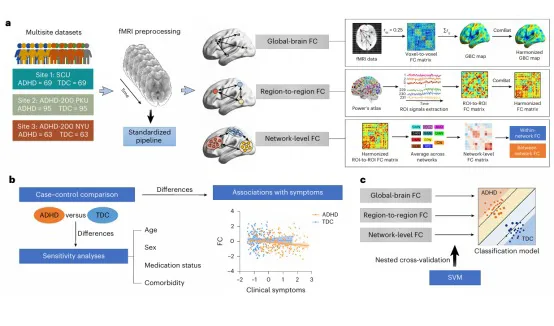
The substantive finding is the imbalance itself: default-mode and frontoparietal systems that direct attention appear to interact abnormally with auditory, visual and sensorimotor systems that process input. That offers a circuit-level account of why children with ADHD are both distractible by sensory input and poor at sustaining goal-directed attention [2][5].
What this does not license
This is a group-level statistical difference, not a diagnostic test. The overlap between groups is substantial in every imaging study of ADHD, and no connectivity measure has been validated as a clinical biomarker [2][3].
Resting-state connectivity is sensitive to medication, head motion, vigilance and comorbidity, and the matching procedures reduce but do not eliminate these effects. ADHD is clinically heterogeneous — inattentive, hyperactive and combined presentations may have different connectomic signatures, and this analysis treats them together. The findings also cannot distinguish cause from consequence: atypical connectivity could reflect compensatory adaptation rather than the primary pathophysiology [3][5].
The condition in context: ADHD
It is the commonest neurodevelopmental disorder of childhood, and diagnosis remains behavioural.
| Region | What the data shows | Source |
|---|---|---|
| Prevalence | About 7.2% globally [3][5]. | China Science Media / Chongqing [3][5] |
| Prior inconsistency | Earlier imaging results varied widely by method, sample and analytic scale [5]. | Chongqing Weiscine [5] |
| Diagnostic basis | Clinical behavioural criteria; no imaging biomarker in use [3]. | China Science Media [3] |
Because treatment works but is often delayed, a mechanistic marker that predicted response or subtype would have real clinical value — which is the direction this line of work points, without reaching it [1][3].
Why it matters
| Potential | What the report suggests | Source |
|---|---|---|
| Mechanism | A circuit account of attention and sensory distractibility [2][5]. | [2][5] |
| Method | Multiscale analysis reconciles conflicting literatures [1]. | [1] |
| Caution | Group-level difference, not a biomarker [3]. | [3] |
Availability and limits
- This is an editorial summary of a research paper, not a diagnostic test [1][2].
- No validated imaging biomarker exists for ADHD [3].
- Subtypes and medication effects are not resolved by this design [5].
- Direction of causation is unknown [2].
- Clinical care remains behavioural assessment and multimodal treatment [3].
What to ask before booking
| Question | Why it matters |
|---|---|
| Is a formal diagnostic assessment being done, not just a scan? | Diagnosis is behavioural [3]. |
| Could imaging rule out another cause of my child's symptoms? | That is its current clinical role [2]. |
| Which department handles foreign patients, and in what language? | West China Hospital is a working hospital we do not book; confirm international-department coordination and language support. |
| What non-drug and drug options are available? | Both have evidence and should be discussed [3]. |
Questions patients ask
What was found?
ADHD involves imbalanced interaction between higher-order cognitive networks and lower-order sensory networks, and the abnormalities look different depending on the spatial scale analysed [1][2].
How many participants?
454 children and adolescents aged 7–18, including 227 with ADHD and 227 matched controls, across three cohorts [2][4].
Where was it published?
Nature Mental Health, 14 October 2025 [1][2].
Can this diagnose ADHD?
No — it is a group-level research finding without clinical biomarker validation [3].
Is this relevant to international patients?
It is useful context for China's psychiatric neuroimaging. West China Hospital is a working hospital we do not book — contact its international department directly [1].