
Quick answer
Psilocybin and related compounds have been declared breakthrough therapies for severe depression, and more than 200 clinical trials are under way. But they cause hallucinations, which makes blinding impossible and raises safety concerns. The receptor they act on, 5-HT2A, was assumed to signal mainly through Gq. Shao Zhenhua, Yan Wei and Yang Shengyong at West China Hospital, with colleagues at CIAC and HUST, found the hallucinogenic effect runs through an unconventional Gi pathway instead — and used that to design a candidate antidepressant with less of it. The work appeared in Nature on 28 January 2026 [1][2][5].
Key takeaways
- Published in Nature on 28 January 2026; West China Hospital is first-author and first-corresponding institution [2][4].
- Finding: hallucinogens elicit their signature effects via 5-HT2A receptor-mediated Gi signalling [1][3].
- This contradicts the conventional view that 5-HT2A acts chiefly through Gq and beta-arrestin [5].
- The team then designed novel lead compounds with antidepressant potential and reduced hallucinogenic signalling [1][4].
- Shao Zhenhua, Yan Wei, Wang Xiaohui, Liu Jianfeng and Yang Shengyong are co-corresponding authors [4].
Why the pathway matters more than the molecule
If hallucination and antidepressant effect run through the same receptor but different downstream pathways, then separating them is a medicinal chemistry problem: design a ligand that engages the therapeutic pathway and not the hallucinogenic one. That is what this paper proposes, and it is why it is a pharmacology paper with clinical consequences rather than a clinical trial [3][5][6].
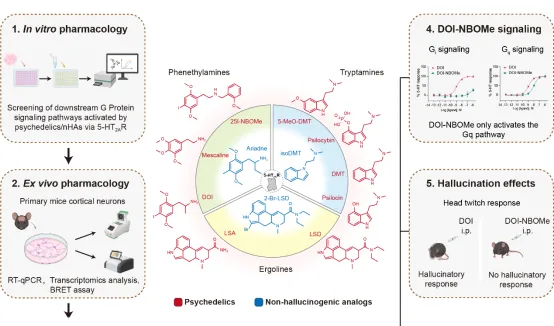
The study combined structural biology, signalling assays and behavioural pharmacology, then moved to rational design of new molecules — a full chain from mechanism to compound. The candidate compounds are described as having translational potential, not as drugs [1][4].
What would count as proof
For a patient, the relevant question is whether a non-hallucinogenic 5-HT2A agonist treats depression as effectively as psilocybin without the perceptual effects. That requires human trials with psychiatric endpoints, and none is reported here [3][5].
The behavioural evidence for "hallucination-like" effects is necessarily animal-based — head-twitch response in rodents is the standard proxy, and it does not capture human phenomenology. The claim that a compound is non-hallucinogenic cannot be fully established without human dosing. Species differences in 5-HT2A pharmacology are also substantial. The finding is a strong mechanistic advance; the therapeutic claim remains to be tested [1][5].
The condition in context: treatment-resistant depression
Depression is a leading cause of disability, and a substantial minority do not respond to available drugs.
| Region | What the data shows | Source |
|---|---|---|
| Treatment gap | First-line antidepressants have limited response rates and slow onset [4]. | West China Hospital [4] |
| Psychedelic interest | Psilocybin has FDA breakthrough designation for major depression and has driven more than 200 trials [1][5]. | iNature / Science Net [1][5] |
| Practical obstacle | Hallucination prevents blinding and complicates safety monitoring [5]. | Science Net [5] |
Because blinding is the backbone of antidepressant trial design, a non-hallucinogenic analogue would make rigorous trials possible for the first time [5].
Why it matters
| Potential | What the report suggests | Source |
|---|---|---|
| Mechanism | A new signalling route explains hallucination [1][3]. | [1][3] |
| Design | Pathway-selective compounds with antidepressant potential [4]. | [4] |
| Caution | No human data; animal proxies only [5]. | [5] |
Availability and limits
- This is an editorial summary of a research paper, not a treatment recommendation [1][2].
- The candidate compounds are preclinical [3].
- Animal behavioural proxies do not establish absence of hallucination in humans [5].
- Psychedelic-assisted therapy remains restricted and regulated in most countries [5].
- Patients should not self-source psychedelics for depression [1].
What to ask before booking
| Question | Why it matters |
|---|---|
| Have standard antidepressants been properly trialled? | Resistance is defined by adequate prior trials [4]. |
| Are any trials of this compound open? | None in humans is reported [5]. |
| Which department handles foreign patients, and in what language? | West China Hospital is a working hospital we do not book; confirm international-department coordination and language support. |
| What supervised options exist for treatment-resistant depression? | Established options should be exhausted first [4]. |
Questions patients ask
What did the study find?
Psychedelics produce their characteristic effects through 5-HT2A receptor-mediated Gi signalling, a non-canonical pathway, rather than only the classical Gq route [1][3].
Why does this matter for treatment?
If hallucination and antidepressant effect use different pathways, compounds can be designed to keep the benefit and drop the hallucination [4][5].
Where was it published?
Nature, online 28 January 2026, with West China Hospital as first-author and first-corresponding institution [2][4].
Is a drug available?
No — candidate compounds are preclinical [3].
Is this relevant to international patients?
It is useful context for China's psychiatric drug discovery. West China Hospital is a working hospital we do not book — contact its international department directly [1].