
Quick answer
Digital subtraction angiography guides most endovascular procedures — aneurysm coiling, chemoembolisation, bronchial artery infusion — and more than 100,000 patients a day worldwide are exposed to its X-rays, along with the staff standing beside them. Dose-reduction methods have been proposed for years but none had been tested prospectively in patients. Zheng Chuansheng and Kan Xuefeng at Union Hospital, Tongji Medical College, with HUST, Wuhan University and the University of Washington, ran the first randomised trial of a generative AI system called GenDSA-V2. It cut exposure by about two-thirds and was published in Nature Medicine on 2 January 2026 [1][2][6].
Key takeaways
- Published in Nature Medicine on 2 January 2026; Zheng Chuansheng, Wang Xinggang, Du Bo, Zhu Chengcheng, Kan Xuefeng and Zhao Huangxuan among the authors [2][4].
- Training data: 46,829 patients and more than five million DSA images from 70 centres [4].
- Design: multicentre randomised controlled trial of GenDSA-V2 versus conventional DSA [1][2][3].
- Result: approximately two-thirds reduction in radiation exposure for both patients and operators [4][5].
- Described as the first prospective clinical validation of any low-dose DSA technique [1][6].
Why this is an AI problem rather than a hardware problem
Lowering the X-ray dose means fewer photons, which means a noisier image. Classical fixes — sparse-view reconstruction, denoising, frame interpolation — were all tried in silico but never validated in the angiography suite, where a misread vessel can mean a missed aneurysm or a non-target embolisation. Generative models attack the problem differently: they learn what a fully-dosed angiogram of that anatomy should look like and reconstruct it from the low-dose acquisition [1][6].
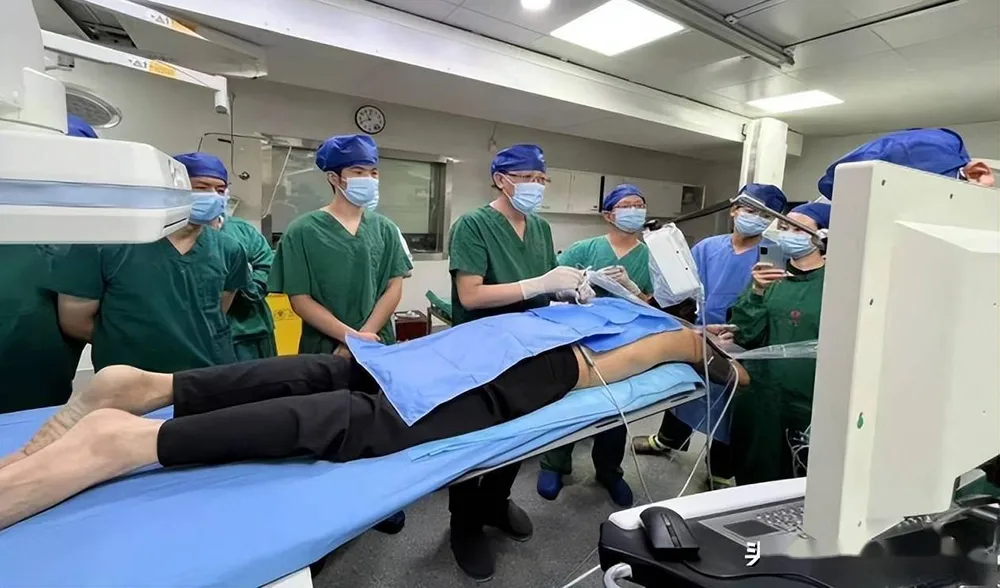
The clinical argument for reducing dose is cumulative rather than acute. Interventional cardiologists and radiologists accumulate occupational exposure over decades, and the INWORKS cohort of nuclear workers showed excess cancer mortality even at low doses. For patients, complex procedures involve minutes of continuous fluoroscopy [1].
What a randomised trial adds
Most medical AI papers report retrospective accuracy against a reference standard. This one randomised procedures, which addresses the question that matters: does the reconstructed image hold up when a clinician is actually treating a patient? That is a higher bar, and it is why the result has attracted attention beyond radiology [2][4].
The trial's primary endpoint is radiation dose, not clinical outcome — which is appropriate for a device study but means it does not show fewer cancers or longer lives. Reader studies can only partly exclude the possibility that a subtly degraded image leads to a rare but consequential error, and those events are too infrequent to detect in any feasible trial. Deployment also requires the reconstruction to run in real time on the angiography workstation, which ties the software to specific hardware vendors [5][6].
The condition in context: interventional imaging
DSA is the backbone of minimally invasive vascular treatment, and its radiation burden is occupational as well as clinical.
| Region | What the data shows | Source |
|---|---|---|
| Volume | More than 100,000 patients a day undergo DSA-guided procedures worldwide [1][6]. | AI analysis commentary [1][6] |
| Occupational risk | INWORKS showed excess cancer mortality at low cumulative doses [1]. | AI analysis commentary [1] |
| Prior attempts | Low-dose reconstruction methods existed but none had prospective clinical validation [1][6]. | AI analysis commentary [1][6] |
Because dose reduction multiplies across every procedure a patient or operator undergoes, a two-thirds cut compounds into a large cumulative benefit [4].
Why it matters
| Potential | What the report suggests | Source |
|---|---|---|
| Patient dose | About two-thirds lower exposure per procedure [4][5]. | [4][5] |
| Staff dose | The same reduction applies to the operator [1]. | [1] |
| Caution | Endpoint is dose, not clinical outcome [2]. | [2] |
Availability and limits
- This is an editorial summary of the publication, not a clinical recommendation [1][2].
- Requires compatible angiography hardware and real-time reconstruction [5].
- No clinical-outcome or cancer-risk endpoint [2].
- Image-quality assessment cannot exclude very rare errors [6].
- Cost and vendor availability determine access [5].
What to ask before booking
| Question | Why it matters |
|---|---|
| Does this hospital use low-dose DSA reconstruction? | It is the practical route to lower exposure [5]. |
| What is my estimated cumulative dose from this procedure? | Repeat interventions accumulate [1]. |
| Which department handles foreign patients, and in what language? | Union Hospital is a working hospital we do not book; confirm international-department coordination and language support. |
| Is the reconstructed image reviewed by the operator in real time? | Safety depends on intraprocedural verification [6]. |
Questions patients ask
What was tested?
GenDSA-V2, a generative AI system that reconstructs low-dose digital subtraction angiography, in a multicentre randomised controlled trial [1][2].
What was the result?
Radiation exposure to patients and staff fell by about two-thirds [4].
Why is the trial notable?
It is described as the first prospective clinical validation of any low-dose DSA technique [1][6].
Does it improve outcomes?
Not shown — the primary endpoint is radiation dose, not clinical events [2].
Is this relevant to international patients?
It is useful context for China's medical imaging AI. Union Hospital is a working hospital we do not book — contact its international department directly [1].