
Quick answer
Glaucoma is the world's leading cause of irreversible blindness, affecting about 80 million people, and treatment is a lifetime of drops and surgery that slows but does not stop the disease. In a minority of patients the cause is a single gene: MYOC mutations account for roughly 30% of juvenile glaucoma, with early onset and rapid progression. Wang Ningli's team at Beijing Tongren Hospital, with Shanghai Jiao Tong University and a gene-therapy company, developed BD113 — CRISPR/Cas9 delivered by virus-like particles to edit MYOC in the trabecular meshwork — and dosed the first two patients in August and November 2024 [1][2][5].
Key takeaways
- Target: MYOC mutation, which causes about 30% of juvenile open-angle glaucoma [1].
- Delivery: virus-like particles (VLP) carrying CRISPR/Cas9, giving transient editing enzyme expression rather than sustained expression [1][3].
- Route: intracameral injection, giving access to the trabecular meshwork [3].
- Dosing: first patient 28 August 2024, second 27 November 2024 [5].
- Follow-up: more than seven and four months respectively by April 2025, with no related serious adverse events [2][5].
Why transient editing is the point
Permanent expression of Cas9 from a viral vector is a safety liability: the longer the nuclease is active, the more chances it has to cut unintended sites. Virus-like particles deliver the editing machinery as protein and RNA, which is degraded within days. The edit is permanent because the genome is permanently changed, but the editor is not [1][3].
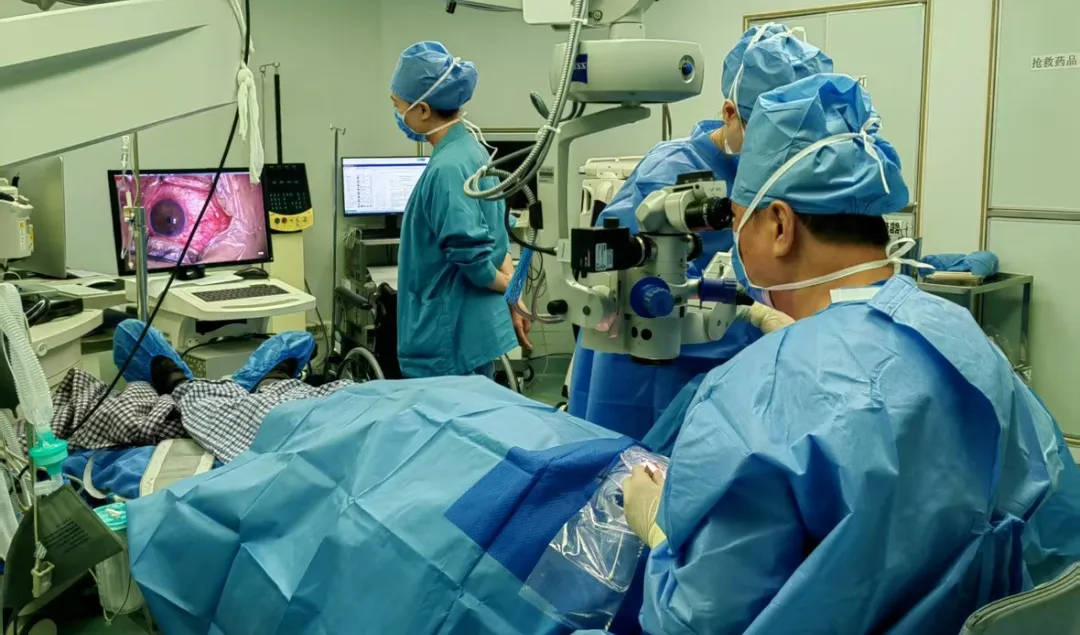
The anatomical logic is favourable: the trabecular meshwork is directly accessible by intracameral injection, and it is the tissue that controls aqueous outflow. Editing the mutant MYOC there addresses the mechanism rather than the pressure it produces [1][2].
Two patients is a safety signal, not an efficacy result
The reported safety profile is genuinely encouraging: no related serious adverse events, with transient intraocular pressure rise and transient anterior segment inflammation after injection, both resolving with treatment [3][5].
Both patients reportedly came off pressure-lowering medication with normal intraocular pressure, and one who was completely blind reported being able to distinguish day from night. These are striking observations, but with two patients and no control arm they cannot separate treatment effect from the natural history of a fluctuating disease or from the effect of stopping medications. Off-target editing, immune responses to the VLP, and durability beyond a year are the questions that will decide whether this becomes a therapy. Regulatory approval is years away at best [2][5].
The condition in context: glaucoma
It is common, asymptomatic until late, and the resulting vision loss is permanent.
| Region | What the data shows | Source |
|---|---|---|
| Burden | About 80 million people worldwide; the leading cause of irreversible blindness [1]. | Physician's Weekly ophthalmology [1] |
| Subtype | Primary open-angle glaucoma is about 74% of cases [1]. | Physician's Weekly ophthalmology [1] |
| Genetic subset | MYOC mutations cause about 30% of juvenile glaucoma, with early onset and high blindness risk [1]. | Physician's Weekly ophthalmology [1] |
Because the genetic subset is small, a gene therapy would help a defined minority — but for those patients it targets cause rather than consequence [2][5].
Why it matters
| Potential | What the report suggests | Source |
|---|---|---|
| First in class | Described as the first gene-editing therapy for glaucoma to reach patients [1][5]. | [1][5] |
| Safety platform | Transient editing limits off-target exposure [3]. | [3] |
| Caution | Two patients; no control group [2]. | [2] |
Availability and limits
- This is an editorial summary of trial reporting, not a treatment offer [1][2].
- Two patients dosed; the study is ongoing and not published in full [2].
- Applies only to confirmed MYOC-mutant glaucoma, which requires genetic testing to establish [1][6].
- Long-term durability and off-target effects are unknown [5].
- Standard pressure-lowering treatment remains essential for all other patients, and the study's regulatory path is years from completion [1][4].
What to ask before booking
| Question | Why it matters |
|---|---|
| Has genetic testing confirmed a MYOC mutation? | The therapy is specific to that cause [1]. |
| Is this available outside the study? | No — it is an ongoing clinical study [2]. |
| Which department handles foreign patients, and in what language? | Tongren is a working hospital we do not book; confirm international-department coordination and language support. |
| What is my current pressure control, and am I losing field? | Established treatment prevents progression now [1]. |
Questions patients ask
What was done?
Two patients with MYOC-mutant glaucoma received BD113, a CRISPR/Cas9 therapy delivered by virus-like particles into the anterior chamber, in August and November 2024 [2][5].
Is it safe?
No related serious adverse events were reported at seven and four months; transient pressure rise and anterior inflammation occurred and resolved [3][5].
Does it work?
Both patients came off pressure-lowering drops with normal pressure, but two open-label patients cannot establish efficacy [2].
Who could it help?
Only patients with confirmed MYOC-mutant glaucoma, a small subset of the disease [1].
Is this relevant to international patients?
It is useful context for China's ocular gene therapy. Tongren is a working hospital we do not book — contact its international department directly [1].