
Quick answer
Diabetic retinopathy and glaucoma are treatable if found early and blinding if found late, but screening requires a fundus camera and someone who can read the images — neither of which is routine in Chinese primary care. A portable AI fundus camera developed by Wei Wenbin's team at Beijing Tongren Hospital compresses that pathway into three minutes and one device. It has been deployed in four Beijing districts and has served more than four million people [1][2][5].
Key takeaways
- Developed by Wei Wenbin, vice president of Tongren Hospital, with a retinal-imaging AI company [1][2].
- Deployed in primary care and health-check institutions across four Beijing districts [1].
- More than four million person-times served to date [1][2].
- A complete scan, assessment and report takes about three minutes, with reported accuracy of 95% [3][5].
- Beyond eye disease, the report estimates risk for ten systemic chronic conditions including cardiovascular and metabolic disease [1][5].
Why the retina is a screening window
The retina is the only place in the body where blood vessels and nerve tissue can be seen directly. Changes there — microaneurysms, haemorrhages, cotton-wool spots, altered vessel calibre, a widened cup-to-disc ratio — track with diabetes, hypertension and atherosclerosis. The model was trained on about 30 million standardised fundus images, each annotated and reviewed twice by clinicians [3][5].
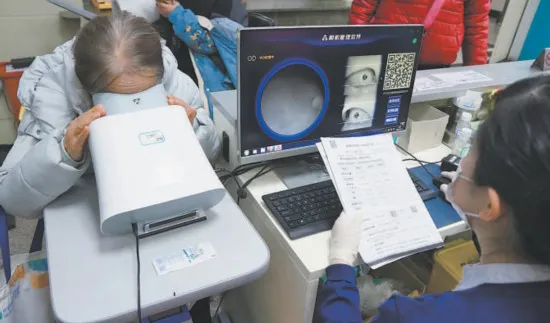
The practical gain is throughput. Manual reading takes five to ten minutes per image; the model reads in about five seconds, which is what makes population-scale screening feasible at a community health centre [5].
Where it has travelled
The device was shown at the World Health Assembly in Geneva in May 2026, where a Tongren system using a single fundus photograph was described as screening for 35 blinding eye diseases within two minutes. Peru's health ministry sent a procurement enquiry afterwards — an early signal of export interest [4].
Screening four million people is a genuine public-health result, and it required solving logistics — device portability, connectivity, reporting and follow-up — not just model training. But "95% accuracy" is a single number covering several different tasks, and sensitivity and specificity for each disease matter more than an aggregate. The sources do not report how many screen-positive patients actually attended referral, which is the step where screening programmes usually fail [2][3].
The condition in context: diabetic retinopathy
China has the largest diabetic population in the world, and retinopathy is a leading cause of working-age blindness.
| Region | What the data shows | Source |
|---|---|---|
| Screening gap | Specialist and equipment shortages in primary care leave most patients unscreened [2]. | People's Daily [2] |
| Timing | Early changes are asymptomatic but treatable; late disease is not [1]. | People's Daily [1] |
| Policy | National eye health planning calls for earlier detection of retinopathy and hypertensive fundus disease [3]. | Beijing science centre [3] |
Because retinopathy screening also flags uncontrolled diabetes and hypertension, it doubles as chronic disease surveillance [1][5].
Why it matters
| For the patient | What the report suggests | Source |
|---|---|---|
| Access | Screening at a community centre instead of a hospital [2]. | [2] |
| Speed | Three minutes to a report [3][5]. | [3][5] |
| Caution | AI flags risk; it does not replace an ophthalmologist's diagnosis [4]. | [4] |
Availability and limits
- This is an editorial summary of hospital and press reports, not a treatment offer [1][2].
- Deployment so far is concentrated in Beijing districts [1].
- Aggregate accuracy figures are not disease-specific [3].
- Referral completion after a positive screen is not reported [2].
- Images of poor quality can produce confident errors; operator training matters [5].
What to ask before booking
| Question | Why it matters |
|---|---|
| If the screen is positive, what happens next? | Referral is where screening succeeds or fails [2]. |
| Which diseases does the report actually grade? | Aggregate accuracy hides per-disease performance [3]. |
| Which department handles foreign patients, and in what language? | Tongren is a working hospital we do not book; confirm international-department coordination and language support. |
| Are images reviewed by a specialist as well? | AI is a triage tool, not a diagnosis [4]. |
Questions patients ask
What was developed?
A portable AI fundus camera by Wei Wenbin's team at Beijing Tongren Hospital, which completes imaging, assessment and reporting in about three minutes [1][2].
How widely is it used?
In four Beijing districts' primary care and health-check institutions, having served more than four million person-times [1].
What can it detect?
Blinding eye diseases such as diabetic retinopathy and glaucoma, plus estimated risk for ten systemic chronic conditions [1][5].
How accurate is it?
Reported at 95%, trained on roughly 30 million annotated images; disease-specific sensitivity and specificity are not given in the sources [3][5].
Is this relevant to international patients?
It is useful context for China's AI screening. Tongren is a working hospital we do not book — contact its international department directly [1].