
Quick answer
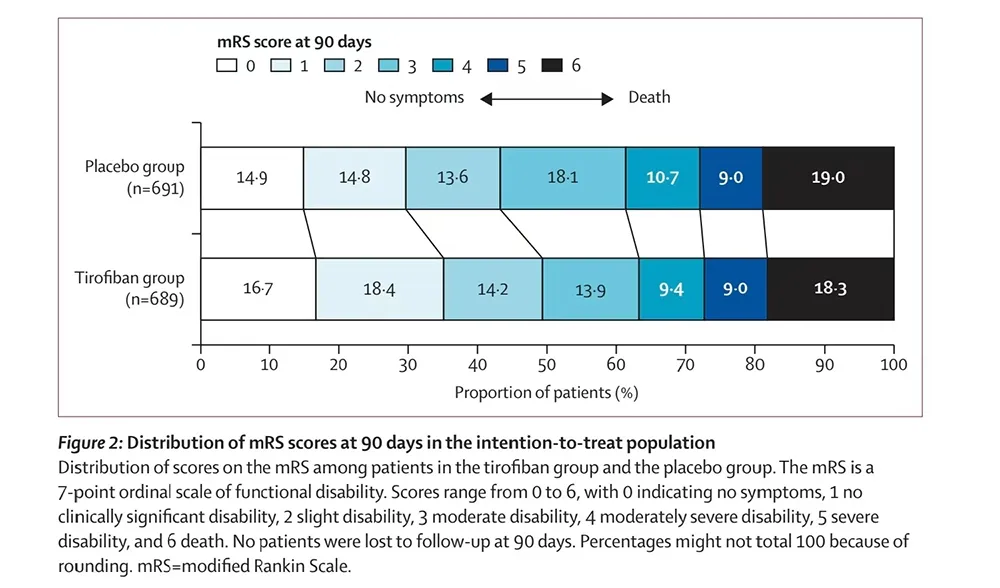
Mechanical thrombectomy opens the blocked artery in large-vessel stroke, but about half of patients still do badly — a paradox called "futile recanalisation". ATTRACTION, led by Tongji Hospital across 82 Chinese centres, tested whether adding tirofiban after successful recanalisation helps. The answer, published in The Lancet [1][2][5], was yes: 90-day functional independence rose by 6.1 percentage points, without a statistically significant increase in symptomatic brain haemorrhage [1][2][3].
Key takeaways
- Multicentre, double-blind, randomised, placebo-controlled trial at 82 Chinese stroke centres [1].
- Population: acute anterior-circulation large-vessel occlusion with successful recanalisation (mTICI 2b–3) after thrombectomy [1].
- Intervention: intra-arterial bolus followed by 24 hours of intravenous tirofiban [1][4].
- Primary outcome: 90-day functional independence (mRS 0–2) [4].
- Result: 49% versus placebo, a 6.1-point absolute increase; symptomatic intracranial haemorrhage not significantly increased [1][3].
The problem
Thrombectomy has transformed large-vessel stroke, but restoring flow in the main artery does not guarantee that the tissue downstream survives. Distal microemboli, microcirculatory failure, platelet activation, endothelial injury, re-occlusion and reperfusion injury all contribute. Roughly 50% of patients are not functionally independent at 90 days despite a technically successful procedure [1][3]. That gap is what the trial set out to close, and why its organisers enrolled only patients whose vessels had actually reopened [5].
Earlier tirofiban studies in thrombectomy gave inconsistent results — mostly pre-procedural intravenous dosing, single centres or small samples. ATTRACTION targeted the post-recanalisation window specifically, with a large, blinded design [2][4].
What the trial found
The absolute 6.1-point gain in functional independence is clinically meaningful at the population level, and the absence of a significant haemorrhage increase addresses the main safety worry about giving an antiplatelet agent immediately after brain reperfusion. The result was presented as a late-breaker at the European Stroke Organisation conference in May 2026 and drew a Lancet commentary from Diederik Dippel, who called it a well-aimed answer in a field where periprocedural antithrombotic trials had repeatedly failed [1][2].
The trial enrolled only patients with successful recanalisation, so it says nothing about tirofiban when flow is not restored. A 6.1-point gain leaves half of patients still dependent, and the bleeding comparison was powered for the primary endpoint, not for safety subgroups. Whether the benefit holds across stroke causes — cardioembolic versus atherosclerotic — needs the subgroup analyses [2][3].
The condition in context: ischaemic stroke
Stroke is a leading cause of death and disability worldwide, and large-vessel occlusion is its most severe form.
| Region | What the data shows | Source |
|---|---|---|
| Outcomes | About 50% of patients have poor outcomes despite successful recanalisation [1]. | Tongji Hospital [1] |
| Disability | Up to 60% are not functionally independent at 90 days even with mTICI 2b–3 reperfusion [4]. | The Paper [4] |
| China | The trial ran across 82 Chinese stroke centres, the largest such network for this question [1][2]. | Tongji / Xinhua [1][2] |
Because thrombectomy is now standard, the marginal gains are in protecting the microcirculation after the big vessel opens [1].
Why it matters
| Potential | What the report suggests | Source |
|---|---|---|
| Function | 6.1 more patients per 100 become independent at 90 days [1][3]. | [1][3] |
| Safety | No significant rise in symptomatic intracranial haemorrhage [1]. | [1] |
| Caution | Applies only after successful recanalisation; half still disabled [2]. | [2] |
Availability and limits
- This is an editorial summary of the publication and hospital reports, not a treatment protocol [1][2].
- Eligibility requires successful recanalisation after thrombectomy [1].
- Tirofiban is an antiplatelet agent and carries bleeding risk in other contexts [4].
- Subgroup effects by stroke cause are still being analysed [3].
- Guideline adoption will take time and further validation [2].
What to ask before booking
| Question | Why it matters |
|---|---|
| Was reperfusion successful, and how completely? | The trial applies only to mTICI 2b–3 [1]. |
| Is adjuvant tirofiban part of the local protocol? | Adoption varies by centre and guideline [2]. |
| Which department handles foreign patients, and in what language? | Tongji Hospital is a working hospital we do not book; confirm international-department coordination and language support. |
| How is post-thrombectomy monitoring arranged? | Haemorrhage surveillance is essential after reperfusion [1]. |
Questions patients ask
What is ATTRACTION?
A multicentre, double-blind, randomised, placebo-controlled trial of adjuvant tirofiban after successful thrombectomy in acute anterior-circulation large-vessel occlusion, led by Tongji Hospital across 82 Chinese centres [1][2].
What were the results?
90-day functional independence rose to 49%, a 6.1 percentage-point increase over placebo, without a significant increase in symptomatic intracranial haemorrhage [1][3].
What is futile recanalisation?
Successful reopening of the large artery without functional recovery, seen in about half of thrombectomy patients, driven by microcirculatory and reperfusion injury [1].
Where was it published?
The Lancet, online 24–25 June 2026, with an accompanying commentary [1][2].
Is this relevant to international patients?
It is useful context for China's stroke care. Tongji Hospital is a working hospital we do not book — contact its international department directly [1].