
Quick answer
Brain-computer interfaces face a trade-off: electrodes inside the cortex give the best signal but damage tissue, while electrodes on the scalp are safe but noisy. Beinao-1 takes the middle route — a flexible electrode array placed on the dura, the membrane covering the brain, through a small skull window, without opening the dura or touching cortex. It has 128 channels sampling at 30 kHz, decodes movement intention in under 100 ms, and has been implanted in seven patients. On 13 April 2026, Beijing Tiantan Hospital broadcast an implantation live nationwide [1][2][4].
Key takeaways
- Developed by the Beijing Institute for Brain Science with Xinzhi Da Neural Technology [1][4].
- Semi-invasive: epidural placement through a minimal bone window, no dural opening [2][5].
- 128-channel synchronous acquisition, 30 kHz sampling, decode latency under 100 ms [2][5].
- Coin-sized implant with wireless transmission and wireless charging, no percutaneous leads [2][5].
- Seven human implantations completed; recipients include spinal cord injury, stroke and ALS patients [1].
Why epidural
Penetrating arrays record individual neurons but provoke glial scarring that degrades signal over years. Scalp EEG is safe but cannot resolve fine motor intent. An epidural array sits between them: close enough to record population activity with good signal-to-noise, far enough that it does not enter brain tissue. The company describes this as the best available balance between safety and signal quality [4][5].
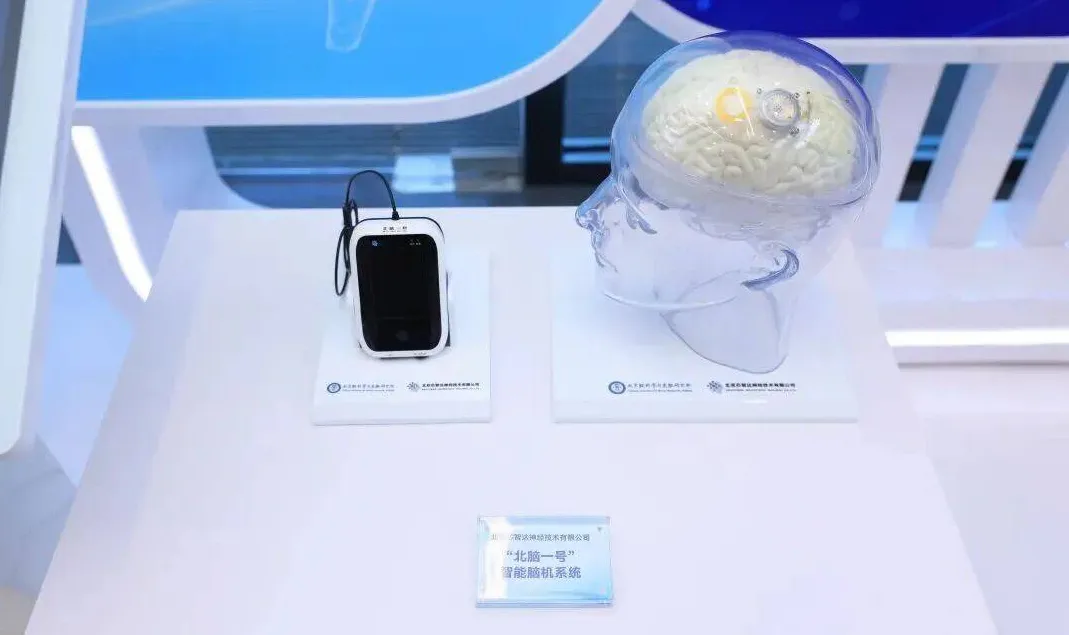
Wireless power and data matter more than they sound. Percutaneous wires are the main route of infection in implanted neurodevices, and removing them allows patients to leave hospital and train at home — which is what makes months of rehabilitation feasible [2][5].
The live broadcast case
The patient was a young man who had been quadriplegic for two and a half years after an electric-bike accident. The implant was placed over the hand motor area, and training with the device was scheduled to begin two weeks after surgery. The operation was streamed in 4K to several hundred specialists at a national BCI conference, with commentary on approach, electrode positioning and intraoperative signal verification [2][4].
Seven patients across several conditions demonstrates that the device can be implanted and used, and the live broadcast demonstrates a standardised procedure. It does not establish how much function is regained, for how long, or in which patients. Those questions need prospective cohorts with validated outcomes, and the field has a history of dramatic videos accompanied by modest measured gains [1][3].
The condition in context: paralysis and BCI
Spinal cord injury and brainstem stroke leave patients with intact intention and no motor output — the exact problem a BCI addresses.
| Region | What the data shows | Source |
|---|---|---|
| Ambition | Restoring walking and speech are the stated goals [3]. | CCTV [3] |
| Policy | BCI was written into the Government Work Report and the 15th Five-Year Plan [3]. | CCTV [3] |
| Recognition | Listed among 21 major achievements at the 2026 Zhongguancun Forum [1]. | Tiantan Hospital [1] |
Because BCI is a national research priority, the pace of Chinese clinical work in this area is likely to stay high [3].
Why it matters
| Potential | What the report suggests | Source |
|---|---|---|
| Safety | No dural opening, no cortical penetration [2][4]. | [2][4] |
| Home use | Wireless charging enables training outside hospital [5]. | [5] |
| Caution | Feasibility data, not efficacy data [1]. | [1] |
Availability and limits
- This is an editorial summary of hospital and press reports, not a treatment offer [1][2].
- The device is in clinical trials; it is not routine care [4].
- Eligibility requires intact cortical function and a suitable skull window [2].
- Outcome measures across the seven cases are not published in the sources reviewed [1].
- Rehabilitation commitment is substantial and essential [5].
What to ask before booking
| Question | Why it matters |
|---|---|
| Is my cortical motor area intact? | Epidural recording needs viable cortex beneath [2]. |
| Is a trial enrolling, and what follow-up is required? | Only research participation is possible now [4]. |
| Which department handles foreign patients, and in what language? | Tiantan is a working hospital we do not book; confirm international-department coordination and language support. |
| What function is realistically achievable? | Published trials report assistive rather than restorative gains [1]. |
Questions patients ask
What is Beinao-1?
A semi-invasive, 128-channel wireless brain-computer interface implanted on the dura through a small skull window, developed by the Beijing Institute for Brain Science and Xinzhi Da [1][4].
How many patients?
Seven implantations have been completed, including patients with spinal cord injury, stroke and ALS [1].
What happened on 13 April 2026?
Tiantan Hospital performed the first nationally broadcast BCI implantation, in a young man with quadriplegia after an accident [2][4].
Why semi-invasive?
It avoids opening the dura or penetrating cortex while recording better signals than scalp EEG [4][5].
Is this relevant to international patients?
It is useful context for China's BCI programmes. Tiantan is a working hospital we do not book — contact its international department directly [1].