
Quick answer
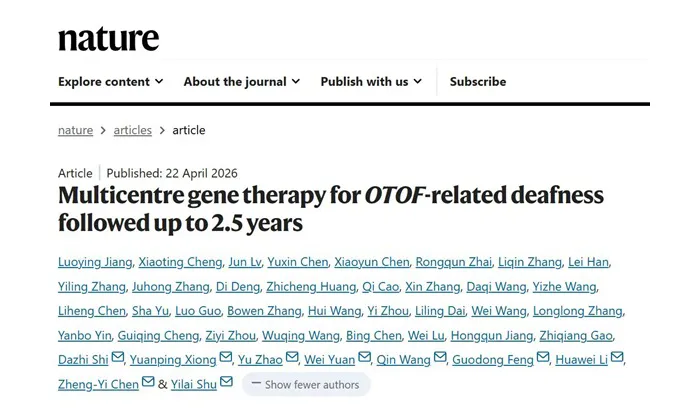
Gene therapy for inherited deafness moved from concept to clinical evidence in a single trial: 42 patients with OTOF-related DFNB9 deafness, aged 9 months to 32 years, treated across eight Chinese centres and followed for up to 2.5 years. 90% recovered clinically meaningful hearing. The Second Xiangya Hospital of Central South University was one of the participating centres, and its ENT director Wang Qin is a co-corresponding author of the Nature paper published on 22 April 2026 [1][2][4].
Key takeaways
- Wang Qin, director of otorhinolaryngology-head and neck surgery at Second Xiangya, is a co-corresponding author [1][3].
- Shu Yilai, a distinguished professor at the hospital and of Fudan's ENT Hospital, is also a co-corresponding author [1].
- Eight centres enrolled 42 patients aged 0.8 to 32 years, followed up to 2.5 years [2][3].
- 90% recovered hearing; ABR thresholds improved from above 97 dB nHL to 42 dB nHL [4].
- Response by age: 100% at 0.5–3 years, 92% at 3–8 years, 60% at 8–18 years [1][2].
What the hospital contributed
Second Xiangya's role sits in the middle of the translation chain. The hospital's ENT department recruited and assessed patients, performed the surgical delivery of the vector into the inner ear, and carried out the audiological follow-up that generates the outcome data — pure-tone audiometry, auditory brainstem response and speech perception testing over years [1][3].
The paper's authors also note a practical detail that matters for replication: delivering a dual-AAV vector through the round window is a specialised procedure requiring both otological surgery and gene-therapy handling, which is why the trial was restricted to centres with both [1][4][5].
The numbers that matter
The headline result is 90% hearing recovery, but the trajectory is more informative. At two years, all patients who completed follow-up heard everyday conversation, 80% could identify library-level soft sounds and 60% could hear whispers; by 2.5 years the figures were 57% and 43% for the last two categories, reflecting both fuller follow-up and the fact that later-treated patients were older [1][2].
DFNB9 is a single genetic form of deafness; these results do not extend to other causes. The trial was single-arm, so the comparison is with natural history rather than a control group. Long-term durability beyond 2.5 years, and the consequences of any immune response to the vector, remain open. Second Xiangya's contribution is clinical execution within a multicentre design, not an independent finding [1][3][4].
The condition in context: congenital deafness
Hearing loss is the commonest sensory deficit at birth, and genetic causes account for most cases.
| Region | What the data shows | Source |
|---|---|---|
| Global | More than 430 million people have disabling hearing loss, including about 34 million children [1]. | Second Xiangya [1] |
| Congenital | About 26 million people have congenital deafness, with genetic causes in up to 60% [1]. | Second Xiangya [1] |
| China | About 30,000 children with hearing loss are born each year [1][2]. | Second Xiangya / Hunan Daily [1][2] |
Because DFNB9 accounts for a minority of cases, the trial is a proof of principle for gene therapy in the ear rather than a solution to congenital deafness overall [1][4].
Why it matters
| Potential | What the report suggests | Source |
|---|---|---|
| Timing | Treatment before age three was uniformly successful [1][2]. | [1][2] |
| Prediction | Baseline DPOAE predicts who will respond [1]. | [1] |
| Caution | Single-arm, single subtype, 2.5 years of data [3]. | [3] |
Availability and limits
- This is an editorial summary of the publication and hospital reports, not a treatment offer [1][2].
- The therapy is investigational [3].
- Eligibility requires confirmed OTOF mutation and suitable inner-ear anatomy [1].
- Only centres with both otological surgery and gene-therapy capability can deliver it [4].
- Long-term safety and durability are still being followed [3].
What to ask before booking
| Question | Why it matters |
|---|---|
| Has genetic testing confirmed DFNB9? | Other forms of deafness do not respond [1]. |
| How old is the child? | Age at treatment is the strongest predictor [1][2]. |
| Which department handles foreign patients, and in what language? | Second Xiangya is a working hospital we do not book; confirm international-department coordination and language support. |
| What auditory rehabilitation follows? | Hearing recovery still needs training and support [1]. |
Questions patients ask
What was the study?
A multicentre trial of AAV-hOTOF gene therapy in 42 patients with OTOF-related DFNB9 deafness across eight Chinese centres, followed up to 2.5 years, published in Nature on 22 April 2026 [1][3][4].
What was Second Xiangya's role?
It was a participating centre, with ENT director Wang Qin as a co-corresponding author alongside Shu Yilai, Li Huawei and others [1][3].
What were the results?
90% recovered clinically meaningful hearing; ABR thresholds improved from above 97 dB nHL to 42 dB nHL at 2.5 years [4].
Who responds best?
Children treated before age three (100% response), and those with baseline DPOAE responses [1][2].
Is this relevant to international patients?
It is useful context for China's gene therapy for hearing. Second Xiangya is a working hospital we do not book — contact its international department directly [1].