
Quick answer
Artificial liver support removes toxins but does not synthesise protein or make bile — it is a filter, not a liver. In February 2026, a team led by Dou Kefeng of Xijing Hospital with He Xiaoshun of Sun Yat-sen University's First Affiliated Hospital did something different: they connected a patient in acute-on-chronic liver failure to a six-gene-edited pig liver kept alive outside his body. The pig liver worked for 66 hours, producing 300–350 mL of bile a day, while the patient's own liver was left in place to rest and recover [1][2][4].
Key takeaways
- Described as the world's first extracorporeal perfusion with a six-gene-edited pig liver in a patient [1][2].
- Duration: 66 hours of continuous treatment [2][4].
- The patient's own liver was left in place — "swap function, not the organ" [1][3].
- Bilirubin and transaminases fell progressively and coagulation recovered; the pig liver produced 300–350 mL bile daily [4].
- Pig livers came from Zhongke Aoge's six-gene-edited donor herd [2].
Why outside rather than inside
Transplanting a pig liver into a human is the more ambitious goal, but it carries the full weight of xenogeneic rejection, immunosuppression and biosafety risk. Perfusing the organ outside the body avoids all three: there is no graft to reject, the circuit can be stopped when the crisis passes, and the patient's own liver — which may recover if given time — is never removed [1][3].
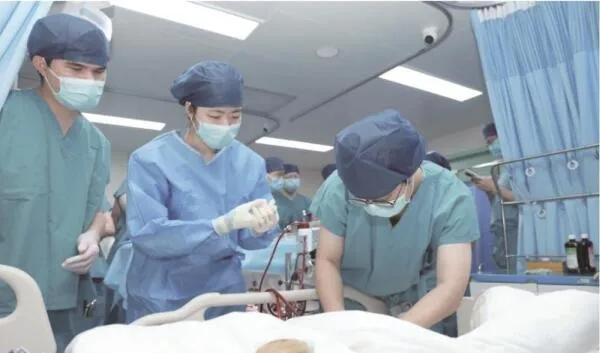
The enabling technology is organ preservation. He's team developed "ischaemia-free" organ maintenance, which keeps an isolated organ in a near-physiological state with closed-loop control of temperature, pressure and oxygenation. Without it, an explanted pig liver loses function within hours and cannot serve as a bridge [1][3].
What was observed
The patient had chronic hepatitis B with alcohol-related injury and developed acute-on-chronic liver failure, with no human donor liver available in time. Over 66 hours of perfusion his key liver indices improved and his coagulopathy corrected, and the pig liver was monitored continuously and functioned throughout [2][4].
A single case cannot establish efficacy, and the report does not say whether the patient ultimately recovered without transplant, was bridged to a human graft, or died later. The immunological consequences of repeated exposure to porcine endothelium — even across a membrane-free circuit — are not trivial, and porcine endogenous retrovirus transmission remains a theoretical concern that requires structured surveillance. The team's own framing is a bridge or a recovery aid, not a destination [1][3][4].
The condition in context: liver failure
Acute and acute-on-chronic liver failure are common in China and carry high short-term mortality.
| Region | What the data shows | Source |
|---|---|---|
| China | About 200,000 patients are hospitalised each year with acute or acute-on-chronic liver failure [5]. | Southern Rural Daily [5] |
| Donor shortage | Human donor livers are scarce and timing-dependent, so many patients deteriorate while waiting [1]. | Guangming Net [1] |
| Artificial support | Plasma exchange and adsorption replace filtration but not synthesis [5]. | Southern Rural Daily [5] |
Because a failing liver can regenerate if the insult is controlled, temporary functional support has a genuine therapeutic rationale, not just a bridging one [3].
Why it matters
| Potential | What the report suggests | Source |
|---|---|---|
| Full liver function | Synthesis and bile production, not just detoxification [4]. | [4] |
| Reversible | The circuit can be stopped; no graft remains [1][3]. | [1][3] |
| Caution | Single case; immunological and infection questions remain [2]. | [2] |
Availability and limits
- This is an editorial summary of hospital and press reports, not a treatment offer [1][2].
- It was performed under research protocols with ethics review and consent [2].
- It requires gene-edited donor pigs, organ maintenance equipment and a specialist team [1][5].
- Long-term outcomes and infection surveillance data are not yet published [4].
- Human donor transplantation remains the definitive treatment [5].
What to ask before booking
| Question | Why it matters |
|---|---|
| Is my liver failure potentially reversible with support? | The strategy depends on the native liver recovering [3]. |
| Is this available only within a research protocol? | Yes — it is not standard care [2]. |
| Which department handles foreign patients, and in what language? | The hospital is a working hospital we do not book; confirm international-department coordination and language support. |
| What xenogeneic infection surveillance is in place? | Porcine retrovirus monitoring is a core safety requirement [4]. |
Questions patients ask
What was done?
A six-gene-edited pig liver was perfused outside a patient with acute-on-chronic liver failure for 66 hours, taking over detoxification, synthesis and bile production while his own liver rested [1][2].
Who led the work?
Dou Kefeng's team at Xijing Hospital with He Xiaoshun's team at Sun Yat-sen University's First Affiliated Hospital [1][2].
Why not transplant the pig liver?
Extracorporeal perfusion avoids graft rejection and immunosuppression, and can be stopped once the crisis passes [1][3].
Did the patient recover?
Liver indices and coagulation improved during perfusion; long-term outcome is not reported in the sources reviewed [4].
Is this relevant to international patients?
It is useful context for China's organ-support research. The hospital is a working hospital we do not book — contact its international department directly [1].