
Quick answer
On 26 August 2026, the First Affiliated Hospital of Sun Yat-sen University (SYSU) opened Guangdong's first standardized hypertrophic cardiomyopathy (HCM) specialty clinic, as part of the national "cardiomyopathy excellence centre — Xinshu Huaxia" programme. Built on the hospital's cardiomyopathy and rare cardiovascular disease centre and its multidisciplinary team, it creates a screen–diagnose–treat–manage pathway from early screening to long-term follow-up [1][2].
Key takeaways
- HCM is a serious inherited heart disease and a common cause of sudden cardiac death in adolescents and athletes — often called a "hidden killer" because early symptoms are nonspecific [2][3].
- About two-thirds of HCM patients have obstructive HCM, which carries worse heart function and roughly double the mortality of non-obstructive HCM [3].
- The clinic gives a fast-track workup: same-day echocardiogram and ECG, and key tests such as cardiac MRI within one to two days [4].
- A multidisciplinary team (cardiology, ultrasound, imaging) provides a combined diagnosis, reducing repeated visits and diagnostic delay [4].
- Treatment targets the left-ventricular outflow-tract pressure gradient, not just symptom relief, because a higher gradient raises the risk of death and transplant [4].
The problem and the clinic's approach
HCM thickens the heart muscle, impairing filling and, in obstructive forms, blocking blood flow out of the left ventricle. Its early symptoms — exertional chest tightness, breathlessness, palpitations, fatigue, or blackouts and fainting during exertion — are easily mistaken for ordinary tiredness, so patients are often missed until a syncope or sudden death event [2][3].
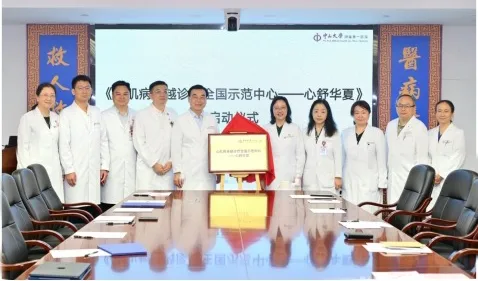
Led by the cardiomyopathy and rare cardiovascular disease centre under director Chen Yili, the clinic coordinates testing so that visiting patients can complete echocardiography and ECG the same day and cardiac MRI within one to two days, then receive a multidisciplinary diagnosis. A dedicated follow-up team keeps standardized records and tracks cardiac function and the outflow gradient [4].
What was reported
The launch is part of a national programme, guided by the National Health Commission's China Population and Development Research Centre — Healthy China Research Centre and initiated by Xinhua, that has expanded from central, southwest and northeast China to South China. SYSU's hospital, a national medical centre, is also tasked with training grassroots doctors and building referral links across the region [2].
This is a new standardized clinic and pathway, not a clinical trial. Its value lies in earlier detection, faster diagnosis and structured long-term management; whether it improves hard outcomes such as sudden death and transplant rates will need data over time [1][4].
The condition in context: hypertrophic cardiomyopathy
HCM is one of the most common inherited heart muscle diseases and a leading cause of sudden death in young people.
| Region | What the data shows | Source |
|---|---|---|
| Worldwide | HCM affects roughly 1 in 500 people, often undiagnosed [5]. | MedlinePlus Genetics (NIH) [5] |
| Subtype | About two-thirds of HCM patients have obstructive disease, with worse outcomes [3]. | Yangcheng Evening News / clinic [3] |
| China | The clinic is Guangdong's first standardized HCM service, within a national programme [1][2]. | Xinhua / Nanfang Daily [1][2] |
Because HCM is common but frequently missed, standardized screening and management — especially for people with a family history — can catch disease before a catastrophe [2][5].
Why it matters
| For the patient | What the report suggests | Source |
|---|---|---|
| Earlier diagnosis | Fast-track echo and MRI shorten the diagnostic delay [4]. | [4] |
| Structured care | A multidisciplinary team and follow-up plan coordinate treatment [4]. | [4] |
| Caution | It is a new service; outcome benefits are not yet measured [1]. | [1] |
Availability and limits
- This is an editorial summary of government, hospital and media reports, not an independent clinical assessment or a booking channel [1][2][3].
- It is a newly launched standardized clinic, not a new treatment or trial [1].
- HCM diagnosis requires echocardiography and often MRI and genetic assessment; a clinic visit alone does not diagnose it [2].
- Treatments (drugs, septal reduction, implantable defibrillators) are chosen case by case [4].
- Prevalence figures describe HCM generally and come from MedlinePlus/NIH, not this clinic [5].
What to ask before booking
| Question | Why it matters |
|---|---|
| Should I be screened if I have a family history of HCM? | Family history is a key risk; echo can detect disease before symptoms [2][5]. |
| Will I get a multidisciplinary diagnosis and a treatment plan? | The clinic's model is team-based, not a single consultation [4]. |
| Which department handles foreign patients, and in what language? | SYSU First Affiliated is a working hospital we do not book; confirm international-department coordination and language support. |
| How is long-term follow-up arranged around travel? | HCM needs ongoing monitoring of function and gradient [4]. |
Questions patients ask
What is hypertrophic cardiomyopathy?
A genetic heart muscle disease that thickens the heart wall, impairing filling and sometimes blocking blood flow out of the left ventricle; it is a leading cause of sudden death in young people [2][5].
What is new about this clinic?
It is Guangdong's first standardized HCM specialty clinic, offering a screen–diagnose–treat–manage pathway with multidisciplinary teams and a fast-track workup [1][4].
Why does the pressure gradient matter?
In obstructive HCM, a higher left-ventricular outflow-tract gradient is linked to higher risk of death and transplant, so treatment aims to lower it, not just relieve symptoms [4].
Who should be screened?
People with symptoms such as exertional breathlessness, palpitations or fainting, and anyone with a family history of HCM, even without symptoms [2].
Is this relevant to international patients considering cardiac care in China?
It is useful context for China's cardiomyopathy services. SYSU's First Affiliated Hospital is a working hospital we do not book — contact its international department directly and confirm candidacy, language support and travel logistics [1][2].