
Quick answer
Diabetic cataract looks much like age-related cataract but behaves differently: it starts 5–10 years earlier and progresses faster, and the surgery carries more risk. Diagnosis currently depends on the patient reporting diabetes or on a single blood test before surgery, which misses undiagnosed cases — a real problem in large-scale screening. Fan Xianqun's ophthalmology team at Shanghai Ninth People's Hospital with Wan Jingjing at East China Normal University measured metabolites in 10 nanolitres of tears, with each sample read in under 30 seconds. The work was published in Nature Communications [1][2][3][4].
Key takeaways
- Sample: 10 nL of non-stimulated tears, collected with a microcapillary at the eye corner, essentially without discomfort [4][6].
- Method: nanoparticle-enhanced laser desorption/ionisation mass spectrometry (NELDI-MS) with an in-house iron nanoparticle matrix [2][5].
- Performance: signal enhanced by one to three orders of magnitude, detection limit 0.1 ng, throughput under 30 seconds per sample [2][5].
- Cohort: 168 cataract patients, 86 of them with diabetic cataract [1].
- Finding: coordinated metabolic reprogramming linking the ocular surface to the aqueous humour [1][4].
Why tears are harder than blood
A tear sample is microlitres at most, and the metabolites in it are at low concentration, so conventional liquid chromatography-mass spectrometry needs more sample, more preparation and more time than a clinic can spare. The technical achievement here is the matrix: engineered iron nanoparticles that transfer laser energy efficiently, lifting the signal enough to work with trace material [2][5].
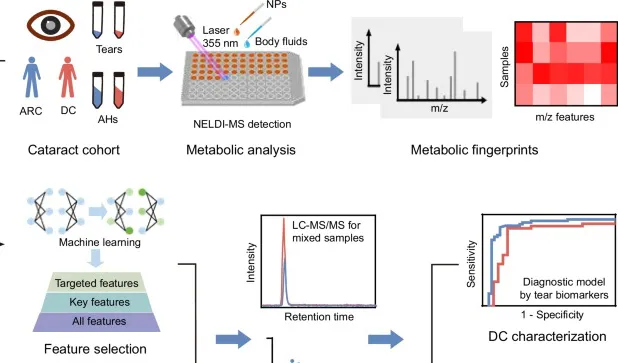
Machine learning then classifies the resulting metabolic fingerprint. The paper also reports a metabolic link between the tear film and aqueous humour, which is mechanistically satisfying: if the two compartments share metabolic state, a surface sample can report on the inside of the eye [1][6].
What has to happen before screening
A 168-patient single-centre study with a promising classifier is the beginning of a diagnostic pathway, not a validated test [1][5].
Diagnostic studies of this kind typically report high discrimination in a case-control setting, where cases are known and controls are healthy; performance falls in a real screening population where most people have neither condition and comorbidities are common. External validation, a defined reference standard, and a health-economic case for replacing or preceding the current workup are all outstanding. The platform also requires a mass spectrometer, which is not an outpatient tool — the practical implementation may be a send-out test rather than an in-clinic device [2][4].
The condition in context: diabetic cataract
Diabetes accelerates lens opacity and complicates its surgery.
| Region | What the data shows | Source |
|---|---|---|
| Onset and course | Starts 5-10 years earlier than senile cataract and progresses faster [4]. | Tencent News / People's Daily Health [4] |
| Diagnostic gap | Current identification relies on reported history or a single blood test, with high miss rates [4]. | Tencent News / People's Daily Health [4] |
| Screening need | Full diabetic assessment is too slow and costly to apply to every cataract patient [4]. | Tencent News / People's Daily Health [4] |
Because cataract surgery in an unrecognised diabetic patient carries higher risk of macular oedema and poor healing, pre-operative identification has direct clinical value [1][4].
Why it matters
| Potential | What the report suggests | Source |
|---|---|---|
| Non-invasive | No needle, no contrast, no fasting [4]. | [4] |
| Speed | Under 30 seconds per sample [2][5]. | [2][5] |
| Caution | Single-centre case-control design [1][5]. | [1][5] |
Availability and limits
- This is an editorial summary of a research paper, not a clinical test [1][2].
- No external validation in a screening population [5].
- Requires mass spectrometry infrastructure [2].
- Tear collection technique affects metabolite profiles [6].
- HbA1c and clinical assessment remain the standard for diabetes diagnosis [4].
What to ask before booking
| Question | Why it matters |
|---|---|
| Has my diabetes status been checked before cataract surgery? | It changes surgical risk and planning [4]. |
| Is a tear test available clinically? | Not yet — it is research-stage [1]. |
| Which department handles foreign patients, and in what language? | The hospital is a working hospital we do not book; confirm international-department coordination and language support. |
| What is the plan if my blood sugar is poorly controlled? | Glycaemic control before surgery affects outcomes [4]. |
Questions patients ask
What was developed?
A nanoparticle-enhanced mass spectrometry method that measures metabolites in 10 nL of tears within 30 seconds and uses machine learning to identify diabetic cataract [1][2].
How many patients?
168 cataract patients, 86 of them with diabetic cataract [1].
Why tears rather than blood?
Collection is completely non-invasive, and the tear film shares metabolic state with the aqueous humour [4][6].
Can I get this test now?
No — it is a research platform without external validation or clinical availability [5].
Is this relevant to international patients?
It is useful context for China's ophthalmic diagnostics. The hospital is a working hospital we do not book — contact its international department directly [1].