
Quick answer
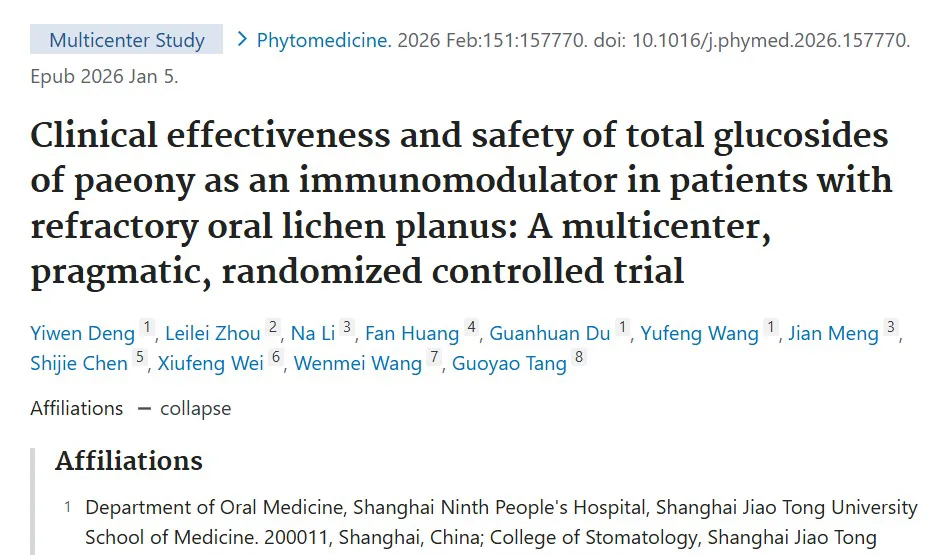
Oral lichen planus affects about 1.27% of the population, and the erosive form is painful, disfiguring and classified by the WHO as a potentially malignant disorder with a transformation risk of 1.4–3.7%. Topical corticosteroids work while they are used, and relapse when they stop, leaving no good long-term strategy. Tang Guoyao's team at Shanghai Ninth People's Hospital led a five-hospital pragmatic randomised trial of total glucosides of paeony, a plant-derived immunomodulator, as an adjunct. It was published in Phytomedicine on 5 January 2026 [1][2][4].
Key takeaways
- Design: multicentre, pragmatic, randomised controlled trial at five Chinese dental hospitals [1][5].
- Population: 448 patients with refractory oral lichen planus [1][3].
- Follow-up: 48 weeks, substantially longer than most OLP trials [1].
- Agent: total glucosides of paeony, a plant immunomodulator acting on NF-kappaB and Th17 pathways [5].
- Published in Phytomedicine (Q1, impact factor 11.3), with Wang Wenmei and Wei Xiufeng among collaborating centres [5][6].
Why a pragmatic design is the right one here
An explanatory trial of an add-on drug in a tightly controlled population answers whether it can work. A pragmatic trial answers whether it works in ordinary clinics, with ordinary adherence, alongside whatever else the patient is taking. For a chronic relapsing mucosal disease managed in outpatient settings, the second question is the useful one [1][3].
The reported pattern is that the benefit is not additive anti-inflammatory effect during steroid use, but maintenance of stability after steroids are tapered and stopped — which matches the clinical problem, since relapse on withdrawal is what forces patients back onto steroids [3].
What the trial supports, and what it does not
A 448-patient, 48-week, five-centre randomised trial is unusually large and long for this disease, and the adjunctive framing is honest: paeony glucosides were added to standard care, not substituted for it [1][5].
Oral lichen planus relapses and remits, which complicates attribution over 48 weeks; the trial's randomised design mitigates this but does not eliminate it. Paeony glucosides are a multi-component plant extract, so batch composition varies and the active constituents are incompletely defined — a general limitation of herbal medicines in trial form. Whether the adjunct reduces malignant transformation, the outcome that matters most, cannot be answered in a 48-week study [3][6].
The condition in context: oral lichen planus
It is a T-cell mediated chronic inflammatory disease, and its malignant potential drives long-term surveillance.
| Region | What the data shows | Source |
|---|---|---|
| Prevalence | About 1.27% of the population [1]. | Ninth People's Hospital [1] |
| Malignant risk | WHO-listed potentially malignant disorder with transformation risk 1.4-3.7% [1]. | Ninth People's Hospital [1] |
| Steroid limitation | Topical steroids are first-line but long-term safety is poor and relapse after withdrawal is common [1]. | Ninth People's Hospital [1] |
Because patients may need decades of management, a steroid-sparing adjunct has value beyond short-term symptom control [3].
Why it matters
| Potential | What the report suggests | Source |
|---|---|---|
| Steroid sparing | Stability maintained after tapering [1][3]. | [1][3] |
| Evidence scale | 448 patients, 48 weeks, five centres [1]. | [1] |
| Caution | Adjunct only; no malignancy endpoint [6]. | [6] |
Availability and limits
- This is an editorial summary of the publication, not a treatment recommendation [1][2].
- Paeony glucosides are an adjunct to, not a replacement for, topical steroids [3].
- Plant extract composition varies between manufacturers [6].
- No data on malignant transformation [3].
- Specialist oral medicine follow-up remains necessary [1].
What to ask before booking
| Question | Why it matters |
|---|---|
| Has the diagnosis been confirmed by biopsy? | Malignant potential makes histological confirmation important [1]. |
| Is an adjunct being offered alongside steroids or instead of them? | The trial tested an adjunct [3]. |
| Which department handles foreign patients, and in what language? | The hospital is a working hospital we do not book; confirm international-department coordination and language support. |
| How often will I be reviewed for malignant change? | Long-term surveillance is part of care [1]. |
Questions patients ask
What was tested?
Total glucosides of paeony as an immunomodulatory adjunct in refractory oral lichen planus, in a multicentre pragmatic randomised trial of 448 patients with 48-week follow-up [1][3].
What did it show?
Improved clinical effectiveness and safety as an adjunct, with stability maintained after steroid tapering [1][3].
Where was it published?
Phytomedicine, online 5 January 2026 [1][5].
Does it prevent cancer?
Unknown — a 48-week trial cannot answer that [3].
Is this relevant to international patients?
It is useful context for China's oral medicine practice. The hospital is a working hospital we do not book — contact its international department directly [1].