
Quick answer
A 15 cm liver tumour usually rules out surgery: too much liver would have to be removed, and the future remnant is too small. The strategy for such cases is to shrink the tumour first, then operate. At Sir Run Run Shaw Hospital, Cai Xiujun's multidisciplinary team used yttrium-90 microsphere selective internal radiation therapy — radioactive beads delivered into the tumour's blood supply — followed by targeted and immune therapy. The tumour volume fell from 1,700 cm³ to 200 cm³, about one-eighth, and the patient became operable [1][2][4].
Key takeaways
- Patient: 68-year-old man with a 15 cm hepatocellular carcinoma, initially beyond surgical criteria [2].
- Yttrium-90 microspheres were delivered by catheter into the tumour-feeding vessels on 16 September 2025 [4].
- Lung shunt fraction was 10.31%, within the criteria for safe yttrium-90 treatment [4].
- Volume fell from 1,700 cm³ in September 2025 to 200 cm³ by January 2026; residual tumour showed complete necrosis on MRI [4].
- Unlike transarterial chemoembolisation, the patient had no significant fever, pain or liver function derangement afterwards [4].
Why yttrium-90 rather than TACE
Transarterial chemoembolisation blocks the tumour's blood supply and delivers chemotherapy locally, but it depends on the tumour being supplied predominantly by the hepatic artery and produces a post-embolisation syndrome of fever and pain. Yttrium-90 microspheres are radioactive rather than chemical: they lodge in the tumour capillary bed and deliver beta radiation locally over weeks, with a much higher dose to the tumour than to normal liver [2][4].
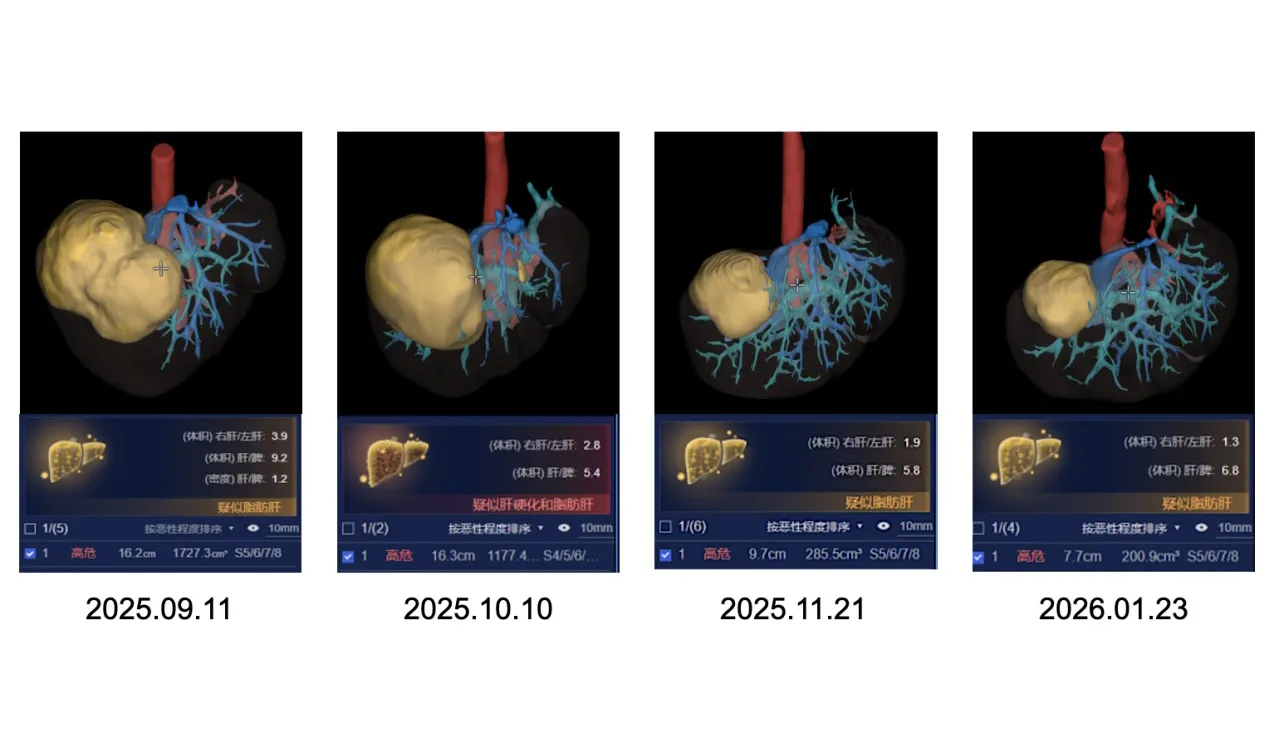
The critical safety step is mapping: a pretreatment angiogram identifies all tumour-feeding vessels, a tracer study simulates isotope distribution, and the lung shunt fraction is calculated to ensure radiation to the lungs stays acceptable. In this case the fraction was 10.31%, comfortably within limits [4].
The sequence, not the single treatment
Radiation alone rarely converts a 15 cm tumour into a resectable one. The team added targeted and immune therapy after the radioembolisation, on the reasoning that radiation releases tumour antigen and may prime an immune response while the targeted agent controls growth. By January 2026 imaging showed the remaining tumour was necrotic, and the patient moved on to surgery [2][4].
Conversion therapy — downstaging an unresectable liver cancer until resection becomes possible — is an accepted strategy, and yttrium-90 is one of several tools used for it. But this report describes one patient, in hospital and media coverage rather than a trial. Response rates to yttrium-90 vary widely by tumour biology, and the combination with immunotherapy is still being studied. The dramatic shrinkage here should not be read as an expected outcome [1][3].
The condition in context: liver cancer
Hepatocellular carcinoma is the third leading cause of cancer death worldwide and is unusually common in China.
| Region | What the data shows | Source |
|---|---|---|
| Resectability | Large tumours with insufficient future liver remnant are unsuitable for primary resection [2]. | Sir Run Run Shaw Hospital [2] |
| Conversion | Downstaging to resectability is the goal for borderline cases [4]. | China Democracy Promotion Association [4] |
| Yttrium-90 use | Also used in colorectal liver metastases, where it can achieve pathological complete response [5]. | Oncology Frontier [5] |
Because most liver cancers arise on a background of cirrhosis, preserving enough functioning liver is as important as removing the tumour [2].
Why it matters
| Potential | What the report suggests | Source |
|---|---|---|
| Downstaging | A tumour initially deemed inoperable became resectable [2]. | [2] |
| Tolerability | No post-embolisation syndrome, preserving fitness for the next step [4]. | [4] |
| Caution | Single case; response varies with tumour biology [1]. | [1] |
Availability and limits
- This is an editorial summary of hospital and media reports, not a treatment recommendation [1][2].
- It describes one patient, not a trial [1].
- Yttrium-90 requires nuclear medicine infrastructure and dosimetry expertise [4].
- Not all tumours concentrate microspheres adequately; mapping excludes some patients [5].
- Cost is high and reimbursement varies [3].
What to ask before booking
| Question | Why it matters |
|---|---|
| Is my tumour genuinely unresectable, and could it be downstaged? | Conversion is the goal of this strategy [2]. |
| Has lung shunt fraction been measured? | It determines whether yttrium-90 is safe [4]. |
| Which department handles foreign patients, and in what language? | The hospital is a working hospital we do not book; confirm international-department coordination and language support. |
| What is the plan if shrinkage is insufficient? | Not all tumours convert to resectable disease [3]. |
Questions patients ask
What was the case?
A 68-year-old man with a 15 cm hepatocellular carcinoma beyond surgical criteria, treated with yttrium-90 radioembolisation plus targeted and immune therapy; the tumour shrank from 1,700 to 200 cm³ [1][2][4].
What is yttrium-90 therapy?
Radioactive microspheres delivered by catheter into the tumour's arterial supply, where they lodge and deliver local beta radiation [2].
Why not just do TACE?
Yttrium-90 delivers a higher tumour dose with less post-embolisation syndrome, which matters when the next step is surgery [4].
Is this a proven approach?
Conversion therapy is established; this specific combination and outcome is a single case report [1][3].
Is this relevant to international patients?
It is useful context for China's liver cancer care. The hospital is a working hospital we do not book — contact its international department directly [1].