
Quick answer
Surgeons have fixed fractures with metal for a century because glue does not work in a bloody field. Bone-02, developed by Fan Shunwu's orthopaedic team at Sir Run Run Shaw Hospital, is an injectable material that cures in one to three minutes in a wet environment, holds fracture fragments, and then degrades as new bone replaces it. It entered China's innovative medical device review in January 2026 and received US FDA Breakthrough Device Designation in April 2026 [1][2][3].
Key takeaways
- Ten years in development by Lin Xianfeng's group within Fan Shunwu's department [2].
- Injects and cures in 1–3 minutes; bonding strength stable in blood and body fluid [1][2].
- Degrades as new bone grows and is replaced by bone tissue [2].
- NMPA innovative device special review in January 2026; FDA Breakthrough Device Designation in April 2026 [1][3].
- A 150-case clinical study has been completed across hospitals including Zhejiang University Second Affiliated and Shanghai Sixth [4].
Why bone glue is hard
Two problems have blocked the field. The first is biological safety: a material that stays in bone for years must not be toxic or carcinogenic. The second is mechanics: blood and marrow fluid form a layer on the bone surface that prevents any adhesive from bonding, and bone is constantly wet [1][2].
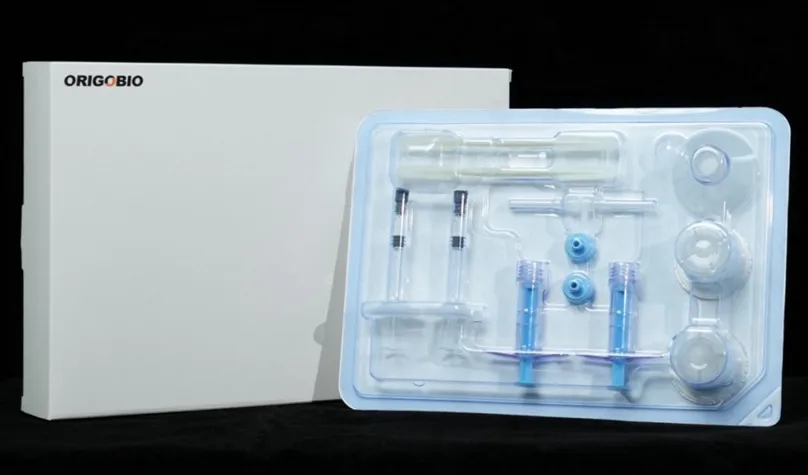
The team describes drawing on the traditional technique of growing oysters onto a hard substrate — creating a material that displaces fluid and bonds to the mineral surface. In the demonstration, mixing and injecting the components produces a hard set within minutes [3].
What it could replace
Metal plates and screws work, but they require wide exposure, devitalise bone, and can loosen or become infected — particularly in osteoporotic fractures where screws have little to grip. In comminuted fractures, small fragments are often too small to fix with any implant at all [2].
FDA Breakthrough Device Designation accelerates review for devices that may offer substantial advantages; it is not an approval. The 150-case clinical study is described as completed, but comparative outcomes against standard fixation have not been published in the sources reviewed, and long-term degradation and bone remodelling data are needed before the technique can be judged [1][4].
The condition in context: fracture fixation
Comminuted and osteoporotic fractures are the hardest fixation problems, and they are becoming more common.
| Region | What the data shows | Source |
|---|---|---|
| Worldwide | Tens of millions of comminuted fractures occur each year [3]. | Zhejiang Government [3] |
| Limits of metal | Wide exposure, devitalised bone, loosening and infection remain problems [2]. | Science and Technology Daily [2] |
| China | The product is described as the first Chinese orthopaedic device to receive both Chinese and US innovation recognitions [5]. | Zhejiang University [5] |
Because fixation failure in an older patient often means a second operation, a material that holds small fragments could change surgical options [2].
Why it matters
| Potential | What the report suggests | Source |
|---|---|---|
| Small fragments | Adhesive can secure pieces too small for screws [2]. | [2] |
| Speed | Fixation time reportedly halved, with fewer displacements [2]. | [2] |
| Caution | No comparative published outcomes yet [1]. | [1] |
Availability and limits
- This is an editorial summary of hospital and government announcements, not a treatment offer [1][3].
- The device is not approved for routine use; it is in regulatory review [1].
- Long-term degradation and remodelling data are not published [2].
- It is not a substitute for all internal fixation [2].
- Cost and availability are undetermined [4].
What to ask before booking
| Question | Why it matters |
|---|---|
| Is my fracture pattern one where adhesive would help? | Comminution and bone quality determine suitability [2]. |
| Is the product available in a trial or only standard fixation? | It remains investigational [1]. |
| Which department handles foreign patients, and in what language? | The hospital is a working hospital we do not book; confirm international-department coordination and language support. |
| What follow-up is needed to confirm healing? | Imaging follow-up remains essential [2]. |
Questions patients ask
What is Bone-02?
An injectable bone adhesive that cures in one to three minutes in a wet field and degrades as new bone forms, developed at Sir Run Run Shaw Hospital [1][2].
What regulatory milestones has it reached?
China's NMPA innovative device special review in January 2026, and US FDA Breakthrough Device Designation in April 2026 [1][3].
Has it been tested in patients?
A 150-case clinical study has been completed across several hospitals; comparative outcome data are not yet published [4].
Does it replace metal plates?
Not universally — it is aimed at fragments that metal cannot easily hold, and standard fixation remains appropriate for many fractures [2].
Is this relevant to international patients?
It is useful context for China's orthopaedic devices. The hospital is a working hospital we do not book — contact it directly [1].