
Quick answer
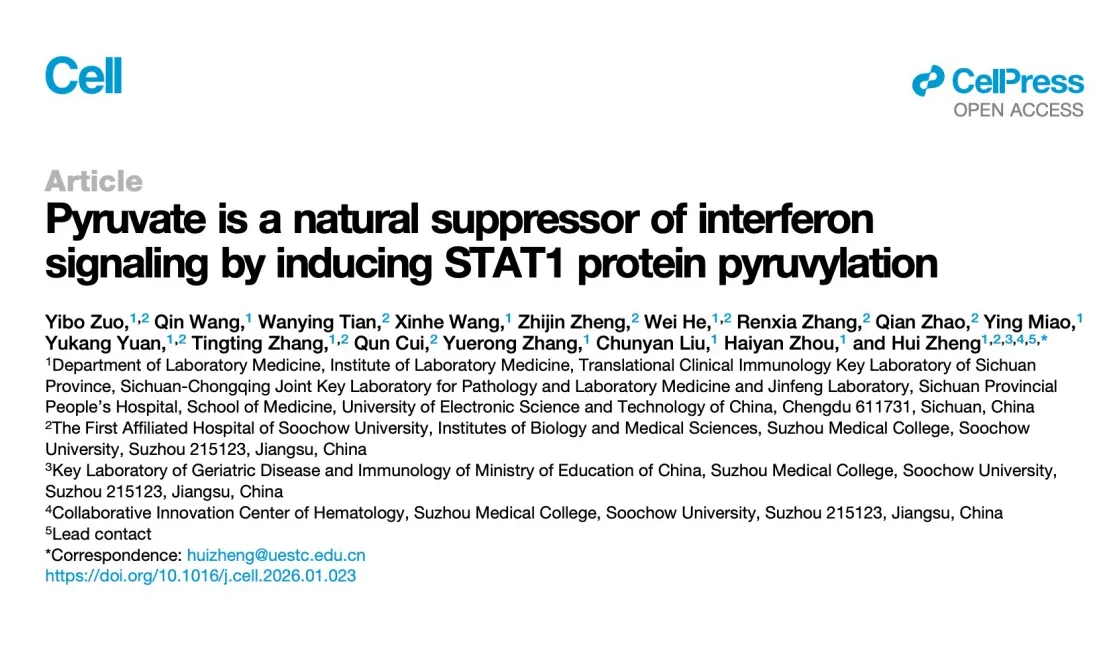
Clinicians have long known that people with diabetes and other causes of hyperglycaemia develop more severe influenza and COVID-19, and that hepatitis B patients with high glucose respond poorly to interferon. The mechanism was unclear. Zheng Hui's team at Sichuan Provincial People's Hospital and the University of Electronic Science and Technology of China found it: pyruvate, the end product of glycolysis, attaches directly to the signalling protein STAT1 at lysine K201 — a modification the team names protein pyruvylation — and that blocks type-I interferon signalling. The work was published in Cell on 27 February 2026 [1][2][4].
Key takeaways
- Published in Cell on 27 February 2026; Zheng Hui is corresponding author, Zuo Yibo first author [2][4].
- Pyruvylation is reported as a previously unidentified post-translational modification [1][3].
- The site is STAT1 lysine 201, and the consequence is suppressed type-I interferon signalling [2].
- Hyperglycaemia increases STAT1 pyruvylation, weakening responses to virus and to interferon therapy [2].
- This is the first Cell paper with the University of Electronic Science and Technology as first-author institution [1][4].
Why a metabolite can act like a signalling molecule
Glycolysis was assumed to end with pyruvate used for energy or fermentation. The finding places pyruvate in a different role: as a donor for a covalent protein modification, in the way acetyl-CoA donates acetyl groups or sirtuins remove them. That reframes glycolysis as a signalling pathway that reports metabolic state directly onto the immune machinery [2][6].
Mechanistically the effect is elegant: type-I interferon must bring STAT1 and STAT2 together to drive antiviral gene expression, and modifying STAT1 at K201 interferes with that step. Because the modification depends on pyruvate availability, it acts as a rheostat — the higher the glycolytic flux, the more the interferon pathway is dampened [2][5].
What it explains clinically, and what it suggests
Two clinical puzzles fit: severe viral disease in hyperglycaemic patients, and interferon resistance in hepatitis B patients with raised glucose. If pyruvylation is the mechanism, then the therapeutic question becomes whether the modification can be blocked or reversed, or whether interferon dosing should account for metabolic state [2][5].
The paper establishes the modification and its role in cells and animal models. It does not report a drug, a human trial, or proof that inhibiting pyruvylation improves outcomes in patients. Naming a modification is a major claim in cell biology and typically invites years of independent replication; readers should treat the pathway as established in the systems studied rather than in human disease. Whether this explains the full excess of severe viral illness in diabetes — which also involves endothelial, pulmonary and inflammatory factors — is unresolved [3][6].
The condition in context: hyperglycaemia and infection
Diabetes is a risk factor for severe respiratory viral illness, and China has the largest diabetic population in the world.
| Region | What the data shows | Source |
|---|---|---|
| Clinical observation | Hyperglycaemic patients have weaker antiviral immunity and more severe viral disease [1][4]. | China.com / SCTV [1][4] |
| Treatment relevance | High-glucose hepatitis B patients respond poorly to interferon therapy [3]. | Chinese Society for Immunology [3] |
| Broader links | Glycolytic dysregulation is implicated in diabetes and cancer [3]. | Chinese Society for Immunology [3] |
Because interferon is used both as an antiviral drug and as a treatment for hepatitis B, a mechanism that predicts non-response has direct clinical value once validated [3].
Why it matters
| Potential | What the report suggests | Source |
|---|---|---|
| New biology | A previously unknown modification class [1][2]. | [1][2] |
| Clinical explanation | Links glucose control to interferon response [3][5]. | [3][5] |
| Caution | No therapeutic or human trial data [6]. | [6] |
Availability and limits
- This is an editorial summary of a research paper, not medical advice [1][2].
- No intervention targeting pyruvylation is in clinical use [6].
- Findings derive from cell and animal systems [3].
- Independent replication of a new modification class is expected [6].
- Glycaemic control remains the practical intervention for patients today [4].
What to ask before booking
| Question | Why it matters |
|---|---|
| Is my HbA1c controlled before starting interferon? | Glucose control is the modifiable factor in this pathway [3]. |
| Is any trial of pyruvylation-targeted therapy open? | None is reported [6]. |
| Which department handles foreign patients, and in what language? | The hospital is a working hospital we do not book; confirm international-department coordination and language support. |
| What is the plan if my interferon response is poor? | Alternative antivirals exist and should be discussed [5]. |
Questions patients ask
What was discovered?
Protein pyruvylation, a new post-translational modification in which pyruvate attaches to STAT1 at lysine 201 and suppresses type-I interferon signalling [1][2].
Why does it matter clinically?
It explains why hyperglycaemic patients have weaker antiviral immunity and respond poorly to interferon therapy [2][3].
Where was it published?
Cell, online 27 February 2026 [1][2].
Is there a treatment based on it?
Not yet — the work is mechanistic, without a drug or human trial [6].
Is this relevant to international patients?
It is useful context for China's immunometabolism research. The hospital is a working hospital we do not book — contact its international department directly [1].