
Quick answer
Oscar Chalupsky, 62, a South African former captain of his country's Olympic kayak team and a twelve-time world champion, was diagnosed with high-risk multiple myeloma in November 2019. After five years and more than ten lines of treatment in South Africa, Portugal and Germany, his doctors told him there was nothing further they could offer. He used AI tools to search for centres running newer cell therapies, contacted Shanghai Ruijin Hospital by email in November 2025, and was admitted on 9 December. Three days of testing produced a plan: three to six months of bridging therapy to rebuild his immune function before any further cell treatment [1][3].
Key takeaways
- Diagnosis: kappa light-chain multiple myeloma with a t(14;16) translocation, a high-risk form, confirmed on 25 November 2019 [1][4].
- Prior treatment: autologous stem cell transplant, multiple targeted drugs and clinical trials across three countries, more than ten lines in total [1].
- Route in: an AI-assisted search for centres with cell-therapy experience, then an email to the hospital's international department in November 2025 [1][3].
- Assessment: whole-body PET-MR, bone marrow biopsy and T-cell function testing within three days, followed by a multidisciplinary review [1].
- Current status: bridging therapy only. No cell infusion has been reported, and no outcome has been published [1][2].
How the case unfolded
The account below rests on reporting by China Youth Daily, which interviewed the hospital's international medical department, and on a Xinhua video report. Neither reports an outcome: the patient was still in preparation when the stories were published [1][2].
| When | What happened |
|---|---|
| 25 Nov 2019 | Diagnosed with kappa light-chain myeloma carrying a t(14;16) translocation — the day before his wife's 60th birthday, which is how he dates it [1][3]. |
| 2019–2024 | Treated in South Africa, Portugal and Germany, including an autologous stem cell transplant, several targeted agents and trial enrolment; the disease kept progressing [1]. |
| 2025 | Disease markers rose to hundreds of times normal. German clinicians said they had nothing further to offer and raised the possibility of only days of life [3]. |
| Late 2025 | He searched with AI tools for centres with chimeric antigen receptor (CAR) T-cell experience; Shanghai Ruijin Hospital kept appearing, largely for its CAR-T work [1][3]. |
| Nov 2025 | Emailed the hospital's international medical department; a remote review followed, and he was judged complex but potentially still eligible for newer cellular immunotherapy [1]. |
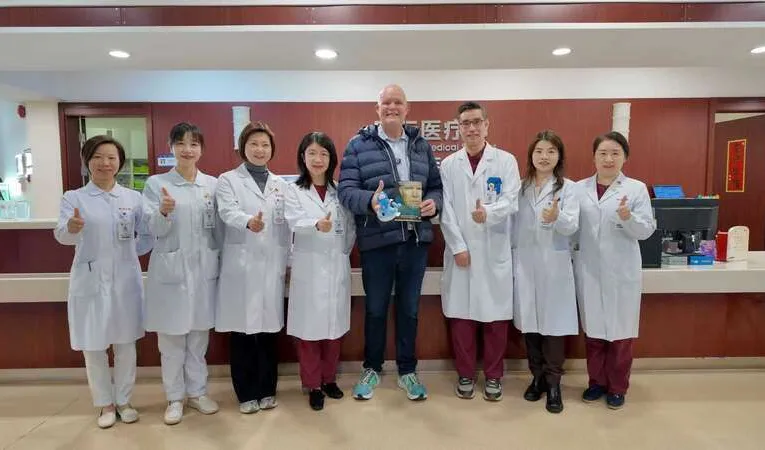
| 9 Dec 2025 | Admitted to the international medical department in Shanghai [1]. |
| Next 3 days | Whole-body PET-MR, bone marrow biopsy and T-cell function testing, then a multidisciplinary review involving haematology and critical care [1]. |
| Plan | Three to six months of bridging therapy to restore immune function, with the hospital in contact with his South African physician about what comes after [1]. |
What "high-risk" means in this diagnosis
Multiple myeloma is a cancer of plasma cells in the bone marrow. It is treatable and often controlled for years, but it is not cured by standard therapy, and the t(14;16) translocation is one of the markers used to label a case high-risk — meaning shorter remissions and earlier relapse after each line of treatment [1][4].
That history is what makes this case interesting to a hospital: a patient who has already exhausted transplant and several drug classes is exactly the population that BCMA-directed CAR-T was developed for. It is also the population in which relapse after CAR-T is common and the next option is genuinely uncertain [5].
What the hospital is doing — and what it is not
The reported plan is bridging therapy, not cell therapy. In this context that means treatment given while the patient waits for a slot and for his own cells to be collected and engineered, with the aim of holding the disease steady and improving his physical state enough to tolerate what follows [1].
It is worth being precise about what has not happened. No CAR-T infusion is reported. No response assessment is reported. No cost is reported. The department director's quoted position is that the plan is preparation, with further treatment to be decided afterwards [1][2].
What this case shows, and what it does not
It shows how far patient-initiated search has moved. He did not come through a referral network or a medical-travel agency; he asked language models which centres were publishing on cell therapy, and cold-emailed one. It also shows how fast a tertiary centre can convert that into a workup: three days, one building, and a multidisciplinary decision [1][3].
It does not show that the treatment will work, or that China is a better place to receive it. The case is being reported while it is still open, by the hospital that accepted him, and the most quotable lines — his enthusiasm about efficiency and about European waiting lists — are the impressions of a patient in his first fortnight, not outcome data [1][4].
Nor does it show that arriving without a plan works. He had a diagnosis, a treatment history, imaging and a physician in South Africa willing to coordinate; the hospital's own account makes clear that the remote review came before the flight [1].
The condition in context: myeloma and CAR-T
BCMA-directed CAR-T has changed the outlook for heavily pretreated myeloma, producing high response rates in patients who have run out of standard options. Two limits matter for anyone reading a story like this one: responses are not usually durable, and relapse after BCMA-directed therapy leaves a thin evidence base for what to do next [5].
| Question | What the evidence and the reporting support | Source |
|---|---|---|
| Is CAR-T standard for newly diagnosed myeloma? | No. It is used in relapsed or refractory disease after several prior lines | [5] |
| Does bridging therapy treat the disease? | It aims to control it while preparations are made, not to replace definitive treatment | [1] |
| What does it cost? | Not published for this case. Chinese providers describe blood-cancer CAR-T at roughly a third of US pricing | [1][6] |
| Who pays? | Foreign patients are overwhelmingly self-paying; fewer than 30% of international insurers settle directly in China | [6] |
If you were this patient: what to arrange
- Send a complete file before asking for a date. Diagnosis, cytogenetics, every prior line with dates and responses, and the original imaging. His remote review started from a file, not a phone call [1].
- Ask what the bridging period requires. Three to six months means housing, money and a visa that covers it, not just the assessment [1].
- Check the entry route against the plan. He entered visa-free for 15 days, which covered the assessment; a months-long stay needs a different arrangement entirely [4].
- Ask who is paying and how. Most foreign patients pay in full and claim later, and direct billing is available only where the hospital has a contract with your insurer [6].
- Keep your home physician involved. The Shanghai team's stated plan includes coordinating with his South African doctor, which is also what makes the return trip safer [1].
Availability and limits
- This is an editorial summary of newspaper reporting, not a clinical record [1][2].
- The patient is named and consented to being identified, but his clinical details come from the treating hospital [1].
- No outcome, no response rate, no cost and no complication record has been published [1].
- High-risk myeloma with a t(14;16) translocation behaves differently from standard-risk disease; do not generalise [4].
- Cell therapy slots depend on manufacturing capacity and eligibility, neither of which is described [1][5].
- Journalists were shown the case during preparation; a later report on the outcome may never appear [2].
What to ask before booking
| Question | Why it matters |
|---|---|
| Is the offer a consultation, bridging therapy, or a cell-therapy slot? | These are three different commitments with different timelines [1]. |
| What has to be true for me to be eligible for CAR-T? | Eligibility depends on prior lines, organ function and disease control [5]. |
| Which department handles foreign patients, and in what language? | The hospital is a working hospital we do not book; confirm international-department coordination and language support. |
| What is the total cost, including the bridging months? | Foreign patients are mostly self-paying, and direct billing is limited [6]. |
| What is the plan if the disease progresses while I wait? | Bridging exists precisely because the wait is real [1]. |
Questions patients ask
Is this patient being treated with CAR-T?
Not yet, as far as the published reporting goes. He is in three to six months of bridging therapy, after which further treatment will be decided [1].
Did he have to pay upfront?
No cost has been published for this case. In general, foreign patients in China pay in full and claim from their insurer afterwards, because fewer than 30% of international insurers can settle directly in the country [6].
How did he find the hospital?
He used AI tools to search for centres with experience in cell therapy for myeloma; Shanghai Ruijin Hospital appeared repeatedly, and he emailed its international department in November 2025 [1][3].
How long can he stay on a visa-free entry?
He travelled on a German passport, which allowed 15 days without a visa — enough for the assessment, but not for months of bridging therapy [4].
Does this mean China is better at treating myeloma?
The case does not show that. It shows a heavily pretreated patient was accepted for assessment and preparation; whether the treatment works will only be known from follow-up that has not been published [1][5].