
Quick answer
Synchronous triple urological cancer is rare, and treating it with three separate operations would mean three anaesthetics and long recovery gaps. At Renji Hospital, a multidisciplinary team treated a 71-year-old man with kidney, bladder and prostate cancer — all advanced, with prostate bone metastasis — in one combined laparoscopic and robotic operation in March 2026, after neoadjuvant chemotherapy and endocrine therapy shrank the tumours [1][2].
Key takeaways
- Case: 71-year-old, found in November 2025 with a left kidney mass, elevated PSA and multiple bladder tumours [1].
- Left kidney tumour extended into the renal vein as a thrombus; the right ureteric orifice was involved by bladder tumour [1][2].
- Prostate cancer was confirmed by biopsy and had metastasised to bone [1].
- MDT included urology, oncology, radiology, pathology, anaesthesia, nuclear medicine and radiotherapy [2].
- Single operation: laparoscopic left nephrectomy (40 minutes), robot-assisted radical cystectomy, ureterocutaneous diversion and bilateral orchiectomy; about six hours, under 300 mL blood loss [3].
Why sequence matters
Operating immediately would have meant dissecting through three actively growing tumours, one of which had already invaded a major vein. The team instead gave neoadjuvant chemotherapy plus endocrine therapy for several weeks, which shrank the bladder tumours, lowered PSA and stabilised the bone metastases — creating a window in which a single operation became feasible [2].
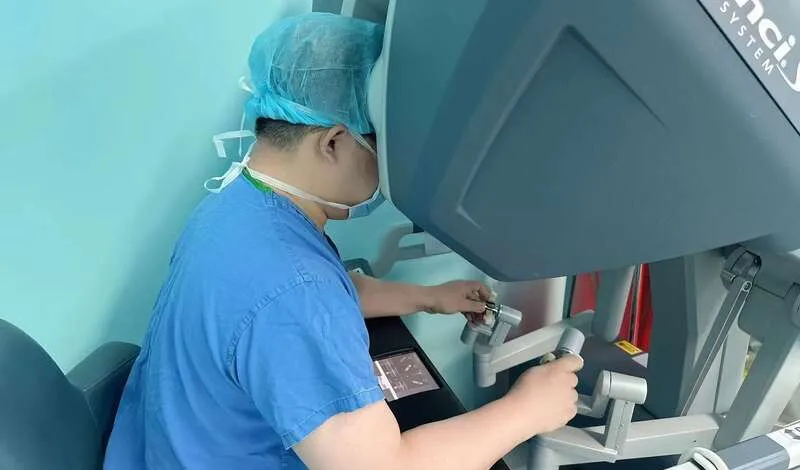
The surgical sequence was chosen to reduce risk: the kidney with its venous thrombus first, handled gently to avoid embolisation; then the bladder with lymph node dissection; then diversion and androgen ablation. The team avoided a 20–30 cm open incision by combining laparoscopy for the kidney with the robot for the pelvis [3][5].
What was reported
The operation lasted about six hours with blood loss below 300 mL. The patient spent one day in intensive care, returned to the ward the next day, mobilised on day three, and had drains removed about a week later [4]. He was learning to manage a urostomy and wrote a letter of thanks to the department [1][2][3].
This is a single case report of a surgical strategy, not evidence that combined surgery is superior. Three simultaneous primaries are rare enough that no trial will exist; the value of the report is in showing that MDT planning, neoadjuvant sequencing and minimally invasive technique can be combined safely in a selected patient. Whether that holds generally depends on tumour biology and fitness [1][2].
The condition in context: synchronous cancers
Multiple primary tumours in one patient are uncommon but increasingly recognised as imaging improves and patients live longer.
| Region | What the data shows | Source |
|---|---|---|
| Complexity | Each cancer would normally have its own guideline and team [2]. | Tencent News [2] |
| Surgical burden | Separate operations mean repeated anaesthesia and recovery [3]. | Tencent News [3] |
| China | Renji's urology department runs a standing MDT for complex cases [2]. | Tencent News [2] |
Because guidelines are written for one cancer at a time, synchronous disease forces a judgement about which treatment to prioritise and how to combine them [1].
Why it matters
| For the patient | What the report suggests | Source |
|---|---|---|
| One recovery | A single anaesthetic and hospital stay [3]. | [3] |
| Less trauma | Laparoscopic and robotic access avoided a large incision [3]. | [3] |
| Caution | Requires a fit patient and an experienced MDT [1]. | [1] |
Availability and limits
- This is an editorial summary of hospital reports, not a treatment recommendation [1].
- It describes one patient [1].
- Combined surgery is not appropriate for everyone with multiple primaries [2].
- Long-term oncological outcomes are not yet reported [2].
- Robotic and laparoscopic capacity varies between centres [3].
What to ask before booking
| Question | Why it matters |
|---|---|
| Which cancer should be treated first? | Priorities differ by prognosis and symptoms [2]. |
| Is neoadjuvant therapy appropriate before surgery? | It created the window for single-stage surgery here [2]. |
| Which department handles foreign patients, and in what language? | Renji is a working hospital we do not book; confirm international-department coordination and language support. |
| What stoma and survivorship support is available? | Bladder removal changes daily life permanently [3]. |
Questions patients ask
What was the case?
A 71-year-old man with simultaneous kidney, bladder and prostate cancer, none early and with prostate bone metastasis, treated with neoadjuvant therapy then one combined minimally invasive operation [1][2].
How long did surgery take?
About six hours, with blood loss under 300 mL [3].
What did the operation involve?
Laparoscopic left nephrectomy with venous thrombus, robot-assisted radical cystectomy with node dissection, ureterocutaneous diversion and bilateral orchiectomy [3].
Is combined surgery standard?
No — it is an individualised decision for a fit patient after multidisciplinary review [1].
Is this relevant to international patients?
It is useful context for China's complex cancer surgery. Renji is a working hospital we do not book — contact its international department directly [1].