
Quick answer
Lupus is treated by suppressing the immune system for life; nothing resets it. Chimeric antigen receptor T cells do something different — they deplete the B cells that produce autoantibodies, and the B cells that grow back are often naive rather than autoreactive. Renji Hospital's rheumatology department, led by Ye Shuang and Fu Qiong, has built a programme around that idea: dual CD19/BCMA CAR-T, CD19 CAR-T, and an allogeneic CAR-NK product, all in refractory lupus [1][2].
Key takeaways
- GC012F, a dual CD19/BCMA autologous CAR-T, produced 104-week drug-free remission in refractory SLE, reported in 2025 [2].
- Relma-cel, a CD19 CAR-T, achieved SRI-4 response in all 12 patients in a phase I study reported at EULAR 2026; phase II is under way [2].
- An allogeneic CAR-NK product was published in The Lancet in late 2025 [2].
- Lu Liangjing's group reported CD19 CAR-T results in systemic sclerosis and in moderate-to-severe SLE, with a phase I dose-escalation establishing a recommended dose [4].
- Ding Huihua presented C-CAR168 (CD19/BCMA) for lupus nephritis, describing deep B-cell and plasma-cell depletion with immune reconstitution [5].
Why two targets
CD19 covers most B cells but not the long-lived plasma cells that secrete antibody. BCMA is expressed on plasma cells. Targeting both addresses the two populations that sustain autoimmunity, which is why dual constructs are being tested in lupus and in other antibody-mediated diseases [2][5].
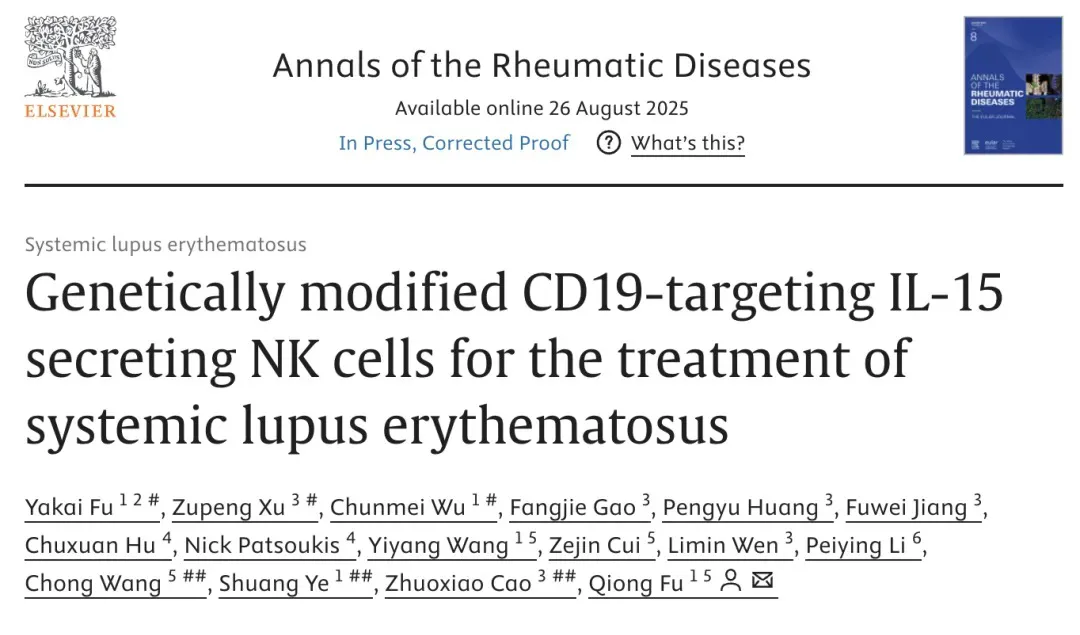
The allogeneic CAR-NK approach takes a different trade-off: an off-the-shelf product that avoids individual manufacturing, at the cost of a shorter persistence and potentially more limited depth of depletion [2].
What "drug-free remission" means
In lupus trials, remission usually means low disease activity on treatment. Drug-free remission — sustained low activity after stopping steroids and immunosuppressants — is a much higher bar, and 104 weeks of it in refractory patients is the headline claim for GC012F [2].
These are small early-phase studies; the phase I CAR-T cohort had 12 patients, and the dual-target data are reported as case series. Lupus activity waxes and wanes, and patients in these programmes are heavily pretreated, which raises regression-to-the-mean concerns. Cytokine release syndrome and prolonged hypogammaglobulinaemia are real risks of deep B-cell depletion, and infection monitoring over years will determine whether the approach is safe as well as effective [2][4].
The condition in context: lupus
Lupus is a chronic autoimmune disease that predominantly affects young women, and standard therapy is lifelong.
| Region | What the data shows | Source |
|---|---|---|
| Treatment model | Standard care is sustained immunosuppression with steroids and steroid-sparing agents [1]. | Renji Hospital [1] |
| Refractory disease | A subset of patients do not respond to, or cannot tolerate, available agents [2]. | MedicalSH [2] |
| China | Renji's rheumatology department was founded in 1979 and is among the earliest in China [1]. | Renji Hospital [1] |
Because the disease strikes young women over decades, a one-off therapy that avoids cumulative steroid exposure would change the life course, not just the symptom score [1].
Why it matters
| Potential | What the report suggests | Source |
|---|---|---|
| Mechanism | Immune reset rather than continuous suppression [2]. | [2] |
| Durability | 104 weeks drug-free in refractory patients [2]. | [2] |
| Caution | Small early-phase studies; infection risk [4]. | [4] |
Availability and limits
- This is an editorial summary of conference and registry information, not a treatment offer [1][2].
- The therapies are investigational [4].
- Cytokine release syndrome and hypogammaglobulinaemia require monitoring [2].
- Manufacturing and cost limit access even within trials [5].
- Trial status can be verified through the registration record for the dual-target study (NCT05858684) [3].
What to ask before booking
| Question | Why it matters |
|---|---|
| Is my lupus refractory to standard therapy? | Eligibility requires failure of conventional treatment [2]. |
| Is a trial enrolling, and which product? | CAR-T and CAR-NK differ in persistence and risk [2][4]. |
| Which department handles foreign patients, and in what language? | Renji is a working hospital we do not book; confirm international-department coordination and language support. |
| What infection prophylaxis and immunoglobulin monitoring are planned? | Deep B-cell depletion has lasting immunological effects [2]. |
Questions patients ask
What has Renji reported?
Drug-free remission at 104 weeks with dual CD19/BCMA CAR-T, SRI-4 responses in all 12 patients in a CD19 CAR-T phase I study, and an allogeneic CAR-NK product published in The Lancet [2].
Who leads the work?
Ye Shuang and Fu Qiong lead the CAR-T and CAR-NK programme in rheumatology, with Lu Liangjing's group also reporting CAR-T results in lupus and systemic sclerosis [2][4].
Why target both CD19 and BCMA?
CD19 covers B cells while BCMA covers long-lived plasma cells; targeting both addresses the two populations sustaining autoantibody production [2][5].
Is it available?
No — these are early-phase investigational therapies [4].
Is this relevant to international patients?
It is useful context for China's autoimmune cell therapy. Renji is a working hospital we do not book — contact its international department directly [1].