
Quick answer
Pancreatoduodenectomy — the Whipple operation — is one of the hardest abdominal procedures, and whether a robot improves it has been argued for a decade. PORTAL, led by Shen Baiyong at Ruijin Hospital across seven Chinese centres, randomised 254 patients to robotic or open surgery. Robotic pancreatoduodenectomy was non-inferior on the primary endpoint of postoperative functional recovery and in fact superior, with patients recovering about 3.9 days faster, while cancer clearance and complications were comparable [1][2][3].
Key takeaways
- Multicentre, single-blind, phase III, non-inferiority randomised trial at seven Chinese centres [1].
- 254 patients: 132 robotic, 122 open; mean age 60; recruitment over 4.5 years [2].
- Primary endpoint was postoperative functional recovery time, not complications alone [1][3].
- Robotic surgery met non-inferiority and showed statistical superiority, with recovery ~3.9 days faster [3][5].
- Complete tumour resection and lymph-node dissection were comparable; overall complication burden did not differ [1][3].
Why the question mattered
Two beliefs have held robotic pancreatic surgery back: that the narrow working space prevents adequate cancer clearance, and that the longer, more complex procedure is riskier. Guidelines have therefore been equivocal, and patients have been reluctant [1][2].
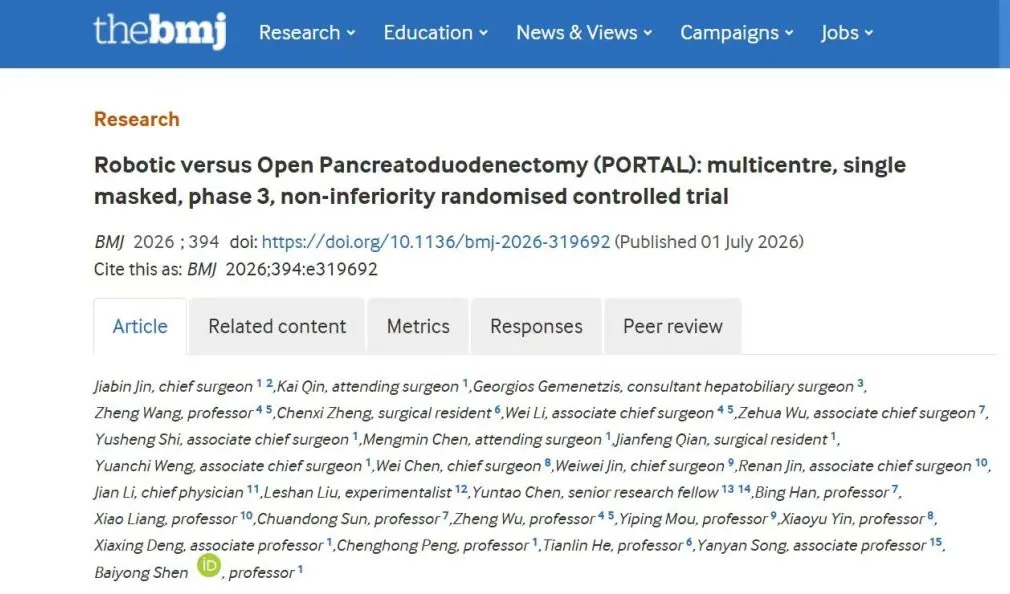
PORTAL tested both claims directly. The trial was designed with a patient-centred primary endpoint — how quickly patients returned to normal function — rather than the usual surgeon-centred metrics of operative time and technical success [2][3].
What the trial found
Robotic operations took longer, as expected, but patients recovered function sooner. In one illustrative case, a man in his late seventies with poor lung function was randomised to the robotic arm; all incisions were in the lower abdomen, the specimen came out through a sub-2 cm suprapubic incision, and he was able to cough and clear sputum after surgery, avoiding the pneumonia that often follows open upper-abdominal surgery [2].
The benefit was demonstrated at high-volume centres by surgeons past the learning curve — exactly the condition the authors specify. Outside that setting, results may not transfer. The trial also does not settle cost-effectiveness: a surgical robot can cost around 18 million yuan, and the health-economics argument remains contested [2][4].
The condition in context: pancreatic surgery
Pancreatoduodenectomy is the only curative operation for tumours of the pancreatic head and periampullary region.
| Region | What the data shows | Source |
|---|---|---|
| Difficulty | The operation involves removing the pancreatic head, duodenum, bile duct and often part of the stomach, then reconstructing three anastomoses [1]. | BMJ China [1] |
| Complications | Pancreatic fistula, bleeding and delayed gastric emptying remain common [1]. | BMJ China [1] |
| China | PORTAL is the first robotic pancreatic multicentre study published in the four major medical journals [2]. | NetEase / Ruijin [2] |
Because the operation is so morbid, even a modest reduction in recovery time matters to patients and to hospital capacity [2].
Why it matters
| Potential | What the report suggests | Source |
|---|---|---|
| Recovery | About 3.9 fewer days to functional recovery [3]. | [3] |
| Oncology | Resection and nodal clearance comparable to open surgery [1][3]. | [1][3] |
| Caution | Requires high volume and surgeons past the learning curve; cost contested [2][4]. | [2][4] |
Availability and limits
- This is an editorial summary of the publication and press coverage, not a treatment recommendation [1][2].
- The result applies to high-volume centres with experienced robotic surgeons [1].
- Overall complication rates did not differ; the gain was in recovery speed [3].
- Cost-effectiveness is unresolved [4].
- Long-term oncological and survival data are still maturing [3].
What to ask before booking
| Question | Why it matters |
|---|---|
| How many robotic Whipples has my surgeon done? | The trial's benefit depended on being past the learning curve [1]. |
| Is my tumour suitable for a robotic approach? | Vessel involvement and prior surgery can rule it out [3]. |
| Which department handles foreign patients, and in what language? | Ruijin is a working hospital we do not book; confirm international-department coordination and language support. |
| What is the cost difference? | Robotic surgery carries higher equipment costs [4]. |
Questions patients ask
What is PORTAL?
A multicentre, single-blind, phase III non-inferiority randomised trial comparing robotic with open pancreatoduodenectomy, led by Ruijin Hospital across seven Chinese centres and published in The BMJ on 1 July 2026 [1][2].
What were the results?
254 patients (132 robotic, 122 open); robotic surgery met non-inferiority and was superior on functional recovery, about 3.9 days faster, with comparable cancer clearance and complications [1][3].
Does robotic surgery remove cancer as well?
Complete resection and lymph-node dissection were comparable to open surgery in the trial [1][3].
Is it better everywhere?
No — the benefit was shown at high-volume centres with surgeons past the learning curve, and cost-effectiveness is unresolved [2][4].
Is this relevant to international patients?
It is useful context for China's pancreatic surgery. Ruijin is a working hospital we do not book — contact its international department directly [1].