
Quick answer
Low rectal cancer is a geometry problem: the pelvis is narrow, the tumour sits close to the sphincter, and a laparoscopic instrument working from above struggles to reach the distal margin cleanly. Transanal total mesorectal excision approaches from below, through the anal canal, and meets the abdominal dissection in the middle. It offers better access — at the cost of a technically demanding operation and, after a safety scandal in Norway in 2018, questions about whether it compromises cancer outcomes. Two randomised trials published in 2025 answered much of that. Renji Hospital's colorectal team, which has performed more than 200 of these operations, was a participating centre [1][3][6].
Key takeaways
- TaLaR: Chinese-led multicentre randomised trial, 1,114 patients in the Chinese report of the 3-year analysis [5].
- TaLaR result: 3-year disease-free survival 82.1% with taTME versus 79.4% with laparoscopic TME, meeting non-inferiority [5].
- COLOR III: taTME had fewer conversions, 4 of 696 versus 56 of 339, with similar 90-day morbidity, anastomotic leakage and complete resection [6].
- Renji's experience: taTME since 2016, more than 200 cases, the largest volume in eastern China [1].
- Both trials were reported as appearing in JAMA and a Lancet title respectively; Renji participated in both, with taTME adopted there in 2016 [1][2].
Why the Norwegian moratorium happened
In 2018 Norway suspended taTME after a cluster of early recurrences and unusually patterned local failures. The concern was mechanistic: working from below in a narrow field could seed tumour cells or leave an incomplete mesorectal envelope. That is exactly the kind of question only randomised data with adequate follow-up can settle — and the answer, from TaLaR, is that local recurrence and disease-free survival were not worse [5][6].
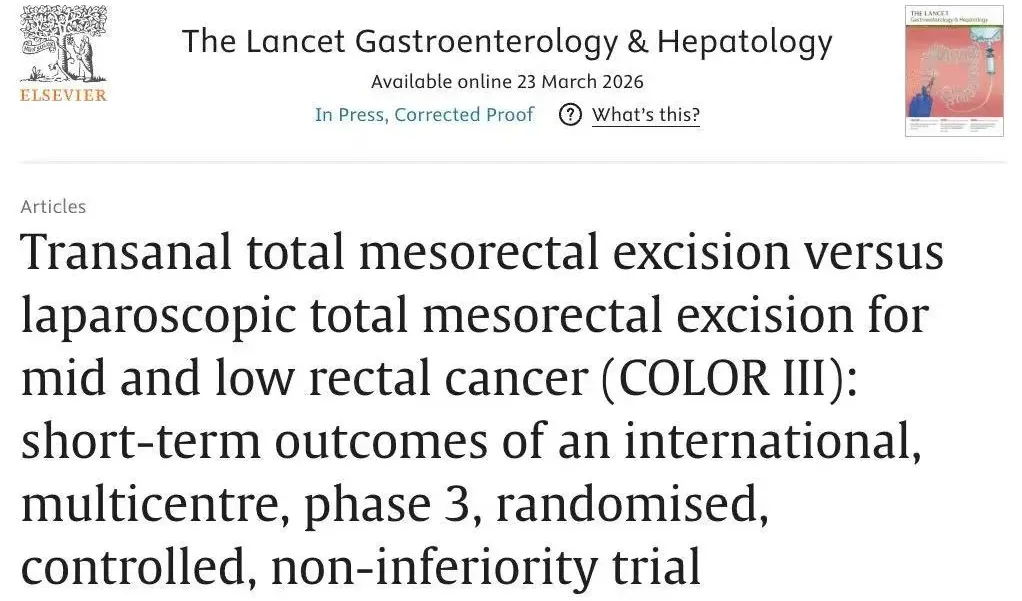
COLOR III answers the complementary question about feasibility: the transanal route achieves the operation more often without conversion, which is what patients experience as avoiding a laparotomy and often avoiding a stoma [6].
Reading "non-inferior" precisely
Non-inferiority is the correct claim and a narrower one than superiority: transanal TME gives comparable cancer control, with fewer conversions and possibly better functional outcomes, not better survival [5][6].
The trials were conducted at expert centres after structured training; taTME has a long learning curve and a documented early hazard, and outcomes in low-volume units are not guaranteed by these results. Functional outcomes — continence and bowel function — are the outcome patients care about most in sphincter-preserving surgery and are reported inconsistently across trials. Follow-up at three years is still short for rectal cancer, where late local recurrence matters, and the Chinese and European populations differ in body habitus and tumour characteristics. Renji's own volume figure is a single-centre experience, not comparative evidence [1][4][5].
The condition in context: low rectal cancer
The trade-off in this disease is between oncological clearance and preserving the sphincter.
| Region | What the data shows | Source |
|---|---|---|
| Surgical challenge | Narrow pelvis, especially in men and obese patients, can compromise specimen quality in laparoscopic TME [3]. | Beijing Cancer Hospital [3] |
| Specimen quality | Earlier comparisons favoured taTME on circumferential margin negativity and 30-day complications [4]. | Toutiao analysis [4] |
| Stoma avoidance | Higher sphincter preservation is the main patient-facing benefit [1]. | Renji Hospital [1] |
Because a permanent stoma has a large effect on quality of life, a technique that preserves the sphincter without compromising cure is genuinely valuable [1][3].
Why it matters
| Potential | What the report suggests | Source |
|---|---|---|
| Oncological safety | 3-year DFS non-inferior in a 1,114-patient trial [5]. | [5] |
| Fewer conversions | 4 of 696 versus 56 of 339 in COLOR III [6]. | [6] |
| Caution | Expert-centre results; long learning curve [1][4] | [1][4] |
Availability and limits
- This is an editorial summary of the publications, not a treatment recommendation [1][5].
- Outcomes reflect high-volume expert centres [4].
- Three-year follow-up is short for rectal cancer [5].
- Functional outcomes are inconsistently reported [1].
- Patient selection for sphincter preservation remains individual [3].
What to ask before booking
| Question | Why it matters |
|---|---|
| How many of these operations has my surgeon performed? | The learning curve is long and early cases carry more risk [4]. |
| Can the sphincter be preserved in my case? | It depends on tumour height and sphincter involvement [3]. |
| Which department handles foreign patients, and in what language? | Renji is a working hospital we do not book; confirm international-department coordination and language support. |
| What bowel and continence function should I expect? | Function matters as much as cure to patients [1]. |
Questions patients ask
What is taTME?
Transanal total mesorectal excision — the tumour and mesorectum are dissected from below through the anal canal and the specimen is removed transanally, avoiding an abdominal incision [1][3].
Is it safe oncologically?
TaLaR reported 3-year disease-free survival of 82.1% versus 79.4% with laparoscopic TME, meeting non-inferiority [5].
What does COLOR III add?
Fewer conversions — 4 of 696 versus 56 of 339 — with similar 90-day morbidity, anastomotic leakage and complete resection [6].
What is Renji's role?
A participating centre in both trials, performing taTME since 2016 with more than 200 cases [1].
Is this relevant to international patients?
It is useful context for China's rectal cancer surgery. Renji is a working hospital we do not book — contact its international department directly [1].