
Quick answer
Lumbar decompression requires removing bone over the spinal canal without touching the nerve beneath — a millimetre of misjudgement can mean paralysis. Surgeons do it by feel, using the change in resistance as the burr crosses from bone to ligament. Li Weishi's team at Peking University Third Hospital built a robot that does the same thing by measurement: multimodal imaging plus an energy-sensing algorithm that identifies tissue as it cuts and stops the moment bone is breached. It completed the world's first autonomous robotic laminectomy and was exhibited at the 2026 China International Fair for Trade in Services [1][2][5].
Key takeaways
- Described as the first robot system in the world to perform autonomous laminar cutting [1][5].
- Core technology: multimodal imaging with an "energy-aware cutting" algorithm and a cut-through-and-stop safety rule [2].
- First autonomous case in July 2023: an older man with lumbar spinal stenosis, treated with posterior decompression and fusion [3][4].
- The system plans the resection path individually and identifies tissue characteristics during cutting [3].
- Shown at the 2026 CIFTIS health exhibition, where it was a focus of the orthopaedics zone [1][5].
What autonomy means here
Surgical robots are usually classified by how much they do themselves. The widely used haptic systems hold the surgeon's instrument within a planned volume but the surgeon moves it; the robot does not decide. This system crosses a threshold: it plans the laminectomy path from the patient's imaging, then executes the cut, using real-time tissue sensing to decide when to stop [2][3].
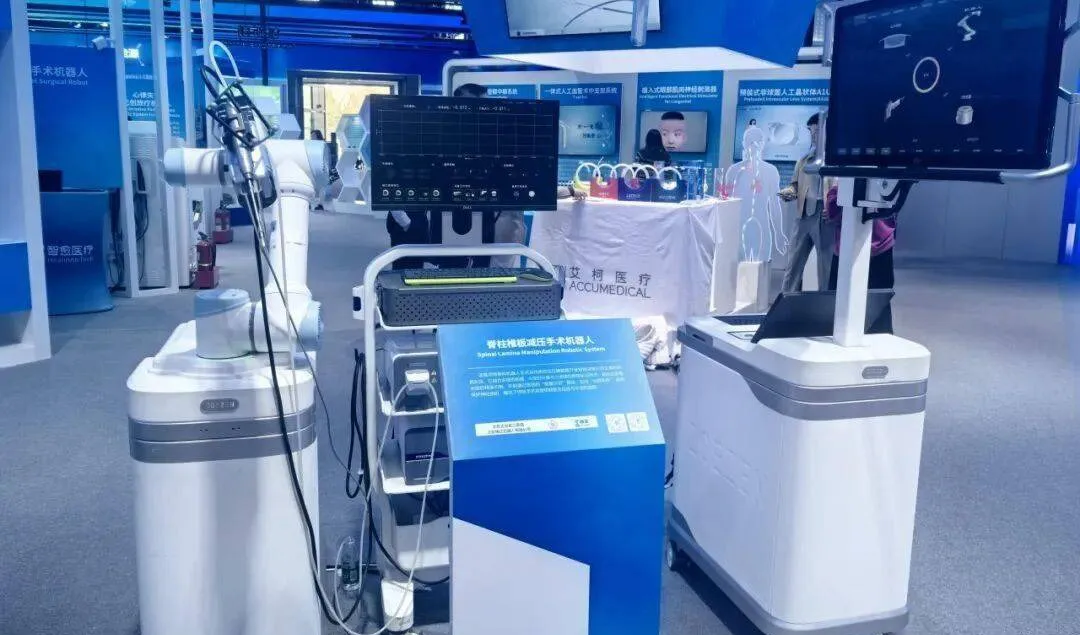
The "cut-through-and-stop" rule is the safety architecture: rather than relying on a pre-operative plan that assumes the bone is where imaging said it was, the robot monitors the machining signal — torque, vibration, acoustic emission — and halts when the signature changes to soft tissue. That matters because the ligamentum flavum lies directly over the dura, and its thickness varies [2].
What has been reported
The first case, in July 2023, was an older man with lumbar spinal stenosis causing back pain, bilateral leg pain and numbness, and intermittent claudication. The team performed posterior decompression plus fusion with the robot doing the laminar cut; there were no complications and symptoms improved. The developers describe the advance as moving orthopaedic robotics from positioning assistance to intelligent decision-making and autonomous operation [3][4].
The sources do not report how many cases have been done, how often the robot converted to manual cutting, or whether cerebrospinal fluid leaks or dural tears occurred at a different rate than in manual surgery. Autonomy also raises regulatory and liability questions that are not addressed. The claim that it is a world first appears to be based on the developers' literature search and has not been independently verified [1][4].
The condition in context: lumbar spinal stenosis
Degenerative stenosis is one of the commonest reasons for spine surgery in older adults, and its prevalence is rising with ageing.
| Region | What the data shows | Source |
|---|---|---|
| Burden | Thoracolumbar stenosis and disc herniation are increasingly common as the population ages [3]. | ScienceNet [3] |
| Technical risk | Laminectomy is a high-difficulty step because the spinal cord and nerves lie immediately beneath [3]. | ScienceNet [3] |
| China | The robot has domestic intellectual property and is being commercialised [1][5]. | Sina / Tonghuashun [1][5] |
Because the operation is common, small improvements in safety and consistency have large aggregate effects [3].
Why it matters
| Potential | What the report suggests | Source |
|---|---|---|
| Consistency | Cutting is guided by sensing rather than by hand feel alone [2]. | [2] |
| Safety rule | Automatic stop when bone is breached [2]. | [2] |
| Caution | Case numbers and complication rates not published [4]. | [4] |
Availability and limits
- This is an editorial summary of hospital and trade-fair reporting, not a treatment recommendation [1][2].
- Clinical adoption appears limited; case volume is not reported [3].
- Regulatory status beyond device development is not described [5].
- Autonomous cutting still requires a surgeon supervising the operation [2].
- Cost and training requirements are undetermined [1].
What to ask before booking
| Question | Why it matters |
|---|---|
| Is robotic decompression available for my level and anatomy? | Not all stenosis patterns suit the technique [3]. |
| How many cases has the team done, and with what complications? | Case volume and audit data are not published [4]. |
| Which department handles foreign patients, and in what language? | PKU Third Hospital is a working hospital we do not book; confirm international-department coordination and language support. |
| Is a conventional decompression still an option? | Standard surgery remains the benchmark [3]. |
Questions patients ask
What was developed?
A spine laminectomy robot that plans the decompression path from imaging and cuts the lamina autonomously, stopping when tissue sensing indicates the bone has been breached [2][3].
Who led it?
Li Weishi, director of orthopaedics at Peking University Third Hospital [1][3].
Has it been used in patients?
Yes — the first autonomous case was in July 2023, in an older man with lumbar spinal stenosis, with no complications reported [3][4].
Is it better than manual surgery?
Not established — comparative complication and outcome data are not published in the sources reviewed [1].
Is this relevant to international patients?
It is useful context for China's surgical robotics. PKU Third Hospital is a working hospital we do not book — contact its international department directly [1].