
Quick answer
Allogeneic stem cell transplantation for a haematological malignancy destroys the ovaries in essentially every patient — conditioning chemotherapy and total body irradiation leave permanent ovarian failure. Egg freezing takes two weeks of stimulation and cannot wait when a transplant is urgent, and it does not work in prepubertal girls. Ovarian tissue cryopreservation does: tissue is removed laparoscopically in a day, frozen, and later reimplanted. Peking University Third Hospital's fertility preservation team has now reported a live birth from that pathway — China's third published case, and the fastest natural conception domestically at seven months after transplantation [1][2][5].
Key takeaways
- Patient: diagnosed with myelodysplastic syndrome in 2021, requiring allogeneic stem cell transplantation [1].
- June 2021: laparoscopic bilateral ovarian tissue harvest and cryopreservation [1][2].
- April 2024: disease cured, tissue reimplanted to restore endocrine function and fertility [2].
- Seven months after transplantation she conceived naturally — the fastest such interval recorded in China [1][5].
- Baby born in 2025, healthy at four months, 6.4 kg and 63 cm, per the team's follow-up [1][4].
What the procedure actually involves
The surgery is a laparoscopy lasting about an hour: the ovarian cortex is stripped and cut into thin strips, which are slow-frozen or vitrified. Later, the strips are thawed and reattached — to the remaining ovary, to a peritoneal window, or as a graft — where they revascularise over weeks. Follicles resume growth, hormones return, and ovulation may follow [3][5].
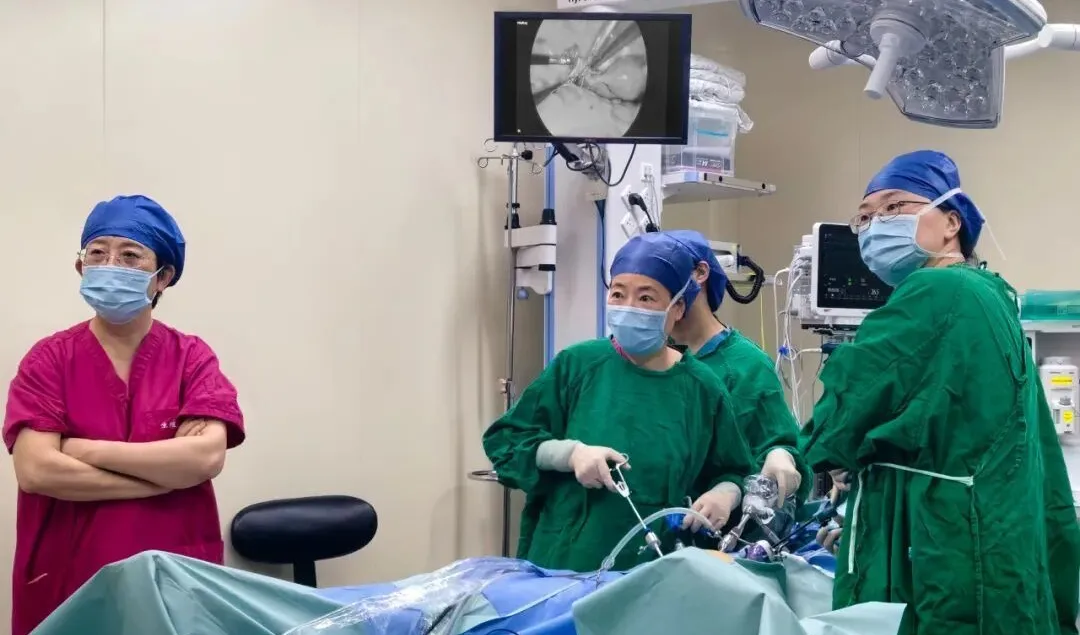
In this case the graft restored both endocrine function and ovulation without IVF, which is the outcome that matters most: the patient had complete ovarian failure and hormone replacement therapy for nearly three years [2].
Why this is rare, and why that matters
Ovarian tissue transplantation is technically established internationally, with more than 200 live births reported worldwide. In China, this is the third published case, which reflects the logistics rather than the biology: harvesting must happen before conditioning, coordination between haematology and reproductive medicine must be immediate, and tissue banking has only recently become available outside a handful of centres [1][5].
In leukaemia and myelodysplasia there is a theoretical hazard that frozen tissue carries malignant cells back at reimplantation; that is why this pathway is more established in solid tumours and why some centres require minimal residual disease testing or avoid reimplantation in high-risk leukaemia. Mature oocyte and embryo cryopreservation remain the default where time allows. A single live birth demonstrates feasibility and safety in this patient, not in the disease category as a whole, and the graft's lifespan is finite — typically a few years — so a second menopause is expected [3][5].
The condition in context: fertility after cancer treatment
Gonadotoxic therapy is the commonest iatrogenic cause of infertility in young women.
| Region | What the data shows | Source |
|---|---|---|
| Risk | Ovarian failure after transplant conditioning is essentially universal [1]. | Peking University Third Hospital [1] |
| Alternatives | Embryo, oocyte and sperm cryopreservation are already routine in assisted reproduction [5]. | Peking University Third Hospital [5] |
| Programme | National fertility preservation activities led by Qiao Jie and Li Rong, with Yan Jie, Song Xueling and Zhang Xinyu [5]. | Peking University Third Hospital [5] |
Because tissue cryopreservation is the only option that does not delay cancer treatment, its availability is an equity issue as much as a technical one [2][5].
Why it matters
| Potential | What the report suggests | Source |
|---|---|---|
| No delay | Harvest takes one operation, not two weeks of stimulation [3]. | [3] |
| Endocrine benefit | Hormone function restored, not only fertility [2]. | [2] |
| Caution | Third Chinese case; finite graft lifespan [1][5]. | [1][5] |
Availability and limits
- This is an editorial summary of a hospital case report, not a treatment offer [1][2].
- Few Chinese centres bank ovarian tissue [1].
- Reimplantation is generally avoided in high-risk leukaemia because of contamination risk [3].
- Graft function lasts a few years, usually requiring a second transplant or HRT [5].
- Success depends on acting before conditioning begins [1].
What to ask before booking
| Question | Why it matters |
|---|---|
| How long until my conditioning starts? | That window determines which option is possible [1]. |
| Is tissue banking available at this hospital? | Only a few Chinese centres offer it [1]. |
| Which department handles foreign patients, and in what language? | Peking University Third Hospital is a working hospital we do not book; confirm international-department coordination and language support. |
| Is reimplantation safe in my specific diagnosis? | Contamination risk differs by disease [3]. |
Questions patients ask
What was done?
Ovarian tissue was harvested laparoscopically and cryopreserved before a stem cell transplant for myelodysplastic syndrome, then reimplanted in 2024 after cure. The patient conceived naturally seven months later and delivered a healthy baby [1][2].
Why not freeze eggs instead?
Egg freezing requires two weeks of stimulation and cannot wait when transplant is urgent; it also does not serve prepubertal girls [3].
Is this common in China?
No — this is the third published live birth from the technique in China, reflecting limited tissue banking capacity [1].
How long does the graft work?
Typically a few years, after which a second transplant or hormone therapy is needed [5].
Is this relevant to international patients?
It is useful context for China's fertility preservation services. The hospital is a working hospital we do not book — contact its international department directly [1].