
Quick answer
The hard part of a total knee replacement is not cutting bone — it is matching the new joint to the patient's ligaments and soft tissues. Mako Total Knee 2.0 addresses that with a dynamic tensioner that measures soft-tissue balance in the operating theatre and feeds it into the plan. On 8 May 2026, Tian Hua's joint surgery team at Peking University Third Hospital performed China's first cases, operating on three patients with severe osteoarthritis and deformity [1][2].
Key takeaways
- Three patients with severe knee osteoarthritis and deformity operated on 8 May 2026 [1].
- The 2.0 upgrade centres on Functional Knee Positioning with a proprietary Digital Tensioner [1].
- Planning uses pre-operative CT three-dimensional reconstruction and intelligent planning [1].
- AccuStop provides real-time data feedback and boundary control during the cut [1].
- Tian Hua's group has also published comparative work on joint-line restoration with Mako versus conventional instruments [3].
What changed from 1.0
Mako 1.0 is a CT-based haptic robotic arm: the surgeon plans component position on a three-dimensional model, and the arm constrains the saw to that plan. It improves alignment accuracy, but the plan is still built before the surgeon can feel how tight the ligaments are [1].
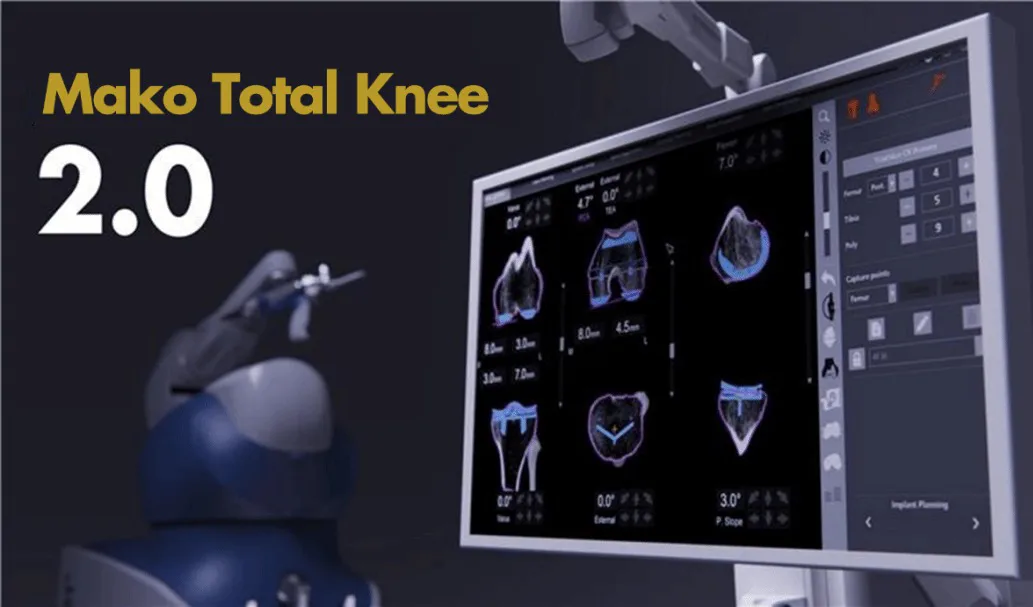
Version 2.0 adds the missing loop: a digital tensioner applies controlled stress across the joint and measures the resulting gap and laxity at each step, so the plan can be adjusted to the patient's actual soft-tissue envelope rather than a population average. In principle that matters most in severe deformity, where the ligaments have adapted to years of malalignment — exactly the three cases selected here [1].
What the hospital reported
All three operations were completed as planned, with component position and soft-tissue balance checked against the intraoperative data. The hospital describes the adoption as a step toward individualised functional reconstruction rather than alignment alone [1].
Three cases at one centre demonstrate feasibility, not superiority. Whether dynamic soft-tissue balancing improves patient-reported outcomes, satisfaction or implant survival over 1.0 or conventional instrumentation is an open question internationally. Tian Hua's group's own propensity-matched study found Mako better restored joint-line height than conventional instruments — a radiographic endpoint, not a clinical one [1][3][5].
The condition in context: knee osteoarthritis
Knee replacement is one of the most common elective operations, and outcomes depend on alignment, balance and soft-tissue handling.
| Region | What the data shows | Source |
|---|---|---|
| Technical goal | Alignment and soft-tissue balance determine function and implant survival [1]. | PKU Third Hospital [1] |
| Evidence | Mako better restored joint-line height than conventional instruments in a 1:1 matched study [3]. | Chinese Journal of Clinical New Medicine [3] |
| China | The hospital's joint surgery volume is among the largest in Asia [4]. | OrientHealthLink [4] |
Because most knee replacements already last 15–20 years, the value of a new robot is in reducing outliers, not in rescuing failures [1][3].
Why it matters
| For the patient | What the report suggests | Source |
|---|---|---|
| Soft-tissue fit | Balance is measured rather than estimated [1]. | [1] |
| Deformity | The technique was used in severe deformity cases [1]. | [1] |
| Caution | No clinical outcome data yet [2]. | [2] |
Availability and limits
- This is an editorial summary of hospital reports, not a treatment recommendation [1].
- Three cases; no comparative clinical outcomes [1][2].
- Robotic systems add cost and operating time [4].
- Surgeon experience remains the dominant factor in outcome [4].
- Long-term implant survival with this version is unknown [3].
What to ask before booking
| Question | Why it matters |
|---|---|
| Is my deformity severe enough to benefit from robotic balancing? | The technology matters most in complex cases [1]. |
| How many robotic knee replacements has my surgeon done? | Experience drives both accuracy and safety [4]. |
| Which department handles foreign patients, and in what language? | PKU Third Hospital is a working hospital we do not book; confirm international-department coordination and language support. |
| What is the additional cost? | Robotic surgery is priced above conventional TKA [4]. |
Questions patients ask
What was the first?
China's first Mako Total Knee 2.0 robotic knee replacements, performed by Tian Hua's team at Peking University Third Hospital on 8 May 2026 [1].
What is new in 2.0?
Functional Knee Positioning with a Digital Tensioner that measures soft-tissue tension intraoperatively, alongside CT-based planning and AccuStop boundary control [1].
How many patients?
Three, all with severe knee osteoarthritis and deformity [1].
Is it proven better than 1.0?
No clinical comparison has been published; the group's own study showed better radiographic joint-line restoration versus conventional instruments [3].
Is this relevant to international patients?
It is useful context for China's robotic orthopaedics. PKU Third Hospital is a working hospital we do not book — contact its international department directly [1].