
Quick answer
On 5 September 2026, the cardiovascular medicine department of PLA General Hospital's Sixth Medical Center completed an artificial-intelligence ultrasound robot-guided transcatheter closure of an atrial septal defect in a 48-year-old man. A technology-novelty search reported it as the world's first clinical use of this class of intelligent system for congenital heart defect closure [1][2].
Key takeaways
- The patient was a 48-year-old man with an atrial septal defect whose residual rim was too poor for standard catheter closure; several hospitals had recommended open-heart surgery [1][2].
- The AI ultrasound robot performs autonomous ultrasound scanning, identifies and locks onto the defect, builds a real-time 3D cardiac model and plans a safe path [3][4].
- Critically, the robot did not deliver the catheter — it took over intraoperative imaging and navigation, the part normally done by a sonographer holding the probe [4].
- The closure reportedly took about 25 minutes, with the robot providing stable imaging and precision in a hard case [2].
- It is a first-in-human-class demonstration in one patient; broader benefit and safety need larger studies [1][4].
The case and the technology
Atrial septal defect (ASD) is a hole between the heart's upper chambers. Small defects may close on their own; larger ones need closure — usually by a catheter-delivered device, or by open surgery when the defect's rim is unfavourable. In this case the rim was so poor that multiple tertiary hospitals advised open-heart surgery, but the patient wanted a minimally invasive option [1][2].
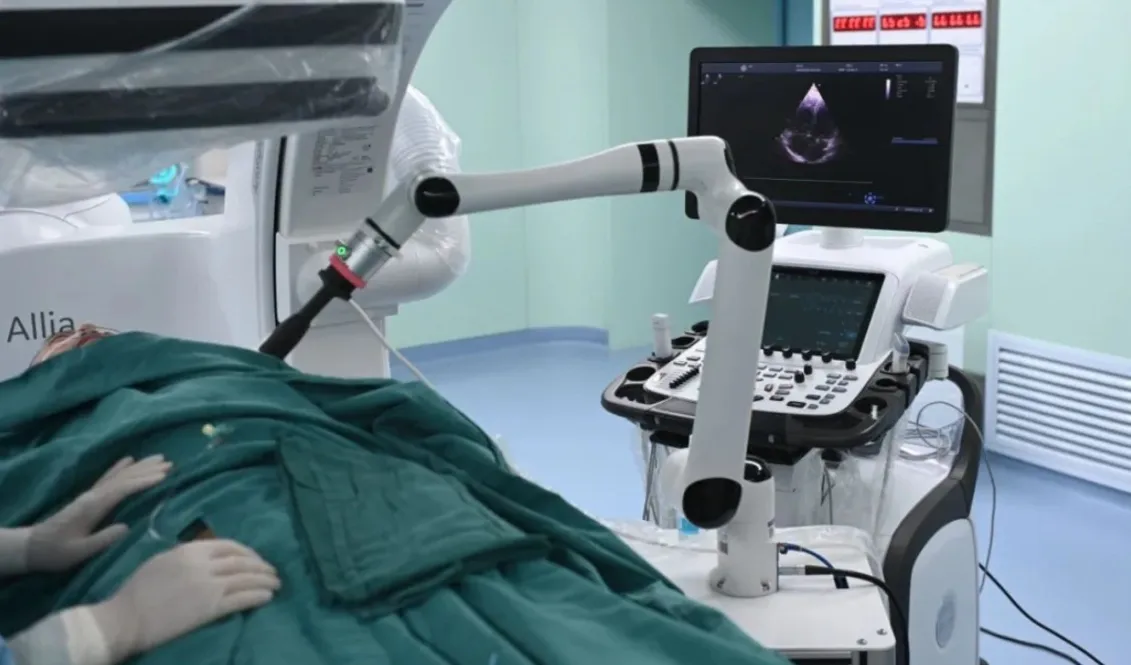
Conventional structural-heart intervention depends heavily on a sonographer hand-holding the probe, repeatedly finding standard views and judging anatomy in real time — a task limited by probe stability and the difficulty of identifying complex targets. The AI ultrasound robot, developed by Zhu Hang's team at the Sixth Medical Center with Tsinghua University's Huang Gao team, instead uses a robotic arm for stable autonomous scanning and AI algorithms to outline the defect and build a 3D model, turning experience-dependent 2D reading into standardised, reproducible 3D navigation [3][4].
What was reported
The team — Zhu Hang (deputy director of structural heart disease), Zhou Hao and Wang Jing — planned an individualised minimally invasive strategy. During the procedure the robot autonomously acquired images, located the lesion and provided real-time navigation, helping the team select and implant the occluder accurately; the closure was completed in about 25 minutes [1][2].
This is a world-first demonstration in one patient, confirmed by a technology-novelty search rather than a comparative trial. It shows feasibility in a complex anatomy; whether it improves outcomes at scale needs larger, controlled studies [1][2].
The condition in context: congenital heart disease
Congenital heart defects are the most common type of birth defect, and many are now treated with catheter-based rather than open surgery.
| Region | What the data shows | Source |
|---|---|---|
| Worldwide | Congenital heart defects affect roughly 1 in 100 babies and are the most common birth defect [5]. | Centers for Disease Control and Prevention [5] |
| The challenge | Defects with poor rims are hard to close by catheter and are often referred for open surgery [1][2]. | PLA General Hospital reports [1][2] |
| China | PLA General Hospital's Sixth Medical Center and Tsinghua developed the AI ultrasound robot and ran the first case [3][4]. | Tsinghua / media [3][4] |
Because CHD is common and catheter closure is preferred when possible, better intraoperative imaging and navigation could widen who can avoid open surgery [1][5].
Why it matters
| Potential | What the report suggests | Source |
|---|---|---|
| Precision | Stable robotic imaging plus 3D navigation could raise accuracy in complex anatomy [3][4]. | [3][4] |
| Access | Might let some poor-rim patients avoid open surgery, though this is early [1][2]. | [1][2] |
| Caution | One patient, no control group; long-term outcomes and wider safety are unproven [1][4]. | [1][4] |
Availability and limits
- This is an editorial summary of hospital, university and media reports, not an independent clinical assessment or a booking channel [1][2][3][4].
- The case is a single first-in-human demonstration; it is not a routine, broadly available service [1][2].
- The "world-first" status comes from an authoritative technology-novelty search, not a peer-reviewed comparative trial [1][4].
- Whether such a procedure fits a given patient depends on the defect's anatomy and a specialist's judgement [1].
- Burden figures describe congenital heart disease generally and come from the CDC, not this case [5].
What to ask before booking
| Question | Why it matters |
|---|---|
| Is my defect suitable for catheter closure at all? | Rim anatomy decides feasibility; ask a structural-heart specialist [1][2]. |
| Is the AI ultrasound robot available, or is this still research? | It is an early demonstration, not a standard service [1][2]. |
| Which department handles foreign patients, and in what language? | This is a working hospital we do not book; confirm international-department coordination and language support. |
| How are pre-op imaging, the procedure and follow-up scheduled around travel? | Cardiac closure needs imaging, the procedure and post-op review; plan visits accordingly. |
Questions patients ask
What was the world-first procedure?
An AI ultrasound robot-guided transcatheter closure of an atrial septal defect in a 48-year-old man, performed at PLA General Hospital's Sixth Medical Center on 5 September 2026 [1][2].
What does the robot actually do?
It performs autonomous ultrasound scanning, identifies and locks onto the defect, builds a real-time 3D cardiac model and plans navigation; it does not deliver the catheter itself [3][4].
Why was this case hard?
The defect's residual rim was poor, so several hospitals recommended open-heart surgery; conventional catheter closure is difficult in such anatomy [1][2].
Is this available to patients now?
No, not as a routine service. It is a single first-in-human demonstration confirmed by a technology-novelty search; larger studies are needed before broad use [1][4].
Is this relevant to international patients considering cardiac care in China?
It is useful context for China's structural-heart innovation. PLA General Hospital is a working hospital we do not book — for closure assessment, contact its international department directly and confirm language support and logistics [1][3].