
Quick answer
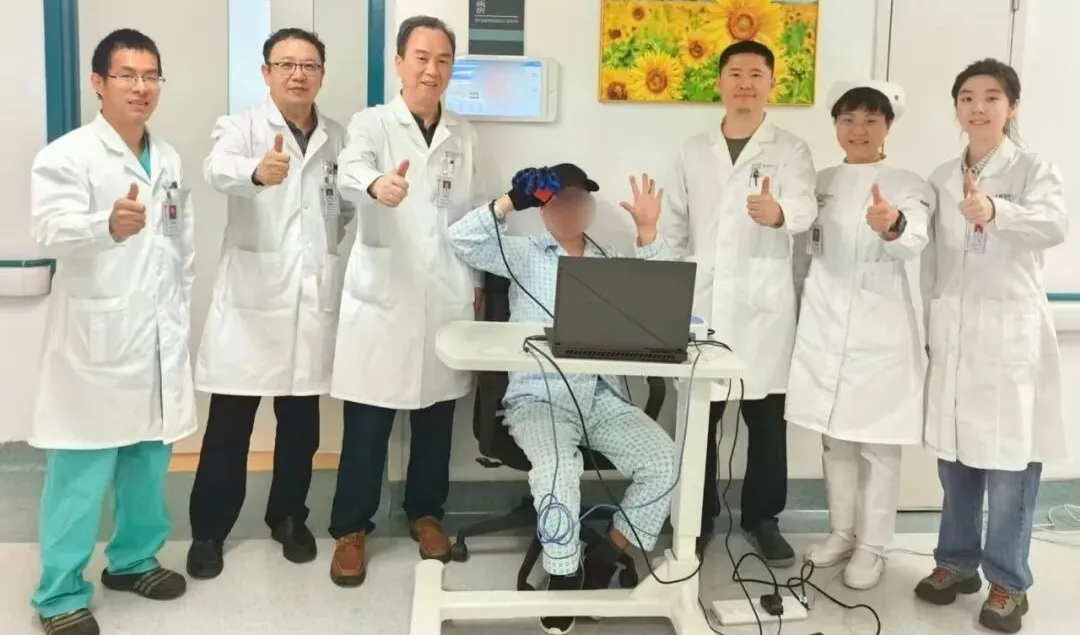
Most stroke survivors with severe arm weakness never recover useful hand function, and rehabilitation plateaus. A brain-computer interface attacks the problem from the other end: it reads the patient's movement intention directly from the cortex and uses that signal to drive rehabilitation. In March 2026, Zhang Jianning's neurosurgery team at PLA General Hospital implanted a fully domestic flexible BCI in a 40-year-old man with right hemiplegia. Within a month he could grasp, pour water and write Chinese characters [1][2][4].
Key takeaways
- Patient: 40-year-old man, right hemiplegia for two years after a haemorrhagic stroke [2][4].
- Implant: high-channel-count flexible thin-film electrode array placed epidurally over the motor cortex, plus a domestic wireless transmission chip [1][4].
- Technique: minimally invasive, through a small skull window, without opening the dura or touching brain tissue [1][4].
- Function: grasp and pouring water within the first month; handwriting after further training, with decoding accuracy above 95% [2][4].
- The team describes it as the first military-wide case using a fully domestic BCI chain for post-stroke hemiplegia [4].
How the system works
Before surgery the team built a high-resolution image model of the patient's cortex to localise the upper-limb motor area and plan electrode placement. The electrode array — flexible enough to conform to the curved cortical surface — was laid on the dura over that area, and a wireless chip was implanted and fixed. Together they form a complete chain: cortical signal acquisition, wireless transmission and closed-loop modulation [1][4].
The epidural route is a deliberate safety choice: no dural opening, no electrodes in the brain parenchyma, and therefore lower infection and bleeding risk than penetrating arrays. The cost is a weaker signal, which places more weight on electrode density and decoding algorithms [1][4].
The rehabilitation result
Grasp returned early, which is the usual first milestone. Handwriting is a harder test: it requires coordinated control of many small muscles and graded force, and the team reports that decoding of the patient's writing intention stayed above 95% accuracy. Writing is not a functional necessity in itself, but as a proxy for fine motor control it is a meaningful step beyond gross grasp [2][4][5].
This is a single case, described through hospital and press reports rather than a peer-reviewed trial. Brain-computer interfaces for stroke rehabilitation have shown promising results in small studies internationally, but separating the BCI effect from intensive rehabilitation is difficult — the training itself matters. Whether the improvement persists when training stops, and whether it generalises to patients with larger lesions or longer paralysis, are open questions [1][2].
The condition in context: post-stroke hemiplegia
Stroke is a leading cause of adult disability, and upper-limb recovery is the hardest part of rehabilitation.
| Region | What the data shows | Source |
|---|---|---|
| China | More than 2 million new stroke cases occur each year, and about 70% have residual disability [5]. | NetEase / Health News [5] |
| Recovery gap | Conventional rehabilitation often plateaus, leaving severe hand impairment [2]. | People's Daily [2] |
| Platform | The team works within Beijing's key laboratory for BCI and brain-disease neuromodulation [2]. | People's Daily [2] |
Because hand function determines independence more than walking in many patients, a therapy that targets distal control addresses an unmet need [2][5].
Why it matters
| Potential | What the report suggests | Source |
|---|---|---|
| Fine motor | Handwriting represents a step beyond gross grasp [2][4]. | [2][4] |
| Domestic chain | Electrodes, chip and system are all domestically developed [1][4]. | [1][4] |
| Caution | Single case, no controlled comparison [1]. | [1] |
Availability and limits
- This is an editorial summary of hospital and press reports, not a treatment offer [1][2].
- It describes one patient; no trial data are available [3].
- The device is investigational and requires neurosurgery [1].
- Implanted hardware carries infection, hardware failure and revision risks [4].
- Rehabilitation intensity is part of the treatment, not an optional extra [2].
What to ask before booking
| Question | Why it matters |
|---|---|
| Is my stroke lesion compatible with cortical recording? | Extensive cortical damage limits available signal [1]. |
| Is a trial recruiting, and what does follow-up involve? | Only research participation is currently possible [3]. |
| Can foreign patients be accepted, and through which office? | Access rules at military hospitals differ [1]. |
| What rehabilitation programme runs alongside? | The BCI is a rehabilitation tool, not a standalone cure [2]. |
Questions patients ask
What was implanted?
A fully domestic, minimally invasive flexible brain-computer interface: a high-channel flexible thin-film electrode array placed epidurally over the motor cortex with a wireless transmission chip [1][4].
What did the patient regain?
Grasp and pouring water within the first month, and handwriting after further training, with decoding accuracy above 95% [2][4].
Why epidural?
It avoids opening the dura and placing electrodes in brain tissue, reducing infection and bleeding risk [1].
Is it available as treatment?
No — it is investigational, described as a single case within a research programme [3].
Is this relevant to international patients?
It is useful context for China's neurotechnology. Access rules at military hospitals should be confirmed directly with the hospital [1].