
Quick answer
On 5 August 2026, the implant team at Peking University School and Hospital of Stomatology's Sanya hospital, working with oral-maxillofacial surgery, anaesthesia, internal medicine and nursing, performed Hainan's first autologous iliac-bone reconstruction of a severe maxillary defect. The patient had congenital absence of multiple upper teeth and only about 1 mm of residual alveolar bone — too little for conventional implants — and the procedure was done in a 3.5-hour operation [1][2].
Key takeaways
- The patient, surnamed Li, was missing teeth at positions 15–25 with a severe maxillary alveolar defect; horizontal bone was only about 1 mm, so many clinics judged implants impossible [1][4].
- The team used a two-site approach under general anaesthesia: harvesting a bone block from the anterior iliac crest, then reconstructing the maxilla [1][2].
- The operation took about 3.5 hours and required coordinated oral-maxillofacial, anaesthesia and medical teams [2].
- It is Hainan's first such case, delivered in Sanya by PKU Stomatology's "rotating resident experts + local team learning" model [1][3].
- It is a single complex case demonstrating feasibility; longer-term implant and bone outcomes will follow [1].
The case and the technique
Severe maxillary alveolar deficiency is a classic barrier to dental implants: without enough bone, there is nothing to anchor an implant. For patients missing many teeth, rebuilding the ridge with an autologous bone block can restore the foundation, but it means two surgical sites — the donor iliac crest and the recipient maxilla — which is technically demanding and higher-risk [1][2].
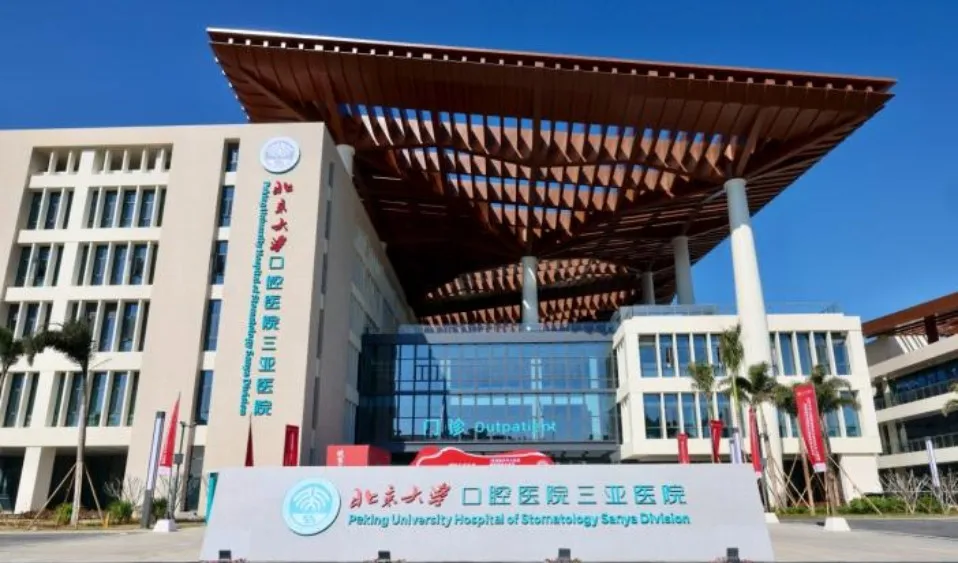
The team, led by Ouyang Siyuan (a deputy chief physician from the head hospital's implant department, dispatched to Sanya), judged that an anterior iliac-crest block graft was feasible despite the difficulty, and planned the procedure with a multidisciplinary assessment of the patient's condition and surgical risks [1][2].
What was reported
Under general anaesthesia, two senior surgeons harvested the iliac bone and reconstructed the maxilla; the Sanya hospital reports the operation took about 3.5 hours. It is described as the first autologous iliac-bone reconstruction of a severe maxillary defect in Hainan [1][2].
This is one patient's operation, reported by the hospital and local government to show capability, not a comparative trial. It demonstrates feasibility of complex reconstruction outside the head hospital; implant survival and long-term bone stability will need follow-up [1][2].
The condition in context: severe alveolar bone loss
Tooth loss and severe periodontal disease are common worldwide, and when bone is severely resorbed, implant treatment becomes much harder.
| Region | What the data shows | Source |
|---|---|---|
| Worldwide | Oral diseases affect about 3.5 billion people; severe gum disease and tooth loss are widespread, and can leave too little bone for implants [5]. | World Health Organization [5] |
| The barrier | With roughly 1 mm of residual bone, standard implants are not possible without grafting [1][4]. | PKU Stomatology reports [1][4] |
| China | The Sanya hospital delivered the first such case in Hainan via head-hospital expertise [1][3]. | PKU Stomatology / Sanya government [1][3] |
Because severe bone loss is common and disabling for chewing, techniques that rebuild the ridge where patients live — not only at a capital's head hospital — widen access to implants [1][3].
Why it matters
| For the patient | What the report suggests | Source |
|---|---|---|
| Restored option | Bone grafting can make implants possible when bone was judged too thin [1][2]. | [1][2] |
| Local access | Head-hospital experts rotating to Sanya let complex cases be done locally [1][3]. | [1][3] |
| Caution | Two-site grafting is demanding and higher-risk; it needs an experienced team [1][2]. | [1][2] |
Availability and limits
- This is an editorial summary of hospital and government reports, not an independent clinical assessment or a booking channel [1][2][3].
- It is a single complex case, not a controlled study; outcomes of the graft and implants will need follow-up [1].
- Whether grafting is suitable depends on each patient's bone, health and goals, assessed by a specialist [1][2].
- Two-site bone harvesting is more demanding than routine implant surgery and carries added risks [1][2].
- Burden figures describe oral disease generally and come from WHO, not this case [5].
What to ask before booking
| Question | Why it matters |
|---|---|
| Do I have enough bone for implants, or is grafting needed? | Bone volume decides the plan; ask for imaging and a specialist assessment [1][4]. |
| Is this hospital experienced in complex bone grafting? | Two-site reconstruction needs an experienced, multidisciplinary team [1][2]. |
| Which department handles foreign patients, and in what language? | Sanya hospital is a working hospital we do not book; confirm international-department coordination and language support. |
| How are grafting, healing and implant placement scheduled around travel? | Bone grafting needs healing time before implants; plan multiple visits. |
Questions patients ask
What is an iliac-bone maxillary reconstruction?
It uses a block of the patient's own bone, taken from the anterior iliac crest, to rebuild missing upper-jaw bone — here in a severe maxillary defect, so dental implants become possible [1][2].
Why could this patient not just get implants?
The patient had congenital absence of teeth at positions 15–25 and only about 1 mm of horizontal alveolar bone; without rebuilding, there was too little bone to anchor implants [1][4].
How long did the operation take?
The Sanya hospital reports about 3.5 hours, with two surgical sites working in sequence under general anaesthesia [2].
Is this a routine service now?
It is Hainan's first such case and demonstrates capability; complex grafting is done by an experienced team, and suitability depends on each patient [1][2].
Is this relevant to international patients considering dental care in China?
It is useful context for China's complex implant work. The Sanya hospital is a working hospital we do not book — contact its international department directly and confirm candidacy, language support and travel logistics [1][3].