
Quick answer
Implant planning is a three-dimensional puzzle: the titanium root must sit in enough bone, avoid the adjacent roots, the buccal and lingual plates, the maxillary sinus and the mandibular canal, and still allow a crown that looks right. A team at Peking University School of Stomatology tested an AI system that performs that planning from CBCT and intraoral scans. In 20 single-tooth cases, the AI-selected implants met the distance criteria and 90% satisfied the safety clearance to the sinus or nerve canal [1][2].
Key takeaways
- 20 patients (9 men, 11 women; mean age 59.5) with a single missing tooth [2].
- CBCT and intraoral scans were imported into AI software for 3D reconstruction, implant selection, tooth-position identification and crown design [2].
- Implants ended 3.05±1.44 mm from adjacent roots and 2.52±0.65 mm from the bone plate edge [2].
- 90% of cases met the required safety distance to the maxillary sinus or mandibular canal [1].
- Two patients needed sinus lift or bone augmentation, which the system flagged [2].
What the study did
Published in the Journal of Oral Rehabilitation, the study is a preclinical case series rather than a randomised trial: the aim was to check whether AI planning produces positions a clinician would accept, and whether it catches the anatomical risks that make single-tooth implants tricky [1][2].
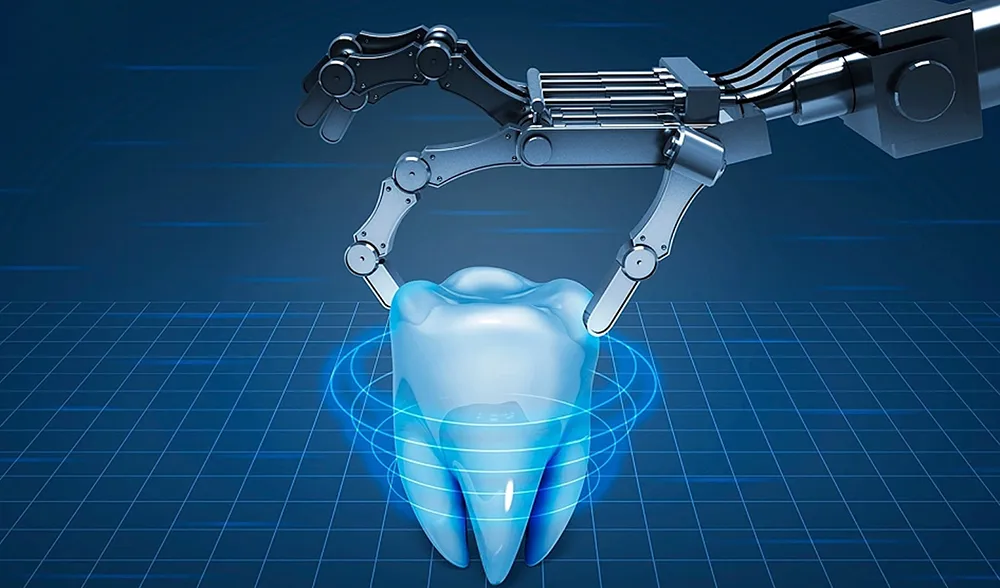
The system reconstructs the jaw in 3D, proposes an implant type and position, identifies the target tooth position, and designs the crown. It also raises risk warnings — insufficient bone volume, proximity to the sinus or nerve — and suggests steps such as sinus floor elevation [1].
What it found
All implants were placed within the planned positions, and the measured distances fell within accepted clinical ranges. The two patients whose bone was inadequate were identified in planning, not in the chair. The authors conclude that AI improves the precision and efficiency of single-tooth implant planning, while explicitly calling for larger studies to confirm safety and effectiveness [1][2].
Twenty cases, no control arm and no comparison with human-only planning means the study cannot show that AI planning is better than an experienced clinician — only that it is feasible and safe enough to test further. Single-tooth cases are also the simplest implant scenario; multiple and fully edentulous cases are harder [1][2].
The condition in context: tooth loss and implants
Dental implants are the main replacement for missing teeth, and planning errors are the commonest cause of avoidable complications.
| Region | What the data shows | Source |
|---|---|---|
| China | The digital implant market is forecast to grow more than 20% a year and exceed 10 billion yuan by 2026 [3]. | China Stomatology Network [3] |
| Anatomy | Single-tooth cases still carry sinus and nerve proximity risks requiring precise planning [2]. | Journal of Oral Rehabilitation [2] |
| AI evidence | Most AI implant studies remain preclinical or retrospective; a systematic review found high accuracy for implant identification but limited clinical validation [1][5]. | PKU team [1] |
Because implant failure and nerve injury are costly and sometimes permanent, planning tools that reliably flag risk have real clinical value — if they are validated beyond small series [1]. The department, as a national oral medicine centre, presents digital and AI planning as a core research theme [4].
Why it matters
| Potential | What the report suggests | Source |
|---|---|---|
| Precision | AI-proposed positions met distance criteria in all 20 cases [2]. | [2] |
| Risk flags | The system identified bone deficiency and sinus proximity in planning [1]. | [1] |
| Caution | No control group; clinical superiority unproven [1][2]. | [1][2] |
Availability and limits
- This is an editorial summary of a published case series, not a treatment recommendation [1][2].
- Only 20 single-tooth cases were studied, with no control arm [2].
- AI planning still requires a clinician's review and approval [1].
- Results in multiple-tooth or fully edentulous cases are not established [1].
- Market-growth figures describe the industry, not this system [3].
What to ask before booking
| Question | Why it matters |
|---|---|
| Who reviews and approves the AI-generated plan? | AI proposes; a clinician must verify [1]. |
| How is bone volume and sinus proximity assessed? | These determine whether grafting or sinus lift is needed [2]. |
| Which department handles foreign patients, and in what language? | PKU Stomatology is a working hospital we do not book; confirm international-department coordination and language support. |
| What is the total cost, including any grafting? | Grafting changes both cost and timeline [2]. |
Questions patients ask
What did the PKU study test?
An AI system that plans single-tooth implant surgery from CBCT and intraoral scans, including implant selection, position, crown design and risk warnings [1][2].
What were the results?
In 20 patients, implants met distance criteria (3.05±1.44 mm from adjacent roots, 2.52±0.65 mm from the bone plate) and 90% met the safety distance to the sinus or nerve canal [1][2].
Does this prove AI is better than a dentist?
No — there was no control group; the study shows feasibility and safety, not superiority [2].
Where was it published?
Journal of Oral Rehabilitation (DOI 10.1111/joor.14009) [1][2].
Is this relevant to international patients?
It is useful context for China's digital dentistry. PKU Stomatology is a working hospital we do not book — contact its international department directly [1].