
Quick answer
Total knee arthroplasty works well, but two of its hardest steps — restoring the mechanical axis and balancing soft tissues — still depend heavily on the surgeon's eye and hand. ROSA Optimize tries to make both measurable. Lin Jianhao's team at Peking University People's Hospital [4] used it for China's first case, planning the operation inside the theatre and cutting in a follow-the-motion mode, and reported that implant position and alignment matched the plan [1][2].
Key takeaways
- The hospital is the first in China to apply ROSA Optimize clinically [1].
- The system supports intraoperative planning, without a separate pre-operative CT [2].
- Surgery used a "follow-the-motion" mode for bone cuts, with real-time tracking [1][2].
- Implant position and limb alignment met the planned targets [1].
- The patient had severe knee disease with pain and walking difficulty [1].
The problem
Knee osteoarthritis is rising with the ageing population, and total knee replacement is the standard salvage operation. Conventional surgery is mature in China, but soft-tissue balance and restoration of the lower-limb mechanical axis remain dependent on experience; small errors in component rotation or alignment can cause pain, stiffness or early loosening [1].
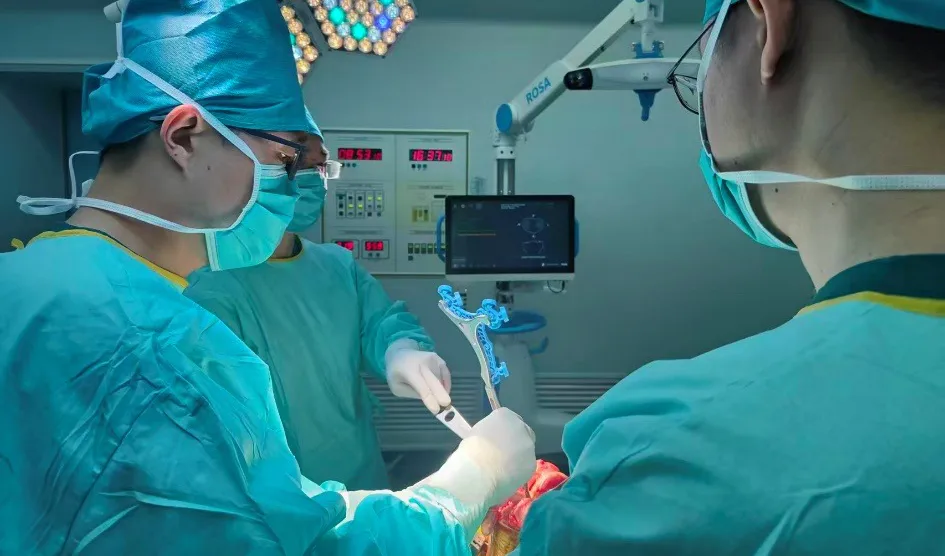
Robotic systems differ mainly in how they register the patient and how much they constrain the surgeon. ROSA Optimize's selling point is that it can be registered and planned on the table — acquiring anatomy, alignment and soft-tissue tension data intraoperatively — and then guide cuts while the surgeon retains control of the saw [2]. The platform registers intraoperatively through 3D modelling and optical tracking, with reported cutting precision around 0.1 mm, and is also used for revision cases [3][5].
What was reported
The team completed the planning quickly, performed the cuts in the guided mode, and confirmed that the final implant position and alignment were within the planned targets. The hospital frames the case as proof that the technology can be used clinically in China, not as evidence of better outcomes [1].
No comparative data are reported: this is a single case at one hospital. Whether robot-assisted knee replacement improves function, survivorship or patient satisfaction over conventional instrumentation is still contested internationally, and the technology adds cost and operating time. The claim supported here is feasibility and planning accuracy, not superiority [1][2].
The condition in context: knee osteoarthritis
Knee osteoarthritis is one of the commonest causes of disability in older adults, and replacement is the definitive treatment for advanced disease.
| Region | What the data shows | Source |
|---|---|---|
| China | Knee osteoarthritis incidence rises with population ageing, driving growth in replacement surgery [1]. | Beijing News [1] |
| Technical limits | Soft-tissue balance and alignment remain the main sources of variability in conventional TKA [1]. | Beijing News [1] |
| Robotic uptake | ROSA systems are used in joint replacement internationally, with intraoperative registration as a distinguishing feature [2][5]. | Science and Technology Daily [2] |
Because most knee replacements already last 15–20 years, the value of robotics lies in reducing outliers and improving consistency rather than in rescuing failed cases [1].
Why it matters
| For the patient | What the report suggests | Source |
|---|---|---|
| Accuracy | Planned alignment and position were achieved in this case [1]. | [1] |
| Workflow | Intraoperative planning avoids a separate pre-operative CT [2]. | [2] |
| Caution | No outcome trial; cost and time increase [1]. | [1] |
Availability and limits
- This is an editorial summary of hospital and media reports, not a treatment recommendation [1].
- It is a single first case, not comparative evidence [1][4].
- Robotic assistance does not remove the need for surgical judgement [2].
- Cost, availability and reimbursement vary [1].
- Long-term implant survival data for this system are not yet available [1].
What to ask before booking
| Question | Why it matters |
|---|---|
| Is robotic assistance likely to help my specific deformity? | Severe deformity and stiffness are where technology matters most [1]. |
| How many robotic knee replacements has my surgeon done? | Experience affects both accuracy and safety [1]. |
| Which department handles foreign patients, and in what language? | PKU People's Hospital is a working hospital we do not book; confirm international-department coordination and language support. |
| What is the additional cost of the robotic approach? | Robotic surgery is priced above conventional TKA [1]. |
Questions patients ask
What was the first?
China's first total knee arthroplasty assisted by the ROSA Optimize system, performed by Lin Jianhao's team at Peking University People's Hospital [1].
What does ROSA Optimize do?
It supports intraoperative planning and guided bone cuts with real-time tracking, without a separate pre-operative CT [2].
Is it proven better than conventional surgery?
No — the report describes one case; comparative outcome data are not presented [1].
Why does alignment matter?
Poor alignment or soft-tissue balance can cause pain, stiffness and early implant failure [1].
Is this relevant to international patients?
It is useful context for China's robotic orthopaedics. PKU People's Hospital is a working hospital we do not book — contact its international department directly [1].