
Quick answer
CAR-T cells and other engineered cell therapies are delivered in a narrow window: after lymphodepletion, during infusion, and through the week or two when cytokine release syndrome and neurotoxicity are most likely. Peking University People's Hospital opened a dedicated cell and gene therapy ward at its Tongzhou campus on 19 June 2026 to concentrate that work in one place, under the hospital's haematology department and the national haematology research centre [1][2].
Key takeaways
- Opened on 19 June 2026 at the Tongzhou campus; unveiled by Huang Xiaojun and vice president Wang Tianbing [1].
- It sits within the haematology department, the National Clinical Research Centre for Haematologic Diseases and the Peking University Institute of Haematology [1].
- It houses CAR-T clinical trials, including one for patients with molecular relapse after allogeneic transplant [1].
- The first patient, a woman with T-cell acute lymphoblastic leukaemia who relapsed after transplant, had lymphocytes collected and was awaiting infusion [2].
- The ward is designed for the monitoring cell therapy requires, not just for infusion [1].
Why a dedicated ward
Cell therapy is not a drug you can give on any ward. Patients are lymphodepleted first, then infused, then monitored closely for cytokine release syndrome and immune effector cell-associated neurotoxicity — complications that can escalate within hours. They also need apheresis, cryopreservation logistics and infection control during prolonged neutropenia [1].
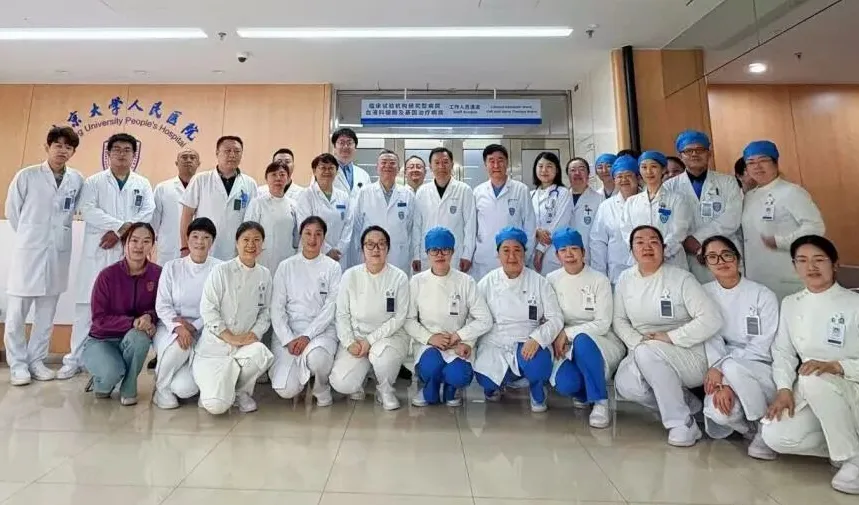
Putting those capabilities together shortens the path from trial eligibility to infusion, and gives the clinical team a single place to run protocols. For a hospital whose haematology department is one of Asia's largest transplant centres, the ward extends an existing transplantation infrastructure into engineered-cell therapy [1][3].
The patient story
The hospital described a woman with T-cell acute lymphoblastic leukaemia who had chemotherapy and an allogeneic transplant, then relapsed at the molecular level. She enrolled in a CAR-T study for post-transplant minimal-residual-disease positivity, had her lymphocytes collected, and was waiting for manufacture and infusion when the ward opened [2]. The hospital's research groups are also testing faster manufacturing and T-cell subsets selected for persistence, which is one route to making such treatments more reliable [5].
Opening a ward is a service development, not a clinical result. It does not tell us the response rate of the trials run there, and CAR-T for T-cell leukaemia remains more difficult than for B-cell disease because the target is shared with normal T cells. The ward's value will depend on the trials it hosts and their published outcomes [1][2].
The condition in context: relapsed blood cancer
For patients who relapse after transplant, options are limited and cell therapy is one of the few with curative intent.
| Region | What the data shows | Source |
|---|---|---|
| China | Seven CAR-T therapies are approved in China, more than in the US or Europe [4]. | China Hospitals Guide [4] |
| Cost | Approved CD19 or BCMA CAR-T costs roughly US$89,000–170,000 per course [4]. | China Hospitals Guide [4] |
| Transplant | PKU People's Hospital runs one of Asia's largest allogeneic transplant programmes [3]. | Hospital guide [3] |
Because relapse after transplant is common and hard to treat, having trial infrastructure co-located with transplant expertise matters clinically [1][3].
Why it matters
| For the patient | What the report suggests | Source |
|---|---|---|
| Access | A single ward streamlines eligibility, collection and infusion [1]. | [1] |
| Safety | Dedicated monitoring for CRS and neurotoxicity [1]. | [1] |
| Caution | Most CAR-T use here is in trials, not routine care [2]. | [2] |
Availability and limits
- This is an editorial summary of hospital announcements, not a treatment offer [1][2].
- Trial enrolment depends on disease, prior therapy and molecular status [2].
- CAR-T carries serious risks including CRS, neurotoxicity and prolonged cytopenias [1].
- Approved products are expensive; trial therapy may be covered differently [4].
- Outcomes for T-cell leukaemia remain inferior to B-cell disease [2].
What to ask before booking
| Question | Why it matters |
|---|---|
| Which trials are open for my disease and stage? | Eligibility is narrow and protocol-specific [2]. |
| How are CRS and neurotoxicity managed here? | These are the main early risks of CAR-T [1]. |
| Which department handles foreign patients, and in what language? | PKU People's Hospital is a working hospital we do not book; confirm international-department coordination and language support. |
| How long must I stay near the hospital? | Monitoring extends for weeks after infusion [1]. |
Questions patients ask
What opened?
A dedicated cell and gene therapy ward in the haematology department at Peking University People's Hospital's Tongzhou campus, opened on 19 June 2026 [1].
What is treated there?
CAR-T and other cellular therapies, largely within clinical trials, for relapsed blood cancers including post-transplant molecular relapse [1][2].
Who leads the department?
Huang Xiaojun, an academician and director of the National Clinical Research Centre for Haematologic Diseases and the Peking University Institute of Haematology [1].
Does this mean CAR-T is routine care?
No — much of the activity described is trial-based; approved products exist but are costly [2][4].
Is this relevant to international patients?
It is useful context for China's cell therapy capacity. PKU People's Hospital is a working hospital we do not book — contact its international department directly [1].