
Quick answer
Perianal and perineal necrotizing fasciitis is a rare, rapidly spreading soft-tissue infection with a reported mortality of roughly 65% in international series — one of the few infections where the diagnosis itself is an emergency. The core treatment is uncontroversial: early, aggressive, repeated debridement plus broad-spectrum antibiotics and intensive care. What Longhua Hospital's Gu's surgery group has added is a standardised perioperative package — multi-incision debridement with thread drainage, topical tissue-regenerating medicines, and oral herbal formulae tailored to the disease stage — and reports mortality below 9% [1][2][3].
Key takeaways
- Protocol structure: surgery, external therapy, internal regulation [1].
- Core operation: multiple incisions for thorough debridement, with drag-thread drainage to keep the tract draining [1][4].
- Adjuncts: tissue-corroding, granulation-promoting topical drugs and stage-differentiated herbal formulae [1].
- Reach: adopted at 23 hospitals in China, with more than 400 patients treated [1][3].
- Reported mortality below 9%, against about 65% in international reports [1].
Why drainage, not just debridement
Necrotizing fasciitis spreads along fascial planes faster than the skin changes suggest, so a single debridement often leaves residual infected tissue. The Longhua approach uses multiple small incisions to open the whole affected plane and places thread drains through them, which keeps the wound draining while allowing repeated irrigation without returning to theatre each time [1][4].
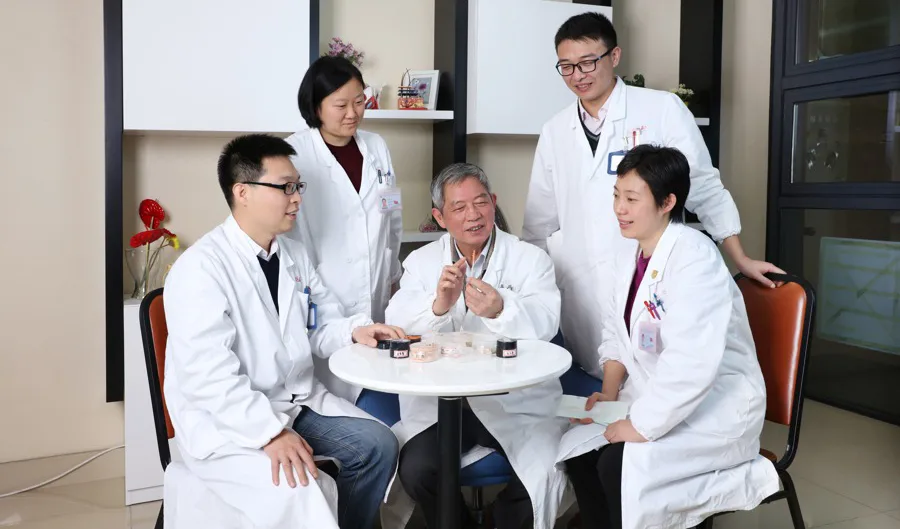
The published retrospective analysis of the standardised protocol found that formalising it shortened the interval from admission to surgery and the length of hospital stay, and reduced the reoperation rate, compared with the earlier era of the same technique applied without a written SOP [4]. That is a plausible mechanism for the mortality difference: in a time-dependent disease, process discipline is the intervention.
What the mortality figure can and cannot mean
A drop from 65% to under 9% would be extraordinary, and it should be read with care [1][3].
International mortality figures come from heterogeneous series that include patients who present late, are immunosuppressed, or have Fournier's gangrene of other origin; a specialist colorectal centre in Shanghai sees a narrower population, often referred early. The data are retrospective and drawn from a single centre's consecutive experience over two decades, during which antibiotics, imaging and critical care all improved. There is no randomised comparison, and the herbal components have not been tested in isolation. The defensible claim is that a standardised protocol is associated with low mortality in this centre's hands — not that Chinese medicine independently halves mortality [4].
The condition in context: necrotizing fasciitis
Survival is determined by time to debridement more than by any drug.
| Region | What the data shows | Source |
|---|---|---|
| Mortality | Reported at 12–35% overall, and much higher in perineal disease in some series [5]. | Tencent Medical Encyclopedia [5] |
| Delay | Delay beyond 24 hours can multiply mortality several-fold [6]. | Fujian Second People's Hospital [6] |
| Surgical principle | Incisions must extend beyond visible necrosis to healthy bleeding tissue, often needing 3–4 debridements [6]. | Fujian Second People's Hospital [6] |
Because the disease is time-dependent, anything that shortens the interval to definitive surgery plausibly improves survival [4][6].
Why it matters
| Potential | What the report suggests | Source |
|---|---|---|
| Standardisation | A written SOP shortened time to surgery and hospital stay [4]. | [4] |
| Sphincter preservation | Thread drainage avoids wide excision of perianal tissue [1]. | [1] |
| Caution | Retrospective, single centre, no control arm [4]. | [4] |
Availability and limits
- This is an editorial summary of conference and journal reporting, not a treatment recommendation [1][3].
- Mortality comparisons against international series are not case-mix adjusted [4].
- Antibiotics, intensive care and urgent debridement remain mandatory [6].
- The herbal components lack isolated trial evidence [1].
- Outcomes depend on a team familiar with the protocol [4].
What to ask before booking
| Question | Why it matters |
|---|---|
| How soon after arrival will I go to theatre? | Delay is the strongest predictor of death [6]. |
| Will debridement be repeated as needed? | Residual necrosis is common after a single pass [6]. |
| Which department handles foreign patients, and in what language? | Longhua is a working hospital we do not book; confirm international-department coordination and language support. |
| How is continence protected? | Perianal disease threatens sphincter function [1]. |
Questions patients ask
What is the protocol?
A combined approach: multiple incisions for thorough debridement with thread drainage, tissue-regenerating topical medicines and stage-differentiated oral herbal formulae [1][4].
What mortality is reported?
Below 9%, compared with about 65% in international reports cited by the team; the comparison is not case-mix adjusted [1][3].
How widely is it used?
Adopted at 23 Chinese hospitals, with more than 400 patients treated [1].
Is surgery still the main treatment?
Yes — early and repeated debridement plus antibiotics and intensive care remain the core; the protocol organises and adds to it [6].
Is this relevant to international patients?
It is useful context for China's colorectal emergency care. Longhua is a working hospital we do not book — contact its international department directly [1].