
Quick answer
Granulomatous lobular mastitis is a benign inflammatory disease of the breast that behaves like an infection but is not one: it forms painful masses, abscesses and ulcers, recurs, and is easily mistaken for cancer. Surgery can remove it but often leaves the breast deformed. At Longhua Hospital, Liu Sheng's team treats it with the Gu's-surgery "Qingxiao" method — internal herbal medicine combined with staged external drainage — aiming to cure the disease while preserving breast form [1][2].
Key takeaways
- Qingxiao ("clear and resolve") combines a herbal formula, Chai Kui Qingxiao, with external techniques [2].
- External treatment is staged: small-incision drainage with thread-dragging for abscess, an herbal wash for ulcers, and fire-needle therapy [2].
- In a 160-patient series, cure rates at 3, 6 and 12 months were 34.4%, 58.1% and 93.8% [3].
- Recurrence at 3, 6 and 12 months was 3.1%, 3.8% and 5.6% [3].
- The work won a 2020 Shanghai TCM Science and Technology Award first prize [4].
The disease
Granulomatous mastitis typically affects women around 29 years old, often two to five years after childbirth. It begins as a hard, painful lump, reddens the skin, may retract the nipple and progresses to abscess and sinus tracts. Because it mimics cancer on examination and imaging, patients are frequently misdiagnosed and may be pushed toward mastectomy [1][5].
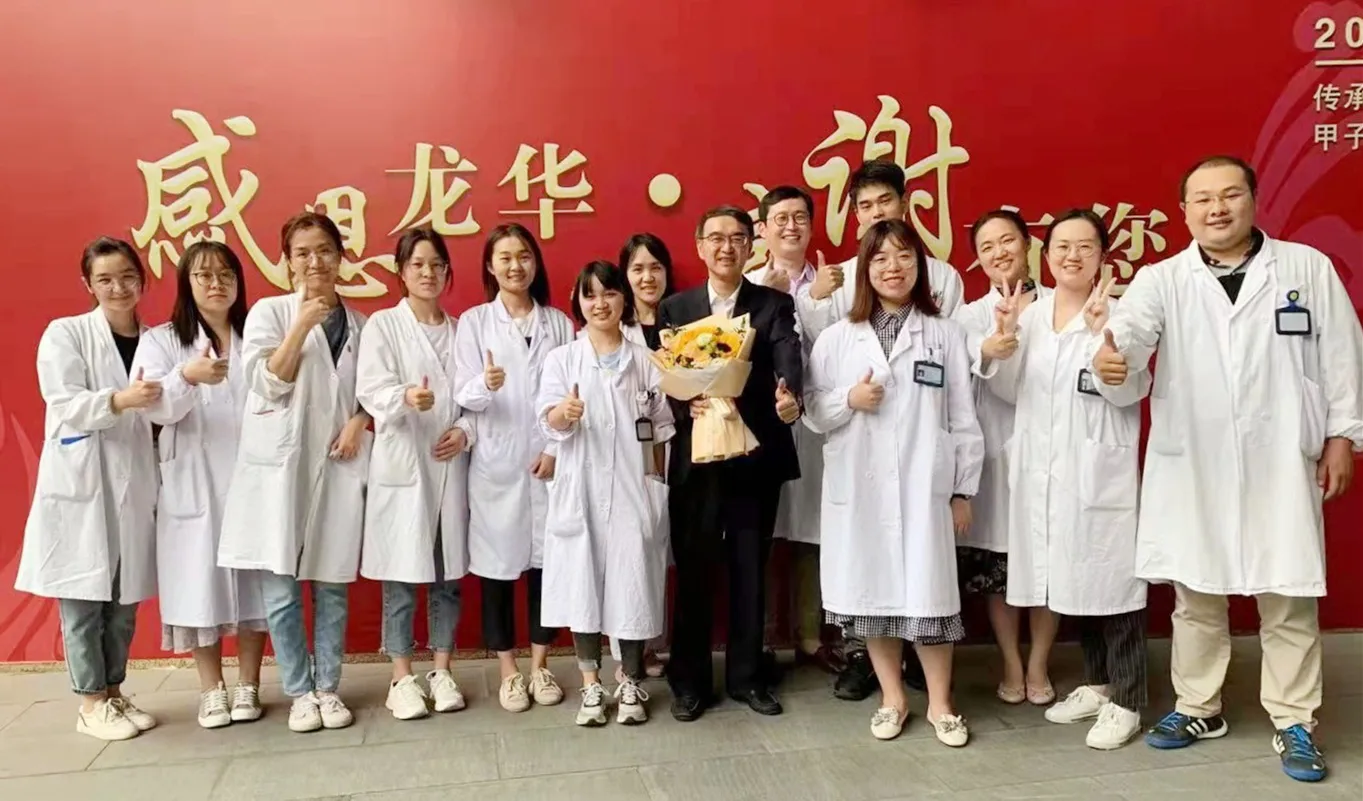
Liu Sheng, a fifth-generation inheritor of the Shanghai Gu's surgery lineage, reframed the treatment. Where traditional external medicine used warming and dispersing methods, he argued the disease is driven by liver-fire and spleen deficiency with turbid dampness, and proposed "clearing and resolving" instead — a formula based on clearing heat, draining dampness and strengthening the spleen, plus local drainage that removes pus without excising the gland [1][2][4].
What the studies show
The evidence base is a series of cohort and case studies rather than one large randomised trial. In the 160-patient series combining Qingxiao with small-incision lesion resection, the 12-month cure rate was 93.8% and recurrence 5.6%. An earlier cohort of 65 patients treated with Qingxiao alone reported a 63.08% cure rate at nine months, 6.15% recurrence at one year, and a mean scar area of 0.65 cm² — small enough to preserve appearance [3][6].
These are single-centre, largely observational studies with different protocols — Qingxiao alone, with small-incision resection, or with drainage — so cure rates (63% to 94%) are not directly comparable. A retrospective comparison found no significant difference from traditional drainage in treatment time or one-year recurrence, which tempers the claims. Blinding is impossible in a surgical-herbal trial [3][6].
The condition in context: granulomatous mastitis
It is uncommon, benign and disproportionately distressing because it affects young women's body image.
| Region | What the data shows | Source |
|---|---|---|
| Typical patient | Average onset around 29 years, usually 2–5 years postpartum [5]. | Tencent Medical Encyclopedia [5] |
| Course | Mass, pain, redness, abscess and ulceration; recurrent and slow to heal [1][5]. | Hospital / encyclopedia [1][5] |
| Treatment gap | No standard guideline; surgery risks deformity and recurrence [6]. | Journal study [6] |
Because the alternatives are prolonged antibiotics that do not work, steroids with side effects, or disfiguring surgery, a technique that preserves the breast has obvious appeal [1][6].
Why it matters
| For the patient | What the report suggests | Source |
|---|---|---|
| Breast preservation | Drainage rather than excision, with small scars [3][6]. | [3][6] |
| Cure | 93.8% at 12 months in the largest reported series [3]. | [3] |
| Caution | Treatment takes months and evidence is observational [6]. | [6] |
Availability and limits
- This is an editorial summary of hospital and journal reports, not a treatment recommendation [1][2].
- Evidence comes from single-centre cohort studies, not a large randomised trial [3][6].
- Treatment usually takes six to twelve months [3].
- Cancer must be excluded by pathology before treatment [5].
- Herbal formulae and external techniques are specific to this lineage and not standardised elsewhere [2].
What to ask before booking
| Question | Why it matters |
|---|---|
| Has cancer been excluded by biopsy? | The disease mimics cancer and misdiagnosis is common [5]. |
| Which stage am I in, and which external technique applies? | Treatment differs by mass, abscess or ulcer stage [2]. |
| Which department handles foreign patients, and in what language? | Longhua is a working hospital we do not book; confirm international-department coordination and language support. |
| How long will treatment take, and how often are reviews needed? | Courses run for months with frequent dressing changes [3]. |
Questions patients ask
What is granulomatous mastitis?
A benign chronic inflammatory disease of the breast that causes painful masses, abscesses and ulcers, usually in women around 29 and often after childbirth; it recurs and can be mistaken for cancer [5].
What is the Qingxiao method?
A Gu's-surgery approach developed by Liu Sheng combining a herbal formula (Chai Kui Qingxiao) with staged external drainage, aimed at curing the disease while preserving breast form [1][2].
How well does it work?
In a 160-patient series, 12-month cure was 93.8% with 5.6% recurrence; other series report lower cure rates (63% at nine months) with Qingxiao alone [3][6].
Does it avoid surgery?
It avoids mastectomy; small-incision drainage or limited lesion resection may still be used [2][3].
Is this relevant to international patients?
It is useful context for China's integrative breast care. Longhua is a working hospital we do not book — contact its international department directly [1].